Thursday, June 27, 2002

O'Neill on Iraq's Tortured Children

Brendan O'Neill tackles the story "about Iraq storing dead babies' bodies so that it then can parade them through the streets in propagandistic mass funerals," which I briefly mentioned a few days ago. His conclusion:

why are so many willing to believe the dead baby story without the same standards of proof we would normally demand - especially for something so shocking? It seems that when it comes to Iraq, some people will buy any story. Many on the right champion reason and rationality, but Iraq is their blindspot, the issue on which they will trumpet anything that bolsters their case for invading and bombing Iraq. And in the absence of any hard, coherent evidence that Iraq poses a threat to the West, any old hearsay will do.

The Pledge Issue

I am not going to spend much of any time spewing forth niceties and/or unpleasantries on the pledge of allegiance story. Leave that to the rabid conservatives and Christian Right to do.

Nevertheless, if you know me, you probably assume that I agree with the ruling to purge "God" from the pledge. And you're right. The reason why was (sorta) put forth by Michael Newdow, the California atheist who brought the case before the 9th U.S. Circuit Court of Appeals, in an exchange on CNN's Talkback Live:

Mike from Atlanta: We are talking about the greatest flag to the greatest nation in the world, I can't believe that Americans will allow something like this to go by without voicing their opinion. This is ludicrous to me. I just can't believe that the courts would give him the time of day.

Newdow: I agree, it is the greatest nation and what has made it great is our Constitution. The framers were quite wise in recognizing what religion can do and how it can cause hatred and how it can cause death. You don't have to go far in this world, outside of our nation, to see where that has happened. It is prevalent over the entire globe and the reason we don't have it here is because we have an establishment clause...If Mike there from Alabama wouldn't mind saying "we are one nation under Buddha" every day, or "one nation under David Koresh" or "one nation" under some religious icon that he doesn't believe in...if he doesn't understand the difference then we have a problem.
Or, to put it another way, why should "god" get the only plug?

Also check out how the attacks on the pledge ruling bolster its logic and David Corn's article on "Pledging Allegiance To Fundamentalism," where he writes that "The response to the court's decision exposed the fundamentalism that weaves through American public life, where many, a la Chung, confuse the worship of God with patriotism."

Anyway, this isn't something I think is worth getting into a fuss about. I expect the ruling to get overturned and the reign of monotheism will again march forward, as usual.

Wednesday, June 26, 2002

Israel Bars Journalists

Again, Israel is shutting out journalists from doing any reporting on their already-in-progress offensive in the West Bank and Gaza. Conveniently, if foreign correspondents aren't allowed in and "indigenous" reporters are kept under house arrest, nobody's gonna be approaching anything resembling the facts for some time.

So, like in Jenin, we'll only be treated to speculative reporting well after the fact, when most of the unpleasantries are covered up or already spun into the proper IDF-approved "context". And, of course, whenever journalists start to get too pesky, or if they approach the truth, they can always be intimidated and/or shot at.

Peggy N: Single-minded and certain in her pursuit of evil

Amusing profile in the UK's Spectator on Peggy "Character King" Noonan. Best part:

I would like to live inside Peggy Noonan’s mind for a while. It would be a calming, well-ordered sort of place, with rooms full of good things like home cooking, churchgoing and plain-speaking. A dank basement, with a door marked ‘To Be Nuked’ would contain many writhing evil things in turbans. An iron maiden would be set aside especially for Bill and Hillary Clinton.
I guess, in some sense, it's good that ol' Peg found the war, cause she has somewhat abated her fawning over Rappin' Ronny. Her hysterical rants are almost as far out as those of my already proclaimed future wife, Ann Coulter (btw, Slander is out; she's exchanged some barbs with Katie Couric on Today and will be all over the media for the next few days).

Actually, now that I think of it, it'd be kinda fun to set up a battle royale for the title of "most wacked out right wing female". We could also invite Michelle Malkin, Debbie Schlussel, and Mona Charen to duke it out. The proceeds raised could be used to augment the budgets of right-wing think tanks even more. Just think of the possibilities...

Corporate Greed

The NY Times filed this report on the security preparations for the G-8 talks in Canada this week:

A wide assortment of protest groups have been quiet about their exact plans. But they have organized a few thousand demonstrators from around Canada and the United States to march this week against globalization, free trade and perceived corporate greed, while supporting ratification of the Kyoto treaty as an antidote to global warming.
Blowback posits this, in response:

Excuse me, perceived corporate greed? The rest of their paper is rife with dark tales of malfeasance at Enron (probe is expanding to include its bankers), Arthur Anderson, Global Crossing and Halliburton, among scores of other former luminaries. And now WorldCom, the nation's second largest long distance company, has admitted to overstating its cash flow by a few billion bucks. Their business section looks like it's being ghost-edited by William Grieder.

Those protesters just can't score a break. They've been documenting and fighting precisely this sort of corporate corruption for years, back when the Times was uncritically whooping the stock bubble as a brave new economic paradigm. Yet far from being vindicated, their arguments still aren't afforded the slightest legitimacy.

Next thing you know, those hysterical conspiracy-mongers will be claiming that the elite media are mouthpieces for the corporate congomerates that own them.
Excellent.

The Worldcom story - more accurately, the Worldcon story - broke last night and now there's the typical flood of talk about the need to, maybe, rethink the regulatory apparatus surrounding virtual capital flows and accounting practices. The market is, of course, floundering. After Enron and Martha it's not going to be easy to sidestep this one...

Still, biz analysts are trying to contain the rhetoric to questions on how to best rid the financial industry of a few bad apples and "restore confidence". Democrats are starting to salivate over the chance to exploit the issue and, while I often despise the Demmys' political opportunism, this time I think it's warranted.

Fun stuff ahead, for sure. I keep telling you people: capitalism just doesn't work! (hehe. how 'bout that for shameful opportunism?)

Tuesday, June 25, 2002

Kate vs. Greg

Following his piece on the "Great Florida Ex-Con Game," Greg Palast and Katherine Harris get into a brief sparring match over the Choicepoint issue (which I referenced a few weeks ago) in the letters section of this month's Harper's Magazine. Harris writes:

Greg Palast's Annotation ["Ex-Con Game," March] distorts and misrepresents the events surrounding the 2000 presidential election in Florida in order to support his twisted and maniacally partisan conclusions. To the chagrin of responsible journalists everywhere, Palast's effort implodes under the slightest scrutiny, owing to his abject failure to check the accuracy of his facts.
To which Palast responds:

Regardless of where Harris seeks to shift the blame, her office clearly did wrong. The NAACP has filed suit over the voter purges uncovered by our BBC and Guardian reports. NAACP v Harris goes to trial in August. Katherine, if you've got an alibi for operating a Jim Crow election operation, tell it to the judge.

Katherine Harris, cochairwoman of Florida's George W. Bush for President campaign and now candidate for Congress, accuses this London reporter of "partisanship." To that, one hardly knows how to respond.
That last comment from Palast is classic...

NB: If you pick up the July issue, be sure to check out Stanley Fish's piece on "Postmodern Warfare" and Edward Said's "Impossible Histories". Fish tackles the relentless and ill-informed attack on postmodernism in 9-11's wake, while Said reviews Bernard Lewis' What Went Wrong? and Karen Armstrong's Islam: A Short History.

Bush and Global Warming

Mark Hertsgaard has a good, short article in the Nation on the Bush administration's triangulations on global warming and the recent release of the EPA's Climate Action Report 2002.

Criticism of Bush's Speech

Predictably, the fallout from Bush's speech last night fills the commentary spots in major newspapers and online media around the world. While I feel his remarks are good in what they promise long term, they seem to be short on activity in the short term. As Palestinian cabinet minister Ghassan Khatib noted, "Unfortunately, the immediate and practical impact of this speech is zero."

In addition, the onus for action and "reform" is placed nearly completely on the Palestinians. Ali Abunimah observes, "George Bush's much-anticipated speech on how to end the Israeli-Palestinian conflict, weighed in at 1,867 words. By my count, more than one thousand words were devoted to criticizing and making demands of the Palestinians, while just 137 words dealt with what Israel should do. And if you look for any criticism at all of Israel, you will not find it."

So the extrajudicial assassinations are bound to continue and Sharon's rampage will go on as he sees fit. BTW, did you know that 400,000 Palestinians are under what amounts to a house arrest? If that isn't a most egregious form of "collective punishment," I don't know what is...

For further criticism, see why the speech ignores the bloody reality, why it is a one-sided offer that will change nothing, and how it all adds up to a victory for Sharon.

It will be interesting to see how this plays out. At least there is some kind of plan on the table. I worry, though, that it may be structured to fail, perhaps purposefully.

Monday, June 24, 2002

FBI Begins Visiting Libraries

I sure hope they're not checking out my lending habits at the library. My FBI file is probably big enough, as it is...

Bush's Speech on a Palestinian State

Matt Welch noticed something strange about the closing comment from Bush's speech today on plans for an eventual Palestinian state. Here is the passage in question:

This moment is both an opportunity and a test for all parties in the Middle East: an opportunity to lay the foundations for future peace; a test to show who is serious about peace and who is not. The choice here is stark and simple. The Bible says, "I have set before you life and death; therefore, choose life." The time has arrived for everyone in this conflict to choose peace, and hope, and life.
Welch writes that the statement "seems mighty questionable to me, suddenly quoting the Bible at the end of a major policy speech about the Middle freakin’ East."

I agree. That's a very awkward statement, considering the forum.

As for my general opinion on these remarks, I'm ok with them. Promises are being made and core-issues for the Palestinians are being addressed (although with several strings attached). I don't think the mandatory "no Arafat" clause is prudent, especially when it follows rhetoric that we want a "democratic process". If we have that much confidence in democracy, then we should leave the selection of a leader solely up to the Palestinians.

Right now, Arafat would probably win an election hands-down. If he does get scrubbed out of the process, there are six contenders to take the lead, according to the NY Times.

'No Child Left Behind' Song

I'm sorrry, but this is friggin' ridiculous...

Israeli spies cheer as WTC burns

Justin Raimondo responds to ABC's 20/20 story on five Israelis and their magical white van. He ridicules the woeful investigative work by the FBI:

No wonder Mohamed Atta and his fellow ghouls managed to sidestep our Keystone Kops so easily. If these jokers are still "debating" the obvious, then our government officials are right when they tell us that another massive terrorist attack is "inevitable." With these retards on guard duty, I'm surprised it hasn't happened already.
And the piss-poor ABC media coverage:

The intrepid reporters over at 20/20 look like they went to a lot of trouble to check out this story. They tracked down one of the original witnesses, went all the way to Israel to hear the young Israelis’ denials, and hauled out ABC’s highly-paid pet "expert" to spin away the obvious. But, somehow, they failed to do the elementary sort of research that would’ve mandated only a trip to their local library. There they might have read this astonishing story that appeared in the [September 12, 2001] Bergen Record, which describes the 5 Israeli detainees picked up 8 hours after the WTC attack as "carrying maps linking them to the blasts"
His conclusion:

We won’t know what really happened that fateful day until and unless Congress takes seriously its responsibility to investigate. For starters, let’s take a look at those highlighted maps – and then drag the rest of Israel’s spy operation out into the full light of day. Then and only then can we answer an increasingly important question about the background to 9/11: What did the Israelis know – and how did they know it?
Read more about the Israeli spy story here.

Dismembering the P.A.

Following the promise of a “crushing offensive" by Israel, the WSWS analyzes the long term goal of Sharon's Likud-Labour coalition:

[S]haron is seeking to create the conditions where he can finish the job he started and destroy what is left of the PA. That is why his government ignores or dismisses repeated condemnations of suicide bombings by Arafat. He wants Arafat’s leadership to be deposed, not because the Fatah leader is secretly masterminding terrorist attacks, but because Sharon wants the more militant factions within the PA and the Islamic opposition groups to provide Israel with a cassus beli for the reoccupation of the West Bank and Gaza.

CNN Bows to Israeli Pressure

A "special report" on the Victims of Terror popped up immediately after CNN admitted an error in its Mid East coverage after heavy criticism from Israelis. What a co-winky dink, eh?

I would guess that the killing of women and children at market will not be included in CNN's special report...

Alas, I've said it before:

...the label of terrorism is completely useless unless there is some effort to find and apply a similar politicized label to violence induced by a state actor. “Moral equivalency,” some will yell…but it’s hard to not see that “terrorism” is being rolled out for political purposes; and to serve as a functional trump card to unleash military action on populations or political entities which cannot respond or defend themselves in a formal military confrontation with any reasonable sense of proportionality.
Also on Israel:

While they haven't started executing relatives of suicide bombers yet, the Israeli government is going to start demolishing their homes in preparation for expulsion.

Plus, who's winning the e-war?

Iraq's Tortured Children

Interesting article by John Sweeney of the BBC on Iraq's tortured children. Neocons who support the sanctions and military action against Hussein probably love it. This article is likely to get heaped onto the "why we need to attack Iraq" propaganda pile.

MediaLens, the British media-watch group modeled partially on FAIR, has written a response to Sweeney's reporting. The MediaLens editors cited this email fom Hans von Sponeck, former director of the UN's oil for food program, which assesses Sweeney's story:

Sweeney's article is exactly the kind of journalism that is Orwellian, double-speak. No doubt, the Iraq Government has manipulated data to suit its own purposes, everyone of the protagonists unfortunately does this. A journalist should not. UNICEF has used large numbers of international researchers and applied sophisticated methods to get these important figures. Yes, the Ministry of Health personnel cooperated with UNICEF but ultimately it was UNICEF and UNICEF alone which carried out the data analysis exactly because they did not want to politicize their work...This article is a very serious misrepresentation.
On a related note, the Nation has a good, brief editorial on why a War on Iraq Is Wrong.

Saturday, June 22, 2002

Kelley: Finding Strength

Check out this very personal and probing essay from Robin D.G. Kelley - the mack daddy, in my mind, and one of the major reasons for me wanting to go to NYU - on "Finding The Strength To Love And Dream." Gilles d'Aymery, editor of Swans, puts the essay into context with an introduction.

Killing weapons inspections would clear way for war

I contend recent activity towards Iraq suggests we're trying to provoke Hussein into striking preemptively. Scott Ritter, former chief inspector for UNSCOM, contends we're trying to kill off the possibility for renewed weapons inspection, thus destroying "the last chance to avoid bloody conflict." He writes:

The leaked CIA covert operations plan effectively kills any chance of inspectors returning to Iraq, and it closes the door on the last opportunity for shedding light on the true state of affairs regarding any threat in the form of Iraqi weapons of mass destruction.

Absent any return of weapons inspectors, no one seems willing to challenge the Bush administration's assertions of an Iraqi threat. If Bush has a factual case against Iraq concerning weapons of mass destruction, he hasn't made it yet.
I fear that we both may be right.

Friday, June 21, 2002

End of Line for US

Just some brief comments on the US' ride in the World Cup...

They played very well today against Germany by showing a composure on the ball and ability to run their opponents ragged that I don't think I've ever seen before from an American squad. The fallout from their performance over the last few weeks should be interesting to see. Me thinks that American interest in the sport will wane as quickly as it grew, unfortunately. It's up to the people at MLS to try to capitalize on this momentum.

Some people at work were saying, "well, at least they have next year." *Sigh* I guess we need to start somewhere, right?

Check out some comments from Marc Connolly and Tommy Smyth.

As for US players, Claudio Reyna was amazing today. Tony Sanneh played out of his skin the whole tournament. Landon Donovan basically proved that he can play anywhere (will he go back to Leverkusen?). A whole host of other players - DaMarcus Beasley, Brian McBride, and John O'Brien, especially - saw their stock fly though the roof with solid and, at times, gamebreaking performances. Mathis did not do well in the Cup, although I still think he can garner interest from Europe (not Bayern, anymore; maybe Perugia - to take Ahn's place?). This Cup should, hopefully, encourage him to put a little more emphasis on his fitness and training, something Arena has been very critical of.

Overall, the US performance has been delightful to watch. I hardly expected to see an American squad perform at this level so quickly; I figured I wouldn't see this till at least 2006. I'm not going to ring in with any bloated predictions or the lame "we've finally made it on the world stage" rhetoric, but this has been a very promising development for football (ahem, soccer) in this country. At the least, it kept baseball out of the spotlight for a few weeks...which is always a good thing. ;)

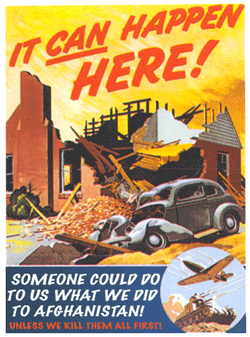
Remixed Propaganda Posters


(via dack)

My Point of View on Iraq

A variety of folks have asked for clarification in regards to this comment I made a few days ago on Iraq: "Since we have no credible reason for attacking Iraq which takes into account our own sordid history with Hussein, or the catastrophic effects a war against Iraq will likely have this time around, a quickly manufactured and uncontroversial pretext would be a gift for the war-hungry Bush cabal."

To elaborate on my perception of the situation in Iraq, here's something I wrote to a colleague a few months ago (with footnotes, too!)...

-

For some time now, the Bush administration has harped on the fact that Iraq maintains “weapons of mass destruction” and serves as a threat to the security of the United States. That no official can link any substantial act of aggression by Iraq against the United States in recent years does not seem to be an important point for some reason.[1] Provocative rhetoric on Iraqi "lawlessness" abounds, but hard evidence against the nation is lacking. Nevertheless, CIA director George Tenet recently warned that we should not “dismiss the possibility of state sponsorship” of terrorism from Iraq. The U.S. government, Tenet tells us, is going to wait and “see where the evidence takes us,” but one gets the impression that this search for evidence against Iraq is being conducted to serve a certain end: to find, as quickly as possible, a credible pretext that can be used to justify a full-fledged assault by the American military.[2] To fill the evidentiary vacuum, countless analysts continue to invoke the specter of an Iraqi regime hell-bent on unleashing their weapons against us.

While Hussein maintains a small arsenal of chemical and biological weapons, there is little agreement on his potential for deployment.[3] Since UN weapons inspectors left Iraq in 1998, the lack of intelligence has precluded any meaningful consensus on Iraq's capabilities, as well as its willingness to use them. The inspection teams have been denied reentry into Iraq since then, partly because the U.S. was using the inspection teams for spying, and Iraq continues to waffle over when and how they will be allowed back in.[4]

Even though Washington has little evidence to back up claims of an imminent threat of Iraqi weapons deployment, they are right on one thing: Saddam Hussein is a tyrant and has always been a tyrant. From his conduct in the Iran-Iraq war, to his multiple suppressions and outright slaughters of several Kurdish and Shiite rebellions within Iraq’s borders, to the invasion of Kuwait, up until now, the common denominator of his reign has been ruthlessness. However, political expediency seems to govern the U.S. relationship towards Hussein more than any concern about the Iraqi people or a vague stance on human rights.

During much of the 1980s, the U.S. actively supported Hussein's reign, often by helping him acquire the armaments and materials to perpetrate his worst crimes. Of most significance, the U.S. government feigned ignorance while he was gassing his population and kick-starting his biological weapons program, the latter done with the aid of the Department of Commerce and companies like American Type Culture Collection.[5]

Thus, Hussein’s atrocities are rolled out for public display only when it is convenient and when it fits in with the larger goals of Washington’s military and political establishment. The contention that we are going after Iraq because it is a future or potential terrorist threat is a smokescreen to mask our wider goals in the Middle East. This broader campaign is based on “perpetuating Western hegemony and protecting economic interests from real or imagined threats,” according to Said K. Aburish, a Palestinian-born journalist and author of A Brutal Friendship: The West and the Arab Elite. In plainer language: our policy is propelled by the desirability of securing further control over the Persian Gulf's oil resources. Understanding this point is crucial in order to adequately grasp the aims of American foreign policy in the Middle East.

Along similar lines, the global and military intelligence organization STRATFOR reported in August 2001, well before the attacks on 9/11, that “a future blow to the Iraqi military-industrial complex is a prerequisite to achieving Washington's ultimate objective in the Middle East.” It contended that the U.S. wanted “a more flexible foreign policy no longer preoccupied almost solely with Saddam,” which meant a transition to a “regional approach to stability, enlisting the aid of its Gulf allies while scaling back its overseas military commitments and increasing oil production.”[6] Clearly, our preoccupation with Iraq predates the rabid concern with terrorism that dominates (at least in rhetoric) current policy.

Isolated from any further considerations, this analysis still might leave the proponents of “attack Iraq” unconvinced that a campaign to remove Hussein is not the best course of action. Nevertheless, that is precisely because there is little acknowledgment, much less discussion, within the media about the disastrous effects that a “Gulf War, Part III” could have on the Iraqi population, the situation within the Middle East, or the general state of the world.

A war against Iraq would be an arduous affair that would likely inflict thousands of American casualties, perhaps in Vietnam-like proportions. Varying military scenarios – from provoking a military coup, to outsourcing the war by arming opposition forces, or initiating a full-scale invasion requiring some 200,000 ground troops – have been proposed to overthrow Hussein.[7] Of course, no matter what route the United States military decides to take, the civilian population of Iraq will be on the worst end of this violence, much like in the American-lead Persian Gulf War.

Here it might be useful to recall that war.

Due largely to the media's obsession with the performance, not destructive power, of "smart weapons," the viewing public were given the impression that buildings, military installations, and other justifiable targets were being destroyed during the Iraqi war, not human lives. The preoccupation with military hardware sanitized the bombing into a public spectacle that depicted a conflict with few casualties and consequences. Leslie H. Gelb, writing in the New York Times during the air attack, labeled it, “Iraq, the Movie,” with “glamorous stars, non-stop virtual action and thus far not a single dead body on the screen.”[8]

Ironically, despite the American military’s insistence that extraordinary efforts were made to protect civilian life, the Iraqi civil infrastructure was crippled precisely because the bombing was so effective. The notion that the smart bombing had allowed for a sort of humanitarian assault was quickly discredited once credible analysts embarked on their post war visits through the country. A Harvard University medical team, for instance, toured Iraq after the war and found that “the worst civilian damage occurred not as a result of smart bombs going astray or hitting the wrong target but, conversely, when they hit precisely what they were aimed at in the coalition’s attempts to destroy Iraq’s generators and electrical grid.”[9] A similar bit of analysis came from William M. Arkin, then with Greenpeace International, who remarked following his visit that, “You can’t separate neat and clean bombing from postwar deaths. People just died in a different way because of the efficiency of the attacks.”[10]

Following the war, the imposition of a UN sanctions program was intended to reel-in Hussein’s Ba’ath regime, and hopefully undermine its power, but it wound up further devastating the country’s health, education, and food capabilities. Hundreds of thousands of “excess deaths” are attributed, at least partially, to the effects of the sanctions since their initiation.[11] In 1998, Denis Halliday, the UN Humanitarian Coordinator for Iraq and director of the Oil for Food sanction program, resigned his post in protest and called the continued imposition of the sanctions a “genocidal destruction of a nation.”[12] His successor, Hans von Sponeck, resigned two years later with a similar sense of disgust. “How long,” von Sponeck bitterly asked following his departure, “should the civilian population of Iraq be exposed to such punishment for something they have never done?”[13]

The noxious mix of sanctions, war, and Hussein’s rule has decimated a nation that once boasted one of the best public health and welfare systems in the Middle East.[14] A future attack on Iraq could only make the situation worse and is precisely why several prominent opposition groups within Iraq oppose a military attack by the United States and its allies.

“That the regime is terrorist and has destructive weapons is something no one disputes,” says Ibrahim al-Jaafari, a spokesman for the Daawa Party, a Shiite opposition group within Iraq, “but history has shown that bombing, destruction and sanctions do not lead to its collapse, but further compound the suffering of the Iraqi people.” Similarly, a spokesman from another opposition group, the Patriotic Union of Kurdistan (PUK), argues that “democratic change…cannot be brought about by means of foreign conspiracies, indiscriminate bombing, or the plotting of military coups” because it would “inflict enormous harm on the Iraqi people and lead to a repeat of the tragedies we have suffered for so long.”[15]

Besides massive destruction to Iraqi civilian life, other, perhaps more sinister results of an attack against Iraq might be in store. Being that Hussein does have access to some weapons of mass destruction, it is likely that he will not refrain from using them if his regime is in danger of collapse.[16] Should this happen, one must recognize the potential – perhaps, probability – that a missile with biological or chemical agents would be fired at American troops or allies, such as Saudi Arabia and Israel. The response to such an attack would likely be nuclear, especially in light of Israel’s capabilities and proclivities, as well as the Bush administration’s recent admission that nuclear weapons are a viable option, as revealed in the leaked Nuclear Posture Review.[17] A development of this sort in the Middle East could have devastating consequences and would preclude any hope of asserting “stability” within the region, even if Hussein was removed from power.

In the end, the current administration needs to be mindful that war cannot be wielded like a scalpel to excise “evil” wherever it may lie. Unless there are overwhelming arguments for resorting to war, it should be avoided in favor of diplomatic solutions that have not been adequately pursued, and at times purposefully avoided, with Iraq.[18]

The burden has not been met by those who urge an assault against Iraq, by any reasonably evaluative criteria that takes into account our history with “Sad-dam” or our larger role in the Middle East. Moreover, the lack of an overriding, immediate motive for attacking Iraq cannot be reconciled with the catastrophic effects such a war will likely have.

Notes:

1. "Iraq: The Phantom Threat," Christian Science Monitor, January 23, 2002; "No Link Between Hijacker, Iraq Found, U.S. Says," Washington Post, May 1, 2002.

2. "CIA Chief: Iran, Iraq May Be Linked to Sept. 11 Attacks," FoxNews.com, March 20, 2002.

3. "Iraq: the myth and the reality," Guardian, March 15, 2002; "U.S. Government White Paper: Iraq Weapons of Mass Destruction Programs," U.S. State Department, February 13, 1998.

4. On the U.S. using inspections team for spying, see: "Unscom 'infiltrated by spies', BBC News, March 23, 1999; "U.S. Aides Say U.N. Team Helped to Install Spy Device in Iraq," NY Times, January 8, 1999. On Iraq's recent flirtation with allowing weapons inspectors back into the country, see: "Iraq Ready to Let Inspectors Back In," Guardian, April 30, 2002.

5. "Iraq Purchased Anthrax From US Company: Baghdad Admitted 'Weaponizing' The Biological Agent, A UN Inspector Says," Vancouver Sun, October 22, 2001; "US Companies Sold Iraq Billions Of NBC Weapons Materials," The Progressive, April 1998.

6. "US Prepares for War with Iraq," Stratfor.com, August 8, 2001.

7. "US Targets Saddam," Guardian, February 14, 2002; "Bush administration confirms plans for war against Iraq," WSWS.org, February 16, 2002.

8. "Iraq, The Movie," New York Times, February 3, 1991.

9. Taylor, Philip M. War and Media: Propaganda and Persuasion in the Gulf War (New York, 1998): 219.

10. "Tactical Bombing of Iraqi Forces Outstripped Value of Strategic Hits, Analyst Contends," Aviation Week & Space Technology, January 27, 1992: 63.

11. It should be emphasized that children have been the party most hurt by the imposition of sanctions, in some estimates accounting for nearly half of the overall deaths attributed to the embargo. One study, “Morbidity and Mortality Among Iraqi Children from 1990 Through 1998: Assessing the Impact of the Gulf War and Economic Sanctions,” by Richard Garfield of Columbia University, found that “106,106 excess deaths from 1990 through the first quarter of 1998 is [a] conservative estimate of excess mortality among under five-year-olds.” For a general overview of many of studies and reports on the effects of the sanctions, see: "Effects of Sanctions on Iraq," Online Journalism Review, December 28, 2001.

12. "Where Is Our Shame? Iraqis Are Dying And We Continue Our Sanctions," Chicago Tribune, May 29, 2000.

13. "UN Sanctions Rebel Resigns," BBC News, February 14, 2000.

14. "Iraqi Health System ‘Decrepit’ Says SLU Researcher After Visit," St. Louis University Publications, August 2, 1999; "Iraqi Health System Close to Collapse Says WHO Director-General," World Health Organization, February 27,1997; "Ten years of sanctions take toll on Iraqi people," IFRC, August 18, 2000.

15. "Targeting Baghdad: What the Iraqi opposition thinks," Lebanon Daily Star, November 30, 2001. For related comments, see also: "Kurds oppose US attack on Saddam," Dawn, March 20, 2002.

16. "The Coming War with Iraq," OpenDemocracy.net, February 20, 2002. For a different twist on the nuclear threat, see also: "Attacking Iraq Brings Nuke Holocaust Closer," Counterpunch, March 19, 2002.

17. On the threat of nuclear weapon use by Israel, see: "Israeli Weapons of Mass Destruction: A Threat to Peace," Centre for Research on Globalisation, March 3, 2002; on the Nuclear Posture Review, see: "Secret Plan Outlines the Unthinkable," LA Times, March 10, 2002.

18. "Iraq: There Are Alternatives to a Military Option," Counterpunch, January 10, 2002.

Thursday, June 20, 2002

On Electronic Music

Good article in Salon on the strange triumph of electronic music, which follows up the question they asked in 2000, who sold out electronic music?

And just to screw with your head, take a peek at Erik Davis' essay on Polyrhythmic Cyberspace and the Black Electronic. (warning: if you don't like postmodern theory, don't even bother)

Orientalism and Occidentalism: Arab states, Islamism and the West

There's a transcript of an interesting lecture given by Gema Martín-Muñoz, a sociology professor at Autonoma University of Madrid, at Open Democracy. She begins,

In pointing to the undeniably negative aspects of Arab and Muslim societies, a simplistic Western view explains them away as the ‘inevitable’ consequences of Islamic determinism. It insists on linking lack of democracy to the Islamic character of these peoples, the inequality between men and women to the imposition of Islam, the violence to ‘Islamic fanatics’.

In the West, this has led to the resurgence of a historic memory of Muslim cultural and religious opposition; while, on the other hand, Muslim historical memory vis-à-vis the West is also stirred into renewed life. These memories have profoundly political roots – they are the result of a long and intensive Western (European, US, Soviet) presence in this part of the world, involving a huge range of experiences: colonisation; artificial division into nation states; the creation of Israel; double standards regarding democracy and human rights; contempt for the massive suffering of civilian people, from Kurds to Palestinians, Iraqis to Afghans.
The first paragraph essentially summarizes, albeit at a superficial level, Edward Said's thesis on orientalism. Thus, we continue to put "Islam" and "the East" on this chopping block of criticism that exposes the West's own ignorance more than the supposed deficiencies of "their culture". September 11, if anything, animated this discourse to heights not previously seen since, probably, the end of imperial ventures in the late 19th century. How, then, can anyone claim that the orientalist critique has reached an end? I just don't get it; while many people showed a sense of restraint in saying that we shouldn't set out for war against Islam (as if that should be applauded; shouldn't it be the logical expectation?), the continued exploration of Islamic society has been underlined by Bernard Lewis' loaded question of "what went wrong?" This tendency to compress hundreds of years of Islamic history into a caricature to provide information on the East solely for the West's benefit - and not to contextualize it for an honest understanding - is precisely what Said was critiquing.

Have you not seen Bill Maher quoting from the Koran on P.I.? Have you not seen the myriad of books in Barnes and Noble that suddenly quench an American thirst that, by gosh, we need to understand "those people"? These are anecdotes, for sure, but they seem to point to an underlying desire to consume knowledge for explicitly utilitarian purposes that reveal a selfish and culturally biased way of trying to grapple with what's going on beyond our borders. They also, at times, stoke the fire of animosity in accord with Huntington's clash of civilizations paradigm.

To be fair, the West does not have a monopoly on this technique, as evinced by the East's own Occidentalism.

Anti-Soccer Conservatives

The American Prospect takes a closer look at the "bizarre phenomenon of anti-soccer conservatism," citing a recent commentary by Jonathan Last in the Weekly Standard, amongst others.

Related comments from me are here. You can see one of the reasons why Tapped loves soccer, here.

The Significance of Joan Peter's Work

There is an excellent discussion at RittenHouse Review on Joan Peter's book From Time Immemorial which takes a look at its broader influence on the historical debates and propaganda wars surrounding the Israeli/Palestinian conflict. Also check a related interview with the most significant debunker of Peter's work, Norman Finkelstein.

Yay for Imperial America

In the Globalist, former neocon Michael Lind asks: is America the New Roman Empire?

Americans used to denounce empire. Many current U.S. pundits, however, call for the United States to establish a benevolent global empire. Is the idea of "Imperial America" an inspiring vision? Or is it a misreading of past and present — and a betrayal of America's republican traditions?
For prime examples of the punditry calling for a "benign" American imperialism, check out essays from Max Boot, Jonah Goldberg, and Paul Johnson.

Hamas Linked with Israel

The links between Hamas and the political leadership in Israel are unveiled in a UPI article from Tuesday:

Israel and Hamas may currently be locked in deadly combat, but, according to several current and former U.S. intelligence officials, beginning in the late 1970s, Tel Aviv gave direct and indirect financial aid to Hamas over a period of years.

Israel "aided Hamas directly -- the Israelis wanted to use it as a counterbalance to the PLO (Palestinian Liberation Organization)," said Tony Cordesman, Middle East analyst for the Center for Strategic Studies.

Israel's support for Hamas "was a direct attempt to divide and dilute support for a strong, secular PLO by using a competing religious alternative," said a former senior CIA official.

According to documents United Press International obtained from the Israel-based Institute for Counter Terrorism, Hamas evolved from cells of the Muslim Brotherhood, founded in Egypt in 1928. Islamic movements in Israel and Palestine were "weak and dormant" until after the 1967 Six Day War in which Israel scored a stunning victory over its Arab enemies...
Israeli funding of Hamas was an explicit move to fragment Palestinian solidarity and undermine the possibility for sustained negotiations. A similar motive is at work with Sharon's desire to get Arafat out of the picture and, hopefully, bring in a more placable opposition for negotiations.

What Are Leftists?

For a little amusement, check out John J. Ray's article on Frontpage Magazine, which breaks down what a leftist is.

I usually don't recommend anything from Horowitz's publication, but sometimes the articles are good for a laugh or two.

MEMRI's in Overdrive

As usual, MEMRI is spitting out a variety of special reports of blood-curdling dialogue from Arab nations. This time it's an interview with the mother of a suicide bomber and an explanation from an Al-Qaeda spokesman about why they fight America.

Take a look at this article for a good explanation of MEMRI's work and approach to political dialogue in the Mid East.

Wednesday, June 19, 2002

Death and Violence in the Mid East

There's a very good article by Edward Said in Al-Ahram this week. His call for elections is quite relevant and urgent now.

Without question, there's going to be some very dark days ahead in Israel/Palestine as Sharon is sure to exploit the recent attacks in Jerusalem. Nothing can be said to contextualize these bombings without sounding banal; they're horrific, monstrous, and need to be stopped as soon as possible for the benefit, and safety, of everyone in the region.

Lamentably, though, the only time the media seems to get into an uproar about a Mid-East "crisis" is when Israelis are killed. Palestinians have died at the ratio of ~3:1, but I doubt many casual observers of the media know this. See this graph for elaboration. Also, B'Tselem has more updated "casualty figures," here.

I'm sure many people would consider this a very poor time to bring up such facts, but the disparity in media coverage is most transparent following a suicide bombing. We all sit and stare at the TV in disbelief - often with that 'oh, no, not again' look - empathizing with the Israelis, and trying to understand their plight (an impossible task). I am struck, however, with the feeling time and time again that we rarely, if ever, have the opportunity to peer into the lives of a Palestinian population which endures a different type of violence, although one that is just as deadly, if not more so.

Suffice it to say, the bombings are, in a perverse way, spectacles; virtually every other aspect of Middle East violence is consigned to a sideshow. Only a moron could not see that this has a tremendous effect on the way people in this country perceive the conflict.

Updated Uncle Sam Poster

Print and post:


(from Liberal Arts Mafia)

Anthrax Cover Up

The Scotsman reported on Sunday that that FBI is guilty of a cover-up over the anthrax suspect. Well, duh. This is probably the worst kept secret in the media right now.

Reuters reported as early as 28 November 2001 that the "anthrax attacks in the United States were probably the work of a member of a U.S. biological warfare program" and Barbara Hatch Rosenberg (mentioned prominently in the Scotsman story) presented solid evidence with the same allegation way back in December. She's also been the main subject of reports and features in several places like the Trenton Times and New Yorker within the last six months.

Will the broadcast media ever get to the bottom of this story? Since they decided to whip the country up into a frenzy over mail attacks, you'd think they might find it their obligation to ride the story to its conclusion...

Hunger's Not an Accident

Following the recently completed World Food Summit, Ashfak Bokhari has penned an interesting piece in Dawn on the politics of food and hunger:

The hard fact is that hunger, like poverty, is essentially a man-made problem, not even dependent on vagaries of weather. Incredible though it may look, it is abundance not scarcity that describes world's food supply situation. Enough wheat, rice and other grains are available each year to easily feed every human being with 3,500 calories a day.

The US grows 40% more food every year than it needs. But it would not rush surplus food to famine areas simply because it won't bring profits. Providing food to the hungry is not a humanitarian act; it is an ideological issue which demands that a sizable population in the impoverished countries must remain hungry, poor and malnourished. So, it is the big powers, the multinational corporations and the institutions run by them such as the IMF and the World Bank that collectively decide as to who should eat and who should starve.
This article echoes much of what John Vidal said in the Guardian at the beginning of the summit. Peter Rosset of Food First reached similar conclusions, as well.

Tuesday, June 18, 2002

Ann

My future wife has finally got her own website! Check it out:


Is there a more attractive sight on earth than a wacked-out blonde with a rifle? I sure as hell don't think so!

Provoking Saddam

A flurry of news stories on Iraq – including threats of a preemptive strike from the Bush administration, recent administrative meetings with several Iraqi opposition groups, an American troop buildup in Kuwait, and new powers granted to the CIA to kill Hussein – have popped up recently.

These reports seem to point to an impending attack by the US. However, something else might be at work here: the US government could be deliberately trying to provoke Saddam into a first strike against our own assets, or, really, anybody. Since we have no credible reason for attacking Iraq which takes into account our own sordid history with Hussein, or the catastrophic effects a war against Iraq will likely have this time around, a quickly manufactured and uncontroversial pretext would be a gift for the war-hungry Bush cabal.

Should Iraq make any show of force, we would be sure to capitalize on it and unleash a military assault. As of now, there is little support for an attack by anyone outside of a claque of American hawks. An aggressive move by Hussein could quickly change that and, conveniently, dissolve dissent immediately.

Monday, June 17, 2002

A Relativist is Someone Who Argues for Moral Consistency...

Check out Robert Jensen's recent op-ed on moral clarity and "relativism". Amongst other things, he writes:

These days, we no longer talk of civilizing the natives, but about bringing freedom and democracy. Such a goal, if pursued in humane and lawful ways under the appropriate international institutions, would be to the good. But simply because politicians say that is their motivation for foreign and military policy does not make it so.

Upon examination of those messy facts, it becomes clear that the United States goes to war for the same reasons great powers have always fought - to secure markets and resources, to extend and deepen domination of strategic regions of the world. Old-style colonialism and conquest have been replaced with new modes of control through economic domination and the selective use of military power, but the goals remain the same.

Nowhere is that more obvious than in the Middle East and Central Asia. Although sold to the public as a war on terrorism, the war in Afghanistan and the war the Bush administration is planning against Iraq are about control of those strategically crucial, energy-rich regions. The United States seeks not to own the oil outright, but rather control the flow of oil and oil profits
Conclusion:

So, moral clarity, as the president uses the term, means just the opposite: the amoral - and sometimes immoral - self-interest of the powerful. An even more curious inversion of reality comes when those of us raising critical questions are accused of being moral relativists.

If moral judgments are applied consistently, it's clear that the United States, like other great powers, has much to answer for. Making this simple point these days leads to further accusations that I must hate America, another curious claim. How is it hateful to apply moral standards to one's own nation? If I articulate clear moral standards and try to apply them to myself as an individual, it is usually taken as a sign of maturity. But when done at the level of a nation, it is widely condemned as a sign of insufficient love of country.

Enemy Still Needed

Ben Cohen of Ben & Jerry's fame continues his search for an enemy to justify the massive amounts of money we spend on "defense". Interestingly, he first brought this subject up about a week before 9/11. He asks:

Were politicians using the endless "war on terrorism" to provide a direct feeding tube from the U.S. Treasury to the bank accounts of special interests, who finance their campaigns?

In a word, yes.

Even Lawrence Korb, a top defense official under Ronald Reagan, says we’re spending tens of billions of dollars on new submarines, planes, and tanks that will be just as useless at fighting terrorists as our current high tech wonders. Korb says that the Pentagon has more than enough money to fight terrorism -- even if its budget were trimmed by 15 percent or more.

In other words, the Pentagon needs to be smarter, not fatter. Why does the Defense Department need $400 billion to fight enemies armed with $5 box cutters?

For perspective, Bush’s much-hyped "axis-of-evil nations" (Iran, Iraq and North Korea) spend $12 billion annually on their militaries combined. Iraq spends less than $2 billion...

[T]errorism, horrible for sure, is not an enemy that requires the military buildup that we are witnessing in our nation. So, I still think America lacks an enemy that justifies the Pentagon budget.

The Case of Two Missing Girls

The Milwaukee Journal Sentinel breaks down how two missing girls' cases show a disparity in media coverage:

The national media flocked to Salt Lake City to tell the nation about Elizabeth Smart. Why haven't the reporters descended on Milwaukee to tell the nation about Alexis Patterson?

Two cases, two cities, two different stories.

In Milwaukee, a 7-year-old girl disappears on May 3 after setting off for Hi-Mount Community School on W. Garfield Ave. in the central city. In Salt Lake City, a 14-year-old is apparently kidnapped at gunpoint from her family's million-dollar home on June 5.
This is a well written story, especially in the way it balances out plausible interpretations for the differing media coverage.

Still, a 14 year old rich white girl disappearing from her bedroom should not be a major media story. I have doubts as to whether it should even be a major local media story. Hundreds of thousands of children go missing each year. The fact that one was taken by force from her bedroom is hardly a convincing reason for heaping this much attention on a singular, isolated case.

War Fails to Diminish Threat of Terrorism

Yesterday's New York Times gave us this little tidbit:

Classified investigations of the Qaeda threat now under way at the F.B.I. and C.I.A. have concluded that the war in Afghanistan failed to diminish the threat to the United States, the officials said. Instead, the war might have complicated counterterrorism efforts by dispersing potential attackers across a wider geographic area.
[insert cynical comment here]

Saturday, June 15, 2002

Attacking Iraq with No Warning

Media Workers Against the War has two articles posted which seem to suggest an attack on Iraq is closer than imagined. There's also an AP story from Friday that contends we'll attack without a "warning" or buildup this time around, in accord with the new Bush doctrine on preemptive strikes:

Most analysts assume Bush would slowly generate support inside and outside the country with a series of warnings to Saddam and a deliberate marshaling of U.S. troops. After all, the world saw the Persian Gulf War coming for six months before Bush's father ordered the attack.

But there may be little or no warning this time.

If the United States' estimation of Iraq's weapons of mass destruction program is correct, a long buildup to war could be catastrophic, analysts say.
So, the coming disaster still looms just around the corner, despite the urging of caution from the military. Also check out some comments on Iraq from two weeks ago.

The Ending of History in Palestine

There's a good essay over at ZNet on the way the conflict over Israel and Palestine is presented in the British media. Playing off the "end of history" argument, Neil Sammond writes, "In Palestine/Israel Fukuyama’s over-publicised thesis is being borne out through other means; an axis of liberal capitalist democracies is putting an end to the history it doesn’t like." After citing some research conducted by the Glasgow University Media Group, he finishes with this statement on the inversion of reality induced by decontextualized media:

With a collective unconsciousness forged by Israel and its allies, a just solution is impossible. History and the present are rewritten and unreality rules. So, there was no Nakba. And the 4 million Palestinian refugees don’t matter. There is not a brutal 35-year military occupation. State terrorism is an oxymoron. Israel never targets civilians. Resistance is terrorism. Barak’s ‘offers’ to the Palestinians were ‘generous’. There are no ‘settlers’ and no Israeli nuclear weapons. British equipment isn’t being used to commit war crimes. Britain and Israel are democracies and have free speech. Long Live the End of History.
Also on the conflict, Linda Belanger writes about the story behind the news over at Counterpunch.

Friday, June 14, 2002

Death for Families of Suicide Bombers

Referencing an article by Ami Eden of Forward, War in Context offers this comment on the "logic of the war on terrorism":

When President Bush announced to the world that the United States would not discriminate between terrorists and those who harbor them, he may not have considered every logical extension of this policy. Washington attorney, Nathan Lewin, uses Bush's logic to advocate a barbaric form of retribution against the families of suicide bombers. Support for Lewin's views may be muted, but anyone who supports the Bush doctrine might find it difficult to explain why they do not also support the Lewin version.
Interesting challenge. Oh, and I just can't wait till Alan Dershowitz jumps on this bandwagon, as he has done on torture.

US War Crimes?

Following the revelations of possible war crimes from infantryman Matt Guckenheimer in the Ithaca Journal (which he somewhat tried to retract), comes this elaboration from Chris Floyd of the Moscow Times:

Let that sink in for a moment: American soldiers were told to kill women and children. "Specifically." To kill a child. To put a bullet in the brain of, let's say, a 2-year old girl. To hold the barrel of a rifle to her tiny temple and pull the trigger. To watch as the tender plate of her skull, the delicate bones of her face, her large bright inquisitive eyes were all obliterated in a burst of red mist. "We were told specifically to kill them." "Women and children." "To kill them."

So that's the kind of warfare being waged by those notorious two cowards, George W. Bush and Dick Cheney. When their own generation was on the firing line, in Vietnam, both men ardently supported the war -- but disdained to fight in it. For his part, Cheney was too busy with his long bootlicking rise to power: "I had other priorities," he has loftily proclaimed.
You can check out a different version of Floyd's remarks at Counterpunch (the Moscow Times link is already in their pay-to-access archive).

Speaking of war crimes, there is a documentary film in Europe accusing the US of perpetrating large numbers of them in Afghanistan. Check out the story at the Guardian or South Africa's IOL. Apparently, the film seems to base much of its accusations on activity surrounding the Mazar-i-Sharif prison revolt/massacre, which Danny Schechter, Geov Parrish, and Jerry White analyzed back in late November and early December. The WSWS has also recently done an article on the film, as well as an interview with the director.

Thursday, June 13, 2002

More Propaganda and Hype

Justin Raimondo has a very good dissection on Antiwar.com of an ABC News "exclusive" about Johnelle Bryant's face-to-face meeting with terrorist Mohamed Atta. Raimondo sniffs some propaganda here:

So now they're telling us that the fabulously wealthy Osama bin Laden, with all the resources of a worldwide terrorist empire at his disposal, was too cheap to put up a mere $650 thousand? Given all the long-range planning and additional resources he poured into the preparations for the 9/11 attacks, this hardly seems possible. Even more unbelievable is the idea that the hijackers had been counting on that government loan to finance their plans, and, when they didn't get it, had to radically shift course. What a load of malarkey! If true, that would have to mean that, on 9/11, myriad agencies of the US government were outfoxed by terrorists who are total retards.
He continues:

It's stories like this that make one wonder if the Office of Strategic Influence – remember them? – really disbanded after all. Or was that just their way of strategically influencing us? The only believable aspect of this tall tale is Bryant's claim of complete ignorance...
Towards the end of his essay, Raimondo brings up the exaggerated charges being thrown around regarding 'dirty bomb' suspect Jose Padilla.

Also on Padilla (aka "Abdullah al Muhajir"), check out the troubling questions about his sudden appearance in the news, as well as how to defuse the hype surrounding this story.

Terrorism's Not Inevitable

Ted Lewis and Jason Mark of Global Exchange contribute some thoughts about the misguided approach we have taken towards the "war on terror":

Statements that future terrorist attacks are "not a matter of if, but when" represent an admission that White House's current strategy is doomed to failure. The Bush Administration does not believe we can win this conflict -- but that is because they are fighting the wrong war. The warnings from Washington reveal an important truth: there is no way to defeat terrorism with warfare alone. As long as our counter-terrorism strategy relies on force, terror attacks will remain a threat. Yes, it's true -- sending US troops to the Philippine jungles, Georgia, or the troubled lands of Central Asia won't make us safe.

But that does not mean that terrorism is inevitable. A strategy that focuses on addressing the sources of resentment and uprooting the causes of terrorism in cooperation with other nations offers a way to ensure American security.

Government officials don't believe they can find a solution to terrorism because they misunderstand the problem. The threats toward the U.S. are not based on hostility to our values -- as some of our leaders have claimed -- but because we have abandoned so many of our values when it comes to our foreign policy.

...The disconnect between rhetoric and reality helps explain why we are threatened. Propping up dictatorships and monarchies just to keep the oil flowing makes enemies easily. If, on the other hand, we put human rights, democracy, and justice at the center of our policymaking, we are less likely to attract such hatred. The U.S. should also re-orient its policies to tackle social ills like injustice and poverty -- which provide fertile territory for terrorist recruiters. We need a new foreign policy that genuinely puts these principles at the heart of our decision-making.
Excellent, albeit obvious, points here. They also mirror, almost precisely, what I was trying to say back on May 20.

Wednesday, June 12, 2002

Sharon and 242

In the International Herald Tribune, Henry Siegman, a senior fellow on the Middle East at the Council on Foreign Relations, writes in response to Ariel Sharon's recent op-ed in the New York Times and his reinterpretation of Resolution 242:

With an audacity that is breathtaking, Sharon offers an entirely new formulation of the keystone of all Middle East peace initiatives since the 1967 war - the UN Security Council's Resolution 242 of 1967. In the face of the resolution's explicit affirmation of "the inadmissibility of the acquisition of territory by war," Sharon proposes that 242 intended to grant Israel rights to the West Bank and Gaza that are equal to the Palestinians' rights formally recognized by the United Nations in 1947.

Resolution 242 affirms Israel's right to "secure and recognized boundaries." Sharon's unspoken assumption is that it was 242's intention to allow Israel to construe "secure borders" as applying not to minor adjustments to a pre-existing border but as giving Israel license to claim large parts of the West Bank and Gaza, if not all of them, on security grounds. Ergo, Sharon concludes, the West Bank and Gaza are not territory occupied by Israel's military but territory whose ownership - in principle, all of it - is "in dispute." Sharon is thus informing the international community that Israel's claim to the West Bank and Gaza is on a par with that of the Palestinians.

The international community had better take heed, for the implications of this idea are as mind-boggling as they are predictable. Given Israel's control of all of the territories, and given its overwhelming military superiority over the Palestinians, there should be little doubt about the outcome of this contest of Israeli and Palestinian "rights."
Yes, there should be little doubt: Sharon's priority has always been the crippling of Palestinian negotiating power in order to extend Israeli control over the West Bank. His stance on 242 is entirely consistent with this and undergirds his ultimate goal of purging the Palestinians from "Israel Proper". If no one steps in to stop him and the rest of Likud, Arafat's vague threat/prediction of a "disastrous explosion that will impact stability of the whole world" may come to fruition.

Tuesday, June 11, 2002

Polling Israelis and Palestinians

Apparently, a recent poll by the Palestinian Jerusalem Media and Communication Center (JMCC) reports that a majority of Palestinians want to see the elimination of Israel as a final goal for the intifada. Right now, the Reuters report on the poll is the most sent story over at Yahoo News. I can imagine a lot of people jumping on the findings in this poll as further proof that the Palestinians would murder all Jews if they only had the chance. Consider, however, this comment from Indymedia:

"liberating all of historic Palestine" does not mean "wiping Israel off the map"...Liberation could also mean regaining control of lost land and homes from 1948 and 1967, namely through return of Palestinian refugees to their homes/lands, mandated by international laws. Israel can still exist, but this would mean a multicultural democracy, with one vote for one person. [Yet] The "only democracy in the Middle East" would never want THIS kind of democracy since it would include Palestinians..."
In short, the findings of the poll may or may not have violent undertones. I can very easily see poll respondents drawing a distinction between destroying Israel and destroying Jewish lives. Indeed, a poll conducted by JMCC in March 2002 suggested that an overwhelming majority of Palestinians advocate a peaceful, although undoubtedly difficult, solution to the conflict:

...41.6 percent, believe that the most favored solution to the Palestinian-Israeli conflict is a two-state solution, while 31.6 percent believe that historic Palestine cannot be divided into two states and that a bi-national state in all of historic Palestine, where Palestinians and Israelis enjoy equal representation and rights, is the most favored solution. Meanwhile, 12.5 percent believe that a Palestinian state on the whole historic Palestine, with the return of refugees, is the favored solution to the Palestinian-Israeli conflict.
Or check out this more recent May 2002 poll from JMCC which "showed that 66% of the Palestinians support the Saudi Initiative that calls for establishing two states: Palestine and Israel, and the Israeli withdrawal till the 1967 borders and holding normal and full relations and a comprehensive peace between the Arab countries and Israel."

Interesting to see that the "elimination of Israel" poll first mentioned is getting top billing in the media when other recent polls with rather different findings - from the same organization! - have failed to garner any comparable amounts of attention.

Also recall a report I mentioned a few weeks ago which basically alluded to the converse position in the conflict - the desire of nearly half of Israelis to ethnically cleanse the Palestinians out of "Judea & Samaria." Perhaps as expected, this poll received little fanfare, too.

Everyone's an expert!

After 9/11 it seemed like everyone became an expert on Islam. This may sound strange, but there seems to be a similar dynamic at work recently with the World Cup.

Everybody seems to be commenting on it, even ignoramuses who obviously know nothing about the game, except the fact that we should care about it once every four years.

For example, Fred Barnes of the Weekly Standard wrote an article last week following the US victory over Portugal. Gems o' wisdom flowed:

...yesterday was a great day for America. By beating the highly skilled team from Portugal in the first round of the World Cup and doing so with three of its best players injured and unable to play, the United States established itself as a rising soccer power in the world, probably the rising power.
Please. The US is rising as a footballing country, but the countries that have made the greatest strides recently are in Africa and Asia.

I suspect not many Americans awoke at 5 a.m. EDT to watch the game live. Yes, more should have, if only for patriotic reasons.
Did you rise early, Fred? Why do I get the feeling that you didn't even fulfill your "patriotic" duty and yet are lightly scolding other red-blooded Americans for not doing so?

The important question now is how did the Americans get so good? The playmaker, Claudio Reyna, was out with an injury, as was the most explosive scorer, Clint Mathis, plus their most exciting midfielder, Chris Armas. Yet they weren't missed. Okay, maybe Reyna was missed in the second half when the U.S. team had trouble controlling the ball at times.
Armas is a workhorse; a pretty good one at that. But he is probably the most un-exciting midfielder on the short-list for the national team.

[Bruce Arena] may be the best soccer coach in the world. He's been a winner everywhere: four NCAA titles in a row at the University of Virginia and I don't know how many titles in Major League Soccer here. He has the knack for bringing out the best in players. In the first half against Portugal, he had Americans playing more dazzlingly well than they ever had. Arena brought out better than the best. It's hard to imagine any team in the World Cup, even Germany or Brazil or Italy, playing a better half.
More hyperbole. Sure, Arena is a quality coach and probably the best person for the job in the US (outside of Bob Bradley, perhaps), but he's not considered the "best soccer coach in the world" by anyone credible.

Yes, I'm being extraordinarily harsh here and this article is probably not worth getting into a fuss about. But it still galls me that we have people jumping on a bandwagon who obviously know little to nothing about the sport. Especially someone so close to my heart, like Fred Barnes. :)

I don't claim a commentary monopoly on the sport, by any means, but if political magazines are going to chime in on football, at least enlist somebody who a) follows the game regularly and b) obviously isn't just reciting the material he picked off of CNNSI or from the nightly Sportscenter broadcast.

On the Wealth of Nation

There's an interesting article in today's Washington Post on the financial situation of The Nation. The author of the article seems to have something against "Navasky's baby," which is quite evident in his tone. This comment, in particular, stands out for being rather awkward and, frankly, unnecessary:

Since its inception, the Nation, based in New York, has been the standard-bearer for political "progressivism," which conservatives would call code for "liberalism." Conservatives would take further delight in observing that the magazine has personally endorsed the entitlement economics of the left, surviving on donations. But, like socialism, that's now yesterday's news.
Despite the subtle jabs at the magazine, the article has some good reporting and is worth looking at.

Social Justice and Globalization

Sam Gindin, author of the winning essay in the Daniel Singer Millennium Prize contest, "Anti-Capitalism and the Terrain of Social Justice," has written another excellent piece for Monthly Review. This time it's on the question of whether the concepts of social justice and globalization are compatible. His essay opens with a bang:

In a speech in 1999, Henry Kissinger, secretary of state under Presidents Nixon and Ford, candidly remarked that “globalization” is another term for U.S. domination. Such clarity tends, in itself, to negatively answer the question posed in the title of this talk. How can anyone argue that U.S. domination—or using the less polite term, “U.S. imperialism”—is compatible with social justice?
Also from MR this month, check out how violence can be a tool of order and/or change.

Monday, June 10, 2002

COINTELPRO at UCal

The San Francisco Chronicle has uncovered more COINTELPRO tomfoolery in a recent special report on how the FBI tried to thwart the Free Speech Movement at UCal in the '50s and '60s with the aid of a certain actor-turned-governor, Ronald Reagan. Check out the whole report - including FBI documents, a timeline, and analysis.

Libbys and Proggys: Hand in Hand?

David Kirby, who apparently works for Cato, calls for more dialogue between libertarians and progressives:

...What's keeping libertarians and progressives from prancing hand-in-hand across the political meadow, violins serenading, to embrace our commonalities?

A typical, and I think oversimplified, response is that we have fundamentally opposing value systems. For progressives, government should champion fairness of outcome and demand that individuals make sacrifices for the public good. For libertarians, government should champion individual freedom and allow individuals to make their own choices and take responsibility for the outcomes.

But this typical response presents a false dilemma. It's not that libertarians don't believe in fairness, or progressives shirk individual responsibility. I think we share these values, only order them differently. Libertarians give primacy to one value over the other; progressives, vice versa. In a libertarian's mind, individual freedom leads to fairness. In a progressive's mind, fairness gives individuals the opportunity to make free choices.

If we were only to recognize this convergence, then I think we could compromise creatively, crafting strong policy positions. Let's be pragmatic for a moment (hypothetically, of course). If forced to find common ground, which viewpoint can you live with? Not which viewpoint can you agree with -- that's a different question. But, which can you live with? Put another way, which scenario would you rather choose: a policy compromise between Democrats and Republicans or a policy comprise between libertarians and progressives?

I'd opt for the latter scenario. I can wrap my mind around progressives, understand their values, and take comfort that they're reasonably consistent in the application of their principles. In short, I get where progressives are coming from. Similarly, in my discussions with progressives, I've been told they find libertarians' consistency remarkable. But, those Ds and Rs -- who knows what the butchered by-product will look like when they finish with it!
The cheerleading tone is a little grating, but overall this is a good article. There should be more dialogue between folks that share certain values or viewpoints, even if they disagree on others. That's just common sense and, I think, we are seeing it, especially on "cultural issues" like drugs, sexuality, and other aspects of personal choice. More recently, just look at the dialogue surrounding the war, especially at places like Antiwar.com.

Kirby is right to call for a stronger alliance, but let's not be mistaken: it's already pretty strong.

Welch on Manufacturing Dissent

War Blogger extraordinaire Matt Welch takes Noam Chomsky and other monolithically-defined “anti-war leftists” to task in a recent article in the National Post.

As always, Welch’s writing suggests that he is a no-nonsense presenter of facts, avoiding the “ridiculous exaggerations” which, “regrettably, become commonplace among the more persistent critics of U.S. foreign policy.”

Whatever. This article is really just old hat. Welch seems to drape out the same tired attack on Chomsky that has become "commonplace" over the years and, especially, recent months. Most notably, Welch ridicules Noam for his prediction of a “silent genocide” in Afghanistan. He doesn’t bother to refute Chomsky – except by saying that events haven’t borne out that way – or even concede that Chomsky was basically quoting the NY Times, relief agencies, and people like Mary Robinson, the UNCHR chair. Thankfully, one of the commentators at Welch’s site notes this (go here, and scroll down to the entry from "southpaw" on June 10, 2002 12:28 PM), essentially echoing the crappy "debate" I endured at Frontpagemag.com following a Ronald Radosh column in January.

After briefly scolding Chomsky, Welch attacks the usual targets: Mark Herold and the variety of activist voices in the collection September 11 and the U.S. War: Beyond the Curtain of Smoke. Of particular interest, he goes after essays from Arundahati Roy and Eduardo Galeano. He predictably raises the old red-herring - the “moral equivalency” implication in Galeano’s case - and writes of Roy:

Arundhati Roy's essay "War is Peace," which alleges that "centuries of jurisprudence" were "carelessly trashed" by the bombing of Afghanistan, was challenged by San Diego blogger Steven Den Beste, who argued that "This is both false and irrelevant; the nations that saw the evidence (such as Pakistan) announced that it was sufficient to indict, and in any case this is war, not law enforcement."
Funny, the quote from Den Beste is irrelevant, too. The fact that he is suggesting we should believe Pakistan for finding this evidence “sufficient” is laughable. As if that nation wasn’t completely bending over backwards for the US and exploiting the “war on terrorism” for their very own internal political problems…but anyway…as I and others have said: if there was convincing evidence of culpability for 9/11, we would have had it shoved in our face.

Eventually, Welch reaches something resembling an argument:

This is what much of the anti-war Left has come to: No hypothesis is too sketchy, no fact too unsubstantiated and no emotive novelist is too under-qualified, as long as they all make the United States (and the U.S.-led globalization project) look bad.
And continues:

Chomsky, however, is far less sloppy with the facts than the contributors to Beyond the Curtain, unless you count the many facts he chooses to leave out. As a result, it's his conclusions that are suspect, such as this reductive explanation of U.S. involvement in Yugoslavia: "In the early 90s, primarily for cynical power reasons, the U.S. selected Bosnian Muslims as their Balkan clients, hardly to their benefit."
Which paragraph above is more absurd? Painting the commentary of the anti-war left with the brush of a scarecrow without going to any reasonable effort to refute arguments? Or lamenting the fact that Chomsky, et al. bring up inconvenient facts, leaving what he perceives to be "relevant material" out of the discussion? Amusingly, as I have noted, Welch has done the exact same thing he is criticizing Chomsky for doing.

Basically, Welch is enraged that these damn leftists don’t focus enough on the conventional narrative and keep bringing up those pesky little incidents of historical amnesia that we should “leave out” of any serious or rational debate on the war or terrorism.

I don't say this often, although perhaps I should: this article is worthless and ridiculous. It’s nothing more than a thinly veiled ad-hominem. If you’re going to attack people, at least do it with something more than name calling or statements that essentially say, “I disagree,” but with little context.

Thursday, June 06, 2002

World Cup - First Round of Matches

Is it me, or does Robbie Keane look a lot like Joe-Max Moore?:


Keane

Moore

Anyway, each team at the World Cup has played at least one game. Highlights of the tournament so far include the two huge upsets, Senegal over France and the US over Portugal. The US win was more of a shock to me...there's no way in hell I could have conceived of them winning and scoring 3 first half goals. I thought Beasley, McBride, O'Brien, and Sanneh were the best players on the field for the US. Agoos, of course, was the worst.

Other heights:
Marc Wilmots' bicycle-kick goal for Belgium, Keane's 90th minute goal against Germany, and Senegal's perfect counterattacking goal against Denmark last night (best goal of the tournament so far, imo).

Low points:
Rivaldo's flop, the penalty-kick decisions in the Spain-Slovenia game, and the woeful attendance at some of the games in Korea.

Wednesday, June 05, 2002

Brouhaha over 9/11 Conspiracies

It’s amazing to see the rhetoric being thrown around in regards to the 9/11 conspiracy theories. Indymedia is full of posts basically calling anyone who doubts the theories a sell out, “weak leftist,” or worse.

Of course, this “debate” really heated up once the media started getting preoccupied with variations on the “what did Bush know?" question. Yet some commentators had already taken up the topic prior to the media's revelations. Most notably, David Corn has addressed the theories on at least two occasions. Others weighed in: Norman Solomon cautioned that “eagerness to believe is no substitute for willingness to think critically,” Salim Muwakkil of In These Times tried to sort fact from fiction, Matthew Rothschild wrote about the “Crude Politics of Scandal,” and Michael Albert and Steve Shalom went as far as to write a recent “instructional” on conspiracy theories for Znet.

Then comes this: Bev Conover, editor and publisher of the lefty-journalism site Online Journal, today denounces the “lily-livered leftists” and ridicules several of the names above for being “handmaiden[s] of the Republican Right”.

Yowzas. It seems like we have a rock solid case of internecine warfare going on now.

Much of the support for the conspiracy theories seems to come from Mike Ruppert. I don’t know what to make of him, and the fact that much of the material on his website is available only by paid subscription makes me skeptical. I can’t imagine someone interested in spreading the “truth” charging a price of admission…

I have read some of his material though, along with several other reports and analyses, and it does seem like there is credible evidence that something fishy was going on prior to 9/11. However, I don’t think the significance of this evidence is known yet; so pointing fingers and throwing around wild theories of complicity at high levels of finance and government seems premature and, yes, reckless, to my eyes.