Wednesday, August 31, 2005

Quick stuff

I'm preoccupied elsewhere at the moment, and likely for the next few days. Here's some stuff worth noting in the meantime. I'm literally cobbling this together in five minutes, so I apologize if it's curt and sloppy:

* Here's a succinct article on "New Orleans' Tragic Paradox." News from the Big Easy has dominated Katrina fallout reporting, for the most part. Don't overlook Mississippi, though.

* Norman Solomon: "The National Guard Belongs in New Orleans and Biloxi. Not Baghdad." Simple enough. Via Cursor, also note this August 1 story from a Louisiana ABC News affiliate, which reported, "When members of the Louisiana National Guard left for Iraq in October, they took a lot equipment with them. Dozens of high water vehicles, humvees, refuelers and generators are now abroad, and in the event of a major natural disaster that could be a problem." The Army Times has more on the dialectic of war abroad/weakness at home, particularly as it relates to the situation now.

* LA Times: "Is the rash of powerful Atlantic storms in recent years a symptom of global warming?"

* Poverty's up in the US. Again.

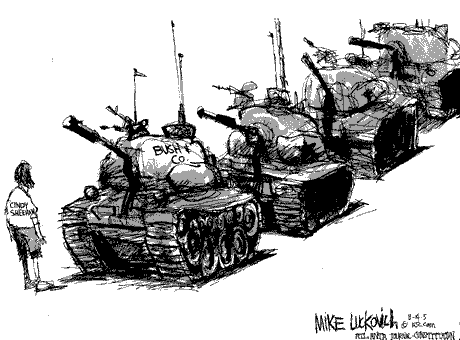
* Here's the beat-back-Cindy meme: the anti-war movement is anti-American. You're going to be hearing a lot of this; even more so than usual.

* Justin Raimondo's happy. There's new info afoot about the Israel-9/11 connection.

* From RSF: "The war in Iraq : the most deadly one for the media since Vietnam"

* Tragedy in Iraq is omnipresent. Also, a few days ago, the US claimed to have struck at terrorist "safehouses" near the Syrian border, killing many bad guys. As usual, the overwhelming majority of those killed were civilians.

Sunday, August 28, 2005

"Big One" aiming for N'Orleans

Damn. More here; some scary speculation here.

Update: Get running news on Katrina from the NHC, NOLA.com, and Google News.

Iraqi constitution talks end in disarray

From The Independent, here's what probably lies ahead for the Iraqi constitution:

Weeks of bitter wrangling over Iraq's constitution ended in disarray yesterday, threatening the country with further violence and undermining efforts towards a timetable for American disengagement.

Hajim al-Hassani, the parliamentary speaker, announced yesterday that a draft constitution would be put before the legislature today, whether Sunni Muslim negotiators accepted it or not. But Sunni leaders said amendments agreed by Shia and Kurdish representatives did not go far enough, and urged voters to reject the draft in an October referendum.

Barring a sudden change of mind by the Sunnis, the stage is set for a bitter political battle ahead of the referendum when the bloodshed in Iraq is increasingly acquiring a sectarian character. Even the optimists who still describe the violence as an insurgency might be forced to acknowledge that Iraq is in the grip of civil war.

The apparent derailing of the Iraqi constitution is a severe blow to George Bush, who urged a senior Shia leader last week not to push the Sunnis to the brink. With nearly 80 per cent of the population, the Shias and their Kurdish allies are gambling that the draft would win approval in the referendum. But if two-thirds of voters in any three of the 18 provinces reject the constitution, it will be defeated.
Here's a similar report from the Observer. As a reminder, the referendum is scheduled for October 15.

One other thing: this pussyfooting around whether Iraq is currently in civil war mode is getting ridiculous. We're not "getting there"; we're there.

Things could get worse, yes, but let's not misrepresent the divisions and factionalisations that currently dominate how the country functions.

Chavez's war with the White House

This Guardian article on Hugo Chavez's Venezuela is pretty good, and succinct.

Friday, August 26, 2005

Reprising the war

More than a year later, and the narrative still stands. Good ol' memories.

Curious evolution

Globalisation Driving Inequality

Haider Rizvi reports on one of the primary consequences of neoliberalism, growing inequality:

Despite unprecedented economic growth in recent years, the rich have become richer and the poor even poorer, says a new U.N. report that also shows women facing more hardship than men in all walks of life.

The report, titled "The World Social Situation: The Inequality Predicament," was issued Thursday just three weeks ahead of a major world summit called by U.N. Secretary-General Kofi Annan to address the pressing issues of global poverty, hunger, disease and illiteracy.

Sounding the alarm over "persistent and deepening" inequality, the authors focus on the chasm between the formal and informal economies, the widening gap between skilled and unskilled workers, the growing disparities in health and education, and opportunities for social, economic and political participation.

The world is more polarised today than it was 10 years ago, says the report, which calls for a deeper commitment to keeping the pledges made by world leaders at the Summit for Social Development held in the Danish capital of Copenhagen in 1995. At that meeting, they promised to confront profound social challenges and place people at the centre of development
Eh, but inequality ain't important, right?

"Disaster looms" in Iraq

The Daily Telegraph rounds up the situation in Iraq, which the paper says is "on brink of meltdown," as the the protracted debate over the constitution continues, competing Shiite groups ramp up the turf wars, and sectarian killings continue apace.

Additionally, in an extended Salon article, Juan Cole explains what's going on with the constitution, and the likely consequences of the stalemate. He concludes:

Parliament can clearly ram the draft constitution through at will, since the Shiites and the Kurds dominate it. In fact, the Kurdistan regional Parliament approved the federal constitution on Aug. 24, even before the federal Parliament had. But the real question now is whether the constitution can survive the referendum. The Sunni Arabs dominate Anbar and Salah al-Din provinces, and almost certainly can muster a two-thirds "no" vote on Oct. 15 in both. They may also be able to pull off a rejection in Ninevah province. In that case, Parliament would dissolve, new elections for Parliament would be held in December, and the entire process would begin all over again - a nightmarish prospect. Meanwhile, the Sunni Arab guerrillas continue their macabre war against a new order that cannot seem to get its act together.
Not too much to be optimistic about, unfortunately.

The US vs. UN

Looks like Bolton's getting to work:

America's controversial new ambassador to the United Nations is seeking to shred an agreement on strengthening the world body and fighting poverty intended to be the highlight of a 60th anniversary summit next month. In the extraordinary intervention, John Bolton has sought to roll back proposed UN commitments on aid to developing countries, combating global warming and nuclear disarmament.

Mr Bolton has demanded no fewer than 750 amendments to the blueprint restating the ideals of the international body, which was originally drafted by the UN secretary general, Kofi Annan.

The amendments are spelt out in a 32-page US version, first reported by the Washington Post and acquired yesterday by The Independent. The document is littered with deletions and exclusions. Most strikingly, the changes eliminate all specific reference to the so-called Millennium Development Goals, accepted by all countries at the last major UN summit in 2000, including the United States.
At one level, you have to give these people credit. They don't mess around. They just go about ramming their pet projects through, no matter the opposition or isolation.

Thursday, August 25, 2005

Shielding Bush

Geez, it's hard to avoid the conclusion that the Rathergate scandal paid off handsomely for Bush in the 2004 election.

No doubt fearing the same fate that befell CBS, major media organs have admitted that they sat on two potentially damaging stories for fear of influencing the election. The NY Times did it with the bulge story; now we learn Time did it with the Rove/Plame imbroglio.

Turning to the West Bank

Israel hasn't wasted much time following the successful -- successful in the sense that it went rather smoothly, with minimal violence or disruption -- withdrawal from Gaza. Already it's turning its sights to the West Bank, prepping moves that will solidify the apartheid wall's path around Jerusalem, while encasing and making more permanent settlements like Maale Adumim.

The US has uttered a peep of protest, but it's safe to assume, as usual, that such words will recede into the night with little effect.

Here it's worth noting a recent Christian Aid report, "Facts on the ground: The end of the two-state solution?," which argues forcefully that Israel is killing a viable Palestinian state with its continued expansion in the West Bank. Old news, yes, but it's pretty maddening to watch this stuff go by without any concerted action from the international community to stop it.

Grooming Politicians for Christ

This LA Times article is damn scary:

Nearly every Monday for six months, as many as a dozen congressional aides — many of them aspiring politicians — have gathered over takeout dinners to mine the Bible for ancient wisdom on modern policy debates about tax rates, foreign aid, education, cloning and the Central American Free Trade Agreement.

Through seminars taught by conservative college professors and devout members of Congress, the students learn that serving country means first and always serving Christ.

They learn to view every vote as a religious duty, and to consider compromise a sin.

That puts them at the vanguard of a bold effort by evangelical conservatives to mold a new generation of leaders who will answer not to voters, but to God.

"We help them understand God's purpose for society," said Bouma, who coordinates the program, known as the Statesmanship Institute, for the Rev. D. James Kennedy.
It's widely acknowledged that Bush has opened up the legislative process to K Street in a manner that would make even Reagan's corpse blush. That's bad enough, but now I have to have nightmares of people on the Hill flipping through the Bible for ideas on how to govern effectively?

(via American Samizdat)

America's Educational Apartheid

If you thought the report on the growing inequality in American schools from The Civil Rights Project at Harvard three years ago was depressing, do not even think of reading Jonathan Kozol's latest article in Harper's.

Rethinking the War in Afghanistan

While Bush's Iraq adventure grows more unpopular with each passing day, Gary Leupp turns his eye to the supposed "good war," in Afghanistan.

Tsuris Over Chutzpah

Yes, Alan Dershowitz is still a horse's ass. Finkelstein destroys the Harvard prof everytime they engage each other in print.

Focusing on the war

The September 24th protests against the Iraq war are coming up and the confluence of events suggest that they could be very important.

Stan Goff highlights this, and also puts in a word of caution to those who might wish to corral the Cindy Sheehan "movement" (for lack of a better term) into the waiting coffers of the Democratic Party:

The most important task over the next month – at least from where I am standing – is to use the momentum created by the Cindy Sheehan breakthrough at Crawford to ramp up the largest possible demonstration against the war for September 24th in Washington DC. Psuedo-leftist “exit strategies,” blaming Republicans for the war (instead of the entire dominant class), or trying to turn this into a recruiting opportunity for small leftist sects, are obstacles to this process. Turning this war into a political liability will do more for every form of resistance to imperialism in every location around the world, as well as the internal colonies of the US, than all the policy fights or all of the pristinely perfect left-maximalist programs in the world.

Persuasion doesn’t bring down the beast. Bleeding does. The US withdrawal from Iraq will be one of the biggest victories for genuine people’s movements, here and abroad, since the US was forced out of Vietnam.
Keep your eye on the ball, in other words.

Goff walks through a number of hot button issues, so his whole post is worth reading.

Anatomy of a killing

This seems to be the definitive article on the Jean Charles de Menezes killing. It explains the entire mess rather well.

Wednesday, August 24, 2005

Makeup linkage

* Has the "tipping point" on Iraq been reached? Jim Lobe and Greg Mitchell weigh in with related analyses. See also: "Can Cindy Sheehan end the war?"

* "Just as President Bush claimed in the build-up to war that the U.S. was threatened by Iraq's weapons of mass destruction and Saddam's connection to Osama bin Laden and 9/11 terrorists - we are now being told a new falsehood - U.S. troops are in Iraq to stabilize the country," argues Kevin Zeese.

* Juan Cole provides a sketch of a withdrawal plan from Iraq, and takes some deserved flack for it.

* Cole also has the goods on the status of the Iraqi constitution, which faces a referendum by Thursday. Plus: "Why Iraq's Sunnis fear constitution."

* Doug Ireland asks, incredulously, "If the Bush administration brokered a deal in Occupied Iraq to enshrine Islamic law as the guiding principle of the new Iraqi Constitution, you'd think it would be headline news in the U.S. media, wouldn't you?"

* Mark Levine explains why "the Oslofication of Iraqi politics will likely be the reality for the near future."

* Laura Bilmes projects in the NY Times, "if the American military presence in [Iraq] lasts another five years, the total outlay for the war could stretch to more than $1.3 trillion, or $11,300 for every household in the United States."

* Newly released memos indicate that the State Department started preparing for a post-Saddam Iraq as early as October 2001, and made several attempts to warn the DoD about its lack of a post-conflict plan before the war began.

* With Iraq said to be standing "at the gates of hell," a Salon article and photo gallery aim to tell the "grim reality" and reveal the war's "horrible human toll."

* The Guardian's Omer Mahdi files a dispatch from Haditha, which he describes as an "insurgent citadel," and Anthony Shadid and Steve Fainaru of the Washington Post report on the rise of militias around Iraq, "which instill a climate of fear that many see as redolent of the era of former president Saddam Hussein."

* "More than ever, al-Qaida militants have a global, non-territorial vision of jihad," announces Olivier Roy in Le Monde diplomatique. "Their goal is not to liberate the Middle East but to combat the world order as they see it. The young second-generation Muslims radicalised in the run-down suburbs and inner-city slums of Europe are motivated by their own situation, not Iraq. They have not been sent to fight somewhere: they fight where they live and where most of them were born."

* Who's winning the "war on terror"? US military contractors, for one.

* So much for the "biggest smoking gun" regarding Iran's nuclear program, which has been disproved by a consortium of international investigators.

* Largely out of public view, Knight Ridder reports that the war in Afghanistan has intensified over the past few months and the NY Times reports that the American death toll in country is at its highest level since 2001.

* With the Guardian's Jonathan Steele annoyed at the "exaggerated focus on the settlement evictions" from Gaza and Charley Reese lamenting the preponderance of "Israeli propaganda" in the media, Danny Schechter reviews what we've learned over the past week.

* Similarly, as the $2.2 billion option is still being considered -- "quietly" -- and Sharon still promising to expand West Bank settlements, the Sunday Herald asks, What Next For Gaza?

* Here's a wide-ranging interview with Jacqueline Rose, the author of the new book, The Question of Zion.

* "A new World Health Organisation (WHO) report shows that less than encouraging results have been obtained so far in the international community's efforts to fulfil the Millennium Development Goals," reports Gustavo Capdevila of IPS.

* Jim Lobe reports, "Nations where fewer people attend church tend to be more generous in their support for development in poor countries than those where church attendance is much greater, according to the third annual edition of the 'Commitment to Development Index (CDI),' published this week in Foreign Policy magazine."

* Peter Maas tackles peak oil, specifically as it relates to Saudi oil supplies, in the NYT Magazine this week. A related Reuters piece warns, "World Running Out of Time for Oil Alternatives."

* In the New Yorker, Malcolm Gladwell rues "One of the great mysteries of political life in the United States" -- "why Americans are so devoted to their health-care system."

* According to the NY Times, Americans are declaring bankruptcy at increasing rates in order to beat changes in the law set to take effect in October.

* This is a very solid article from LBO on the state of Social Security, and why the efforts to "save it" are fraudulent.

* From Pittsburgh protests to Delaware bookstores to Utah raves, the health of civil liberties looks to be in doubt nowadays.

Wednesday, August 17, 2005

FYI

I'll be away until early next week.

Where's the focus?

Kevin Moore drops some well-placed comments on Cindy Sheehan's plight, and the media circus that had grown up around her:

the so-called MSM is simply incapable of rendering her questions in a reasonable way, in a coherent way or in any way at all. It only understands the spectacle surrounding her protest and the symbolism it draws on. Because this symbolism depends as much on the emotional resonance of her son's death in the war as on her identity as a grieving mother, it is no surprise that the establishment Right, well practiced at the art of personal destruction, began to immediately attack her "character," that rhetorical device they used to promote their Presidential candidate during the last two elections. Her real concerns—the war, its purpose and its desired end—are completely lost in the screaming match held between media elites. This is a development that plays very well into the hands of Bush's apologists.
In all, I have nothing against Sheehan, and give her great credit for wading into the fray. But the antiwar movement should avoid building her up as a Joan of Arc figure. Playing politics on the personal level may be the best way to pander to today's media and inject one's issue into the mainstream debate, but doing so runs the risk of conceding the ground to the people that only play politics at this level.

The focus should consciously be on the war, not Cindy. We need to remind ourselves and the rest of the country of this.

The Gazan fiasco

Jennifer Loewenstein is angry, as we all should be:

On Tuesday, 16 August, the Israeli daily Ha'aretz reported that more than 900 journalists from Israel and around the world are covering the events in Gaza, and that hundreds of others are in cities and towns in Israel to cover local reactions. Were there ever that many journalists in one place during the past 5 years to cover the Palestinian Intifada?

Where were the 900 international journalists in April 2002 after the Jenin refugee camp was laid to waste in the matter of a week in a show of pure Israeli hubris and sadism? Where were the 900 international journalists last fall when the Jabalya refugee camp in Gaza lay under an Israeli siege and more than 100 civilians were killed? Where were they for five years while the entire physical infrastructure of the Gaza Strip was being destroyed? Which one of them reported that every crime of the Israeli occupation ­ from home demolitions, targeted assassinations and total closures to the murder of civilians and the wanton destruction of commercial and public property- increased significantly in Gaza after Sharon's "Disengagement" Plan - that great step toward peace - was announced?

Where are the hundreds of journalists who should be covering the many non-violent protests by Palestinians and Israelis against the Apartheid Wall? ­Non-violent protesters met with violence and humiliation by Israeli armed forces? Where are the hundreds of journalists who should be reporting on the economic and geographic encirclement of Palestinian East Jerusalem and of the bisection of the West Bank and the subdivision of each region into dozens of isolated mini-prisons? Why aren't we being barraged by outraged reports about the Jewish-only bypass roads? About the hundreds of pointless internal checkpoints? About the countless untried executions and maimings? About the torture and abuse of Palestinians in Israeli prisons?

Where were these hundreds of journalists when each of the 680 Palestinian children shot to death by Israeli soldiers over the last 5 years was laid to rest by grief-stricken family members? The shame of it all defies words.

Now instead report after report announces the "end to the 38 year old occupation" of the Gaza Strip, a "turning point for peace" and the news that "it is now illegal for Israelis to live in Gaza." Is this some kind of joke?
Unfortunately not.

As Loewenstein notes, this is pretty scandalous when you consider the lack of context provided in most reports and the lack of sympathetic reporting detailing the Palestinian plight, particularly over the past five years of the intifada.

Baghdad's body count

Robert Fisk reports for The Independent,

July was the bloodiest month in Baghdad's modern history - in all, 1,100 bodies were brought to the city's mortuary; executed for the most part, eviscerated, stabbed, bludgeoned, tortured to death. The figure is secret.

We are not supposed to know that the Iraqi capital's death toll last month was only 700 short of the total American fatalities in Iraq since April of 2003. Of the dead, 963 were men - many with their hands bound, their eyes taped and bullets in their heads - and 137 women. The statistics are as shameful as they are horrifying. For these are the men and women we supposedly came to "liberate" - and about whose fate we do not care.

The figures for this month cannot, of course, yet be calculated. But last Sunday, the mortuary received the bodies of 36 men and women, all killed by violence. By 8am on Monday, nine more human remains had been received. By midday, the figure had reached 25.

"I consider this a quiet day," one of the mortuary officials said to me as we stood close to the dead. So in just 36 hours - from dawn on Sunday to midday on Monday, 62 Baghdad civilians had been killed. No Western official, no Iraqi government minister, no civil servant, no press release from the authorities, no newspaper, mentioned this terrible statistic. The dead of Iraq - as they have from the beginning of our illegal invasion - were simply written out of the script. Officially they do not exist.
While there's a pretty steady stream of news about the carnage from IEDs, the daily, grinding violence from criminality, sectarian feuds, old score settling, and the like gets hardly any attention in the Western media.

As this report attests, the degree to which violence has been normalized in Iraq is just staggering.

Tuesday, August 16, 2005

New details of Menezes death

Cold blooded murder. Pure and simple.

British authorities should burn for this, both for the actual operation and the repeated lies that they floated to justify their actions.

Back Rent

Wow, talk about adding insult to injury.

(via scratchings)

Why Don't American Parents Protest?

For all of the yammering about "family values," the truth of the matter is that Americans live in a culture that is decidedly un-friendly to families. Especially when compared with other industrialized nations.

In an essay in Dissent, Janet C. Gornick outlines some of the problems and the political work that needs to be done to build a movement to address issues like poor child care, lack of leave time, and long work hours. She essentially calls for a reconfigurement of the American government to approximate what European welfare states do:

Building a social consensus in the United States for more government support for working families will not be easy, but a few things are clear. If we want to spur change, we need a dramatically altered discourse about the role of government in the lives of American families. We need a new lexicon concerning “family values,” one that includes the damaging consequences of time poverty, as well as income poverty, for American workers and their families. We need to recognize that we, as a nation, must invest in our children’s care and education during the first five years of their lives—rather than waiting until they are old enough for kindergarten. We need to alert many more Americans to the extreme exceptionalism of U.S. family policy offerings relative to the other rich countries of the world—and, increasingly, from a global perspective as well. (The United States is one of five countries in the entire world without a national policy of paid maternity leave.) And, finally, we need to persuade Americans, on both the left and right, that a comprehensive package of work-family policies would be consistent with a more equitable distributional result—for women, for men, and for children—and with healthy macroeconomic outcomes as well.
This amounts to a wholesale social engineering project that is probably ambitious to a fault, but credit to Gornick nonetheless. She has a lot of interesting stuff to say about a crucial topic that tends to get short thrift in this country, even among those of us who consider ourselves politically active.

Camp Casey Attacked

Lovely.

Give peace a chance?

It's amazing that this sort of dreck made its way into the NY Times today.

Look, it's pretty clear to me what's going on with the Gaza withdrawal. I've been pounding that home on a few occasions of late. People can disagree with the view that this is all a ploy to "freeze the peace process," prevent negotiations, and provide cover for West Bank settlement growth and the continued expanse of the illegal wall, but critics should at least try to stay within some reasonable approximation of reality.

Besides relaying the usual racist canard that Arabs are untrustworthy, this Times op-ed by Zev Chafets argues that the pullout is part of some masterful plan that Bush and Sharon hatched to help realize the establishment of a Palestinian state and the implementation of the much-touted Roadmap.

That the withdrawal was widely reported to have been drawn up by Sharon on his own (subsequently sold to Bush), and blatantly flies in the face of the provisions within the Roadmap, apparently doesn't matter. Like a multitude of other commentators, Chafets is now pushing a narrative that is entirely a post-hoc rationalization, glossing up "disengagement" as a bold, essentially benevolent gesture that a good amount of the media is either too confused or clueless to see through.

What's Wrong (and Right) with Indymedia

Some six years into it, the Indymedia project is full of disappointments and a few bright spots.

Writing for LiP Magazine, Jennifer Whitney takes a look at the current state of things.

In the way


(via The River)

No Bush vetoes

This snuck up on me:

Like pardons and executive orders, vetoes are among the cherished privileges of the Oval Office. Ike liked them. So did presidents Truman and Cleveland - and both Roosevelts.

But apparently not George W. Bush. In fact, well into the fifth year of his presidency, he has yet to issue a single veto.

It's a streak unmatched in modern American history, one that throws into question traditional notions of checks and balances.
Interesting. What explains it?
[T]he Bush era thus far underscores a historically high-water mark of collegial cooperation between Congress and the White House, experts say.

"We're pretty close to a parliamentary government," says G. Calvin Mackenzie, professor of government at Colby College in Watervillle, Maine, referring to Congress's close alignment with the executive branch. "We don't have much recent history with that."

Other presidents have enjoyed majority support in Congress. But few, if any, have gotten the level of disciplined backing that Mr. Bush gets from House and Senate Republicans.

"There is unusual coherence between Republicans in Congress and the president," Professor Mackenzie adds. "So there's very little getting to his desk that hasn't been pre-approved by the Republican leadership."
That could change, though, once the stem-cell research issue rears its head.

Constitutional delay and context

The Iraqi constitution has been delayed for at least another week, but the real question is if more time is going to do any good.

The main sticking points -- "revolving around Islam, oil and the distribution of political power" as the NY Times puts it -- are issues that are going to plague Iraq for years, no matter what gets codified in the document.

Still, much of this constitutional debate means little to ordinary Iraqis at the moment. Here's some perspective from Robert Fisk:

Everyone knows the real issue behind the constitution: will it allow Iraq’s three principle communities - the Shias, the Sunnis and the Kurds - to form their own federal states? And if so, will this mean the break up of Iraq? The Sunnis, the only one of the three whose homes do not sit on oil reserves, are naturally against such a division which would, incidentally, allow the Americans and the other Western nations, who still claim to have liberated Iraq for "democracy", to reach oil deals with two weakened entities rather than a potentially united Iraqi nation.

Add to all this Kurdistan’s demand that the future demography of Kirkuk - the Arab population injected by Saddam, the Kurdish population of the city exiled by Saddam and its minority Turkomans - be settled before the constitution is written, and you get a good idea why even the Americans are beginning to lose patience. The Kurds want oil-rich Kirkuk to be the capital of Kurdistan - a state which already exists although no Iraqi seems to be prepared to admit this - and thus further cut away at the frontier between " Arab" Iraq and "Kurdish" Iraq.

The problem is that all these issues are played out not in Iraq but in the Alice-in-Wonderland world already described. This is a unique place in which Saddam’s trial is always being predicted to start in two months’ time - on at least four occasions this has happened - in which Iraqi reconstruction is always about to restart and in which insurgent strength is always weakening. In fact, Iraqi guerrillas are now striking at the Americans 70 times a day and so fearful are senior American officers of an increase in attacks that this has become their principle reason for trying to prevent the release of 87 further photographs and videotapes of the Abu Ghraib prison torture and abuses.

In Real Iraq, it makes no difference. For the "street", Saddam is history, there is no reconstruction and the filth of Abu Ghraib causes no great surprise - because most Iraqis knew all about it months before the West opened its horrified eyes to the pictures.

As for the constitution, I asked an old Iraqi friend what he thought yesterday. "Sure, it’s important," he said. "But my family lives in fear of kidnapping, I’m too afraid to tell my father I work for journalists, and we only have one hour in six of electricity and we can’t even keep our food from going bad in the fridge. Federalism? You can’t eat federalism and you can’t use it to fuel your car and it doesn’t make my fridge work."

The war's over?

Frank Rich, meet Norman Solomon.

Cruise Missile Leftists

Ari Berman takes aim at the "Democratic strategic class" and "liberal hawks" in particular in this week's issue of The Nation.

Good to see and, please, keep it coming. Tons of ink has been spilled on the neocons since 2002, and rightly so. But the folks Berman is talking about deserve equal amounts of critical attention because they are, at least in my estimation, just as much of an odious force in this nation's political scene.

And, as an added bonus, they make really easy targets. I, for one, scream in delight whenever an Ignatieff piece pops up because it always makes for great comedy. The other CMLs are often just as amusing, displaying the insularity and blindness that I suspect can only come from being well-entrenched in American think tanks and elite universities.

Monday, August 15, 2005

Social Security Lessons

Paul Krugman provides a useful reminder in the NY Times today:

Social Security turned 70 yesterday. And to almost everyone's surprise, the nation's most successful government program is still intact.

Just a few months ago the conventional wisdom was that President Bush would get his way on Social Security. Instead, Mr. Bush's privatization drive flopped so badly that the topic has almost disappeared from national discussion.

But I'd like to revisit Social Security for a moment, because it's important to remember what Mr. Bush tried to get away with.

Many pundits and editorial boards still give Mr. Bush credit for trying to "reform" Social Security. In fact, Mr. Bush came to bury Social Security, not to save it. Over time, the Bush plan would have transformed Social Security from a social insurance program into a mutual fund, with nothing except a name in common with the system F.D.R. created.

...privatization seems to be dead for the time being. The Democratic leadership in Congress defied the punditocracy - which was very much in favor of privatization - by refusing to cave in, and the American people made it clear that they like Social Security the way it is.

But the campaign for privatization provided an object lesson in how the administration sells its policies: by misrepresenting its goals, lying about the facts and abusing its control of government agencies. These were the same tactics used to sell both tax cuts and the Iraq war.
Well put. And while I don't say this too often, I think the Democrats deserve a great deal of credit for holding firm on social security. In this case, they won a significant victory that will provide real benefits for a majority of Americans. That's something you don't usually see.

Oh, and lest I forget, the AARP did an admirable job, too. In fact, I doubt the Democrats would have stood as tall as they did if they didn't have the backing and organizational aplomb of a bunch of knowledgable, angry seniors. Kudos to them, because people my age swallowed the GOP Kool Aid completely.

Iraqi Constitution struggles

Juan Cole has the latest on the negotiations over the Iraqi constitution, which was supposed to be ratified today, but probably won't.

I'm no expert on the internal political dynamics in Iraq, but I think it's safe to say that whatever document gets drawn up won't change the situation on the ground. It might actually make things worse if the Shiites are granted autonomy alongside the Kurds, essentially relegating the Sunnis to a pitiful, unviable government in Baghdad.

Disengagement


Check in here for running coverage of the Gaza withdrawal from Ha'aretz.

Withdrawing "not an easy job"

Via Middle East Politiks, the Gaza withdrawal, translated into IDF-speak:

"Normally we would storm a house killing everyone inside, whereas here we have to storm the house and keep everyone alive," said one commander. "It’s not an easy job."
If I didn't have friends who have had family members killed by Israeli soldiers and shrapnel in their legs from IDF munitions, I might find this darkly amusing. Might.

And if you're still confused what's driving Sharon amidst all of the protest from the settlers and the right, Middle East Politiks has you covered on that end, too.

None Dare Call It Stolen

Here's yet another academic study that provides further documentation of the 2004 election fraud, adding to the existing literature from other scholars.

If you haven't yet, read Mark Crispin Miller's latest Harper's article. It should make you angry; hopefully angry enough to do something about it, like lobby your congressional representatives to take voting reform seriously this time around.

Another anti-empire report

Bill Blum's latest round of short blurbs, as usual, are worth a read. In particular, I want to point you to this excerpt:

The cold-blooded murder of the 27-year-old Brazilian, Jean Charles de Menezes, by London police may become a symbol for the War on Terror along with others like the hooded and wired man of Abu Ghraib. It appears now that the police lied about Menezes wearing a bulky jacket, running from them, jumping over the subway turnstile, and being "directly linked" to the bomb investigation. But even if all of that were true, what would be the justification for his execution? That he might have been a suicide bomber just about to explode himself in a crowded subway station? But if that were true, why -- when the police were getting closer to him, then closer, then on top of him -- why didn't he set the explosives off? Should not the absence of any explosion have instantly told the police that they were dreadfully mistaken?
Indeed, the Menezes killing doesn't get much press anymore. A cynic could say that's because the story the police crafted to justify his execution has unravelled, completely.

Lowering the bar on Iraq

Could it be true? Could the Bush administration be moving from neocon idealism to cold, hard realism? The Washington Post suggests so:

The Bush administration is significantly lowering expectations of what can be achieved in Iraq, recognizing that the United States will have to settle for far less progress than originally envisioned during the transition due to end in four months, according to U.S. officials in Washington and Baghdad.

The United States no longer expects to see a model new democracy, a self-supporting oil industry or a society in which the majority of people are free from serious security or economic challenges, U.S. officials say.

"What we expected to achieve was never realistic given the timetable or what unfolded on the ground," said a senior official involved in policy since the 2003 invasion. "We are in a process of absorbing the factors of the situation we're in and shedding the unreality that dominated at the beginning."
I really, really hope it didn't take them three years to realize this. But with the clowns running policy completely out of the Pentagon since 9/11, I wouldn't be surprised if they're just getting the memos today.

Why I Am No Longer A Radical

M. Junaid Alam writes:

After some careful consideration, I've decided that I am, from here on out, no longer a political radical. Now - hold on a minute before you begin to brandish your pitchforks and light your torches.

How did I come to this position? Not by the unremarkable route - the sell-out route. It's not because I've stopped believing in the causes, and it's not because the risks of taking them up are too high to bear, even though many Americans would brand me a "Communist" or a "terrorist" because they've been fed a steady diet of hyper-nationalism that blinds them to all but the skin color and supposed crimes of the enemy of the month.

What's convinced me to discard the robes of political radicalism is not the fear of defending what's right in a world where you're rewarded for doing wrong, but the fear of living in such a world at all. For to let the Right claim the very mantle of "mainstream" for themselves, as they have increasingly tended to do, to let them spin off basic values like social equality, human rights, religious tolerance, and peace as the byproducts of a bygone era of amoral "radical" hippies, would be a total catastrophe.

The simple fact of the matter is that the causes and beliefs we advocate are not "radical" in the commonly understood sense of the word, but rather, moderate, sensible, and fair. Conversely, it is the political mainstream that is antithetical to basic human values, serving up indigestible rationalizations for all kinds of cruelties inflicted upon people on a daily basis, fostering cynicism and frustration.

So the way I see it, if we are to be real radicals, we need stop acting like our agenda is, well, radical.
Lots of good stuff in this essay.

Saturday, August 13, 2005

Catch up

Lots of linkage; little commentary. Read at your peril. Not much good news afoot, but much of it important.

* While Iran "buys some time" from the IAEA and Bush leaves military options on the table, Ian Davis sees ominous days ahead if the US is allowed to push a resolution on Iran's nuclear program to the Security Council.

* For a pessimistic reading of where we're headed regarding Iran, see Gary Leupp and Mike Whitney. Hell, even The New Republic says, "Attacking Iran is a bad idea."

* "Recent attempts by Vice President Dick Cheney and his 'neo-conservative' allies to conjure up a nuclear threat from Iran as 'justification' for military action have been exposed as a charade by timely leaks to the Washington Post," observes Ray McGovern, who then proceeds to send a "Reminder to Patriotic Truth Tellers: Timing makes all the difference."

* Doug Ireland reminds us that the the AIPAC spy scandal is really about "helping to prepare an attack by Israel on Iran."

* Lo and behold, Iran's winning America's war in Iraq, says Michael Schwartz.

* The confluence of deadly attacks, particularly on a single Ohio Marine battalion, and Cindy Sheehan's arrival in Crawford have put renewed pressure on Bush's Iraq policy.

* Contradictory calls for raising and lowering troop levels in Iraq are one thing, but Ashraf Fahim thinks the primary issue at hand regarding the US military's presence in Iraq is whether it is going to hold on to those "enduring bases."

* "If the U.S. Army and its Iraqi allies are killing as many insurgents as reports indicate they are per month, why is the insurgency intensifying instead of collapsing?" asks UPI's Martin Sieff, dredging up an issue that plagued the US during the Vietnam conflict.

* Nothing to see here, folks. Just a coup in Baghdad.

* The CS Monitor's Dan Murphy reports that Iraqis are increasingly taking aim at interim government officials because of fuel and water shortages when in previous summers they blamed the Americans.

* Michael Meacher channels Naomi Klein in the London Times. The "reconstruction" of Iraq, he writes, "amounts in effect to wholesale privatisation of the economy and is little short of economic colonisation."

* Paul Street dissects the recent NY Times piece on the discontent among soldiers in Iraq who see the homefront detached from the war as a whole. The story reflects, according to Street, the "very real ongoing conflict between the hard, murderous requirements of militarism and the soft, 'normalcy'-craving imperatives of American consumer capitalism, which tries to reduce democratic citizenship to the uninterrupted and often trivial pursuit, purchase, and enjoyment of commodities."

* Knight Ridder's Leila Fadel reports on life in Basra, which "is enjoying an economic and religious renaissance, even as the rise of conservative Shiite Islam has put a chill on its traditionally flourishing cultural scene."

* Steven Vincent, an un-embedded reporter and blogger who supported the war, was recently killed in Basra, with many speculating that he was targeted for penning a NY Times piece that highlighted the increasing Shi'ite violence and authoritarianism in the city. Add his name to the already long list of journalists killed in Iraq.

* The London Times' Michael Smith, who broke the DSMs, follows up on the premature bombing of Iraq story, a tale the US media and Congress have no trouble ignoring.

* In a TomDispatch piece, Jim Lobe does some heavy lifting to date Cheney and Co.'s first reference of the Iraqi nuclear threat back to December 2001. As Lobe writes, "It was a new argument being taken out for a test run, one that would become painfully familiar in the months that followed."

* Parts of the long-awaited Volcker report on the UN "oil for food" scandal have been published. The lede from Haider Rizvi's IPS story summarizes the absurdities well: "After spending some 35 million dollars probing wrongdoing in Iraq's Oil for Food Programme, U.N. investigators have accused the former head of the humanitarian project of taking nearly 150,000 in cash bribes." See The Economist for more and a past post of mine for added context.

* Chris Floyd opines that "it looks like they've finally hit on a winning formula" for dealing with Saddam Hussein's trial. "The secret of America's ungodly machinations with this thug will thus stay safely buried."

* The WSWS has more on the killing of Iraqi Maj. Gen. Mowhoush, which was outlined in the recent Washington Post articles on the CIA's team of "Scorpions."

* Considering what's been mentioned previously, I suppose it's no surprise that the Pentagon is claiming that the release of the next round of Abu Ghraib photos would constitute a threat to national security, citing the uproar sparked by Newsweek's Koran flushing story.

* American Leftist notes that Jane Mayer's New Yorker article on the lab rat experiments being conducted on Gitmo detainees is now available online.

* "Leaked emails from two former prosecutors claim the military commissions set up to try detainees at Guantanamo Bay are rigged, fraudulent, and thin on evidence against the accused," reports the Australian Broadcasting Corporation.

* Are you ready for a hoedown this coming September 11th?! Mark your calendars.

* So much for GSAVE. We're back to GWOT, apparently.

* "The U.S. military has devised its first-ever war plans for guarding against and responding to terrorist attacks in the United States, envisioning 15 potential crisis scenarios and anticipating several simultaneous strikes around the country," reports the Washington Post. Essentially, this means the military is planning for martial law.

* According to Gary Berntsen, the field commander of the CIA's operations in the Hindu Kush at the time, the US let Bin Laden slip away at Tora Bora in December 2001.

* Kevin Drum rounds up the flurry of recent news on "Able Danger," along with the fallout from this odd story. "I've had a hard time getting my hands around the whole mess," admits Drum. "The only thing that's sure is that the NRO crowd is going absolutely batshit over it."

* Juan Cole Fisks the "War on Terror" on his blog and then explains in Salon, "What Michael Moore (and the neocons) don't know about Saudi Arabia."

* In a Salon review of Robert Pape's much-discussed new book (amongst others), Laura Miller goes "Inside the Minds of Suicide Bombers."

* Sibel Edmonds, the gagged FBI whistleblower, dropped a bomb in a Vanity Fair interview last week about Speaker of the House Dennis Hastert being discussed as a possible bribe recipient from Turkish sources.

* The FT reports on a survey that shows the decline in American prestige over the past few years is "hurting companies whose products are considered to be distinctly 'American.'" Recall earlier iterations of this trend.

* With Big Oil warning of a coming energy crunch and the US shown to be "over a barrel," Michael Klare's sober musings on the "Twilight Era of Petroleum" are well worth noting. See also: Richard Heinberg on "How to avoid oil wars, terrorism, and economic collapse."

* As the WSWS says Congress "delivers for its corporate masters," Russ Feingold serves up the bad news about the recently passed energy bill.

* "The American public has enjoyed the fiesta, but the blue-light special orgy of easy motoring, limitless air-conditioning, and super-cheap products made by factory slaves far far away is about to close down. Globalisation is finished," declares James Howard Kunstler in the Guardian.

* New research suggests that global warming is making hurricanes more ferocious, melting glaciers at an alarming pace, and thawing out Serbian permafrost "for the first time since it formed 11,000 years ago at the end of the last ice age." See also: "In all likelihood, events are now set to run their course."

* Writing for TomPaine.com, Bill McKibben looks for "The Future Of Environmentalism" and Mark Hertsgaard explains that "Nukes Aren't Green."

* Gar Alperovitz, the leading American "revisionist" scholar on the dropping of the atomic bombs on Hiroshima and Nagasaki, looks at the debate 60 years later; Richard Frank puts forth the case for the bomb in the Weekly Standard; and GWU's NSA collates some primary sources for you to make up your own mind.

* See more a-bomb material: the WSWS' three part series, "Sixty years since the Hiroshima and Nagasaki bombings"; coverage from Democracy Now!; sage advice from Noam Chomsky; Greg Mitchell and E&P's reporting; and yet more reading from Left End of the Dial.

* Particularly with Iran's program being so high on the international agenda right now, Ramzy Baroud implores, "The BBC’s striking revelations regarding the secretive and disconcerting British role in making an Israeli nuclear bomb possible deserves more than a quick pause and a few dozen news reports. It obliges a thorough investigation coupled with a complete reversal in the double standard that views Israel’s fully-fledged nuclear capabilities as a trivial concern."

* What is behind the Gaza "disengagement plan"? Justin Podur takes a measured look.

* "While the world focuses on Gaza, the future of Israeli-Palestinian relations in fact may be playing itself out away from the spotlight, in Jerusalem," goes the executive summary to an important new report by the International Crisis Group.

* How much money has Israel poured into West Bank settlements? Nobody really knows, as Al Jazeera reports.

* The World Bank is already tinkering with the promised G-8 debt relief program, says Emad Mekay of IPS.

* The Independent reports on what investigators have concluded thus far regarding the July 7 bombings in London. In a somewhat related piece, USA Today summarizes "Why suicide attackers haven't hit U.S. again."

* The US was evicted from its K2 airbase in Uzbekistan, a move that the Uzbeks had reportedly been trying to precipitate for some time. See also: Craig Murray on "Why the US won't admit it was jilted."

* Stephen Zunes raises the alarm that the Bush administration "is actively pursuing policies which will likely increase the risk of a catastrophic nuclear confrontation on the Indian subcontinent."

* Here's some reporting on the unrelated crises in Mumbai and Niger.

* Mary Anne Saucier summarizes Mark Crispin Miller's hard-hitting Harper's article on the 2004 election fraud in Ohio. You can read Miller's entire article, here. Additionally, Harper's has posted a short excerpt and the transcript to a related forum on the 2004 election anomalies.

* "More than a month after the Supreme Court ruled that governments could take one person's property and give it to another in the name of public interest," the NY Times reports, "the decision has set off a storm of legislative action and protest, as states have moved to protect homes and businesses from the expanded reach of eminent domain."

* Judy Miller: heroic martyr or White House stooge? Take a guess. Also, Murray Waas alleges Scooter and Judy met on July 8, 2003 to discuss Plame, six days before Novak's infamous column appeared, and the Washington Post strongly hints that Plame's identity was indeed gleaned from the June 2003 State Department memo that wound up making its way on Air Force One for a Bush visit to Africa. Plus: "How Judy Miller Screwed Us All" and "Shades of '92?"

* "Liberals pledge millions to revive US left" reads the Guardian's headline. Well that's one interpretation. Here's another.

* George Monbiot has "no idea why I should love this country more than any other." He's speaking of his homeland, Britain, but his remarks could equally apply to the America-firsters over here.

* Chris Mooney probes the origins of "Intelligent Design" in the American Prospect.

* Eric Hobsbawm has an interesting review of Goran Therborn's new book, Between Sex and Power, in the LRB. Earlier, I posted a review of the book from The Nation.

* Here's a disturbing report from Amina Mire on the emerging skin-whitening industry.

CyberHannity Saves The World (with help from G. Gordon Liddy and co.)

Wednesday, August 03, 2005

Break

I'm out of town and not in a particularly convenient blogging position at the moment, so rather than inefficiently trying to wade through material and throw up posts, I'm putting things on hiatus until next week.

Until then, peruse the links on the right. I've also posted something at American Samizdat that I hope more people latch on to, if only to help push the Downing Street Memos back into the spotlight.