Thursday, March 24, 2005

This week's catch-up

I'm hoping to resume more regular posting some time next week. 'til then.

* Two years after the US-led invasion of Iraq, the Guardian's Gary Younge observes, "the death toll keeps rising, the size of the 'coalition' keeps shrinking and global public support for this reckless occupation has maintained its downward spiral from a low base. Indeed, the only thing that changes is the rationale for starting the war, where the sophistry of the occupying powers keeps plumbing new depths and selective amnesia has attained new highs."

* As an Iraqi poll marks a high point for optimism, Iraqi citizens "strike back" at insurgents, and the US military claims the scalps of 85 insurgents, Tom Engelhardt analyzes the war on the cusp of its third year.

* Protests marking the war's anniversary went down around the US last weekend, which the media of course dutifully downplayed.

* In his syndicated Media Beat column, Norman Solomon cites the reporting of David Enders and takes another shot at MoveOn before laying out the case for an Iraq withdrawal.

* Is Iraq Becoming the World's Biggest Cash Cow? Emad Mekay of IPS reports on the release of Transparency International’s Global Corruption Report 2005 following news that Halliburton beefed up a Pentagon fuel bill, charging $27.5 million to ship $82,100 worth of LPG to Iraq.

* The Independent's Patrick Cockburn reports that the US is routinely letting criminals run free in Iraq if they promise to spy on insurgents, a development that no doubt contributes to soaring rates of crime and violence.

* An Al Jazeera article retells the horrors of Fallujah, teasing together the brutal evidence collated by, amongst others, Dahr Jamail and Naomi Klein. Additionally, Chris Floyd links Dr. Khalid ash-Shaykhli's ignored Fallujah revelations to the media's penchant for "filtering" and a Knight Ridder piece quotes one Iraqi's analysis of Fallujah's current tranquility: "It's the safest city in Iraq because it's a prison."

* Digging deep into a survey of journalists involved in reporting the Iraq conflict conducted by American University's School of Communications, E&P's Greg Mitchell unearths "some very revealing, if buried, comments by some of the unnamed respondents." In particular, Mitchell cites a recurring concern about the American media's inability or unwillingness to report the grisly reality on the ground, and its tendency to present an overly-sanitized and rosy picture of the war. Also see another analysis of the survey from CJR's Paul McLeary, "How War News Is Really Shaped."

* A BBC Newsnight investigation by Greg Palast charts the battle between neo-cons and Big Oil over Iraq, a struggle Palast says predates 9/11 and was eventually won by Big Oil. You can watch the program here and then head over to Palast's site for additional background.

* In related pieces, Michael Klare addresses the role oil played in the decision to invade Iraq and the potential impact of "peak oil."

* A Salon article by Robert Bryce says a leading energy analysis firm, John S. Herold Inc., is predicting that seven of the world's major oil companies will hit their production peaks by 2009. "Herold's work shows that the best minds in the energy industry are accepting the reality that the globe is reaching (or has already reached) the limit of its own ability to produce ever increasing amounts of oil," Bryce contends.

* Is Bush spreading democracy in the Middle East? Juan Cole, Dilip Hiro, Phyllis Bennis, and Bill Blum examine the historical and contemporary evidence and answer with a collective, resounding "no!"

* While Syria completes the "first phase" of its pullout from Lebanon and the London Times claims to have "clear evidence" of Syrian involvement with Hariri's assassination, Stephen Zunes argues that "the complexity of Lebanese politics and the new dynamics on the ground in reaction to Hariri’s killing precludes any premature claim of American credit for whatever positive developments have emerged in that war-ravaged country challenging the undue influence of Syria. Furthermore, it is unlikely that the widespread anti-American sentiment in Lebanon will change as long as U.S. demands that Lebanese sovereignty be respected appear to be limited only to situations where the violator of that sovereignty is not allied with the United States."

* Fear not, says Gary Leupp. The neocon plan to institute regime change in Syria, Iran, and Lebanon is still on track.

* In the American Prospect, Laura Rozen and Jeet Heer say the neocons' favorite Iran-contra stooge, Manucher Ghorbanifar, is being called upon to provide damning evidence against Iran, much in the same way Ahmad Chalabi built a case against Iraq.

* Calling it "the major question for the twenty-first century," Chalmers Johnson asks: can the US and Japan peacefully adapt to the rise of China? "Or is China's ascendancy to be marked by yet another world war, when the pretensions of European civilization in its U.S. and Japanese projections are finally put to rest?"

* While Israel touts disengagement from Gaza, it continues to throw resources behind the construction of settlements in the West Bank, recently adding 3,500 new housing units in a block just outside of Jerusalem. On a related front, Gary Sussman wonders if Sharon is again considering the "Jordan option," a plan to reconfigure the Hashemite Kingdom by merging the federal structure of Palestine with Jordan.

* Michael Scheuer, the veteran CIA officer and author of Imperial Hubris, argues in an antiwar.com piece that it is in the best interests of both the US and Israel to restructure their relationship as soon as possible. "It is in neither nation's interest to delay debate until Americans have begun to evaluate their relationship with Israel through a lens ever more heavily smeared with the blood of their sons and daughters," he advises.

* Long-term bases for Afghanistan? Check. Long-term bases for Iraq? Most likely another check. Rest assured, the American military footprint in Central and West Asia is taking on the look of permanence.

* After several delays, parliamentary elections in Afghanistan are now set for September 18, a year later than initially scheduled.

* The Washington Post's N.C. Aizenman reports from Kandahar, where a spike in crime has brought a "growing local nostalgia for the Taliban era of 1996 to 2001, when the extremist Islamic militia imposed law and order by draconian means."

* Of the approximately 65,000 prisoners taken by the US during the wars in Afghanistan and Iraq, at least 108 died while in custody, many of them due to violent causes, and at least 26 of these deaths were homicides.

* Adrian Levy and Cathy Scott-Clark of the Guardian visit American controlled jails in Afghanistan, which function as the "hub of a global network of detention centres" containing some 10K "ghost detainees."

* The CS Monitor's Tom Regan rounds up some abuse at Gitmo news, in particular claims that videotapes exist of torture there, a la Abu Ghraib, and the intelligence being pried out of detainees is "suspect at best."

* "The crucial lesson of the Pentagon Papers and then Watergate was that presidents are not above the law," writes Anthony Lewis in a NYRB essay. "So we thought. But today government lawyers argue that the president is above the law - that he can order the torture of prisoners even though treaties and a federal law forbid it. John Yoo, a former Justice Department official who wrote some of the broad claims of presidential power in memoranda, told Jane Mayer recently that Congress does not have power to 'tie the president's hands in regard to torture as an interrogation technique.' The constitutional remedy for presidential abuse of his authority, he said, is impeachment. Yoo also told Ms. Mayer that the 2004 election was a 'referendum' on the torture issue: the people had spoken, and the debate was over. And so, in the view of this prominent conservative legal thinker, a professor at the University of California law school in Berkeley, an election in which the torture issue was not discussed has legitimized President Bush's right to order its use."

* Jim Lobe weighs in on the surprising appointments of Paul Wolfowitz to head the World Bank and Karen Hughes to head US public diplomacy efforts.

* While Wolfowitz's appointment is meant to secure the economic pillar of hegemonic power, the Washington Post's Glenn Kessler says that Condi Rice, in her parallel project to consolidate power in Washington, is doing a bang-up job turning the State Department "into an adjunct of the White House communications machine."

* Michel Chossudovsky and Jim Lobe break down the Pentagon's recently-released "National Defense Strategy of the United States of America," which was first reported by the Wall St. Journal.

* Reuters reports that Jan Egeland, the UN's emergency relief coordinator, has stated that the Eastern Congo is "suffering the world's worst current humanitarian crisis, with a death toll outstripping that in Sudan's strife-torn Darfur region." Recently, Egeland claimed that 180K may have died within the past 18 months from illness and malnutrition in Darfur.

* The Independent summarizes Kofi Annan's proposals to revamp the UN.

* David Usborne of the Independent reports on the recent World Water Day as an estimated billion plus people face drastic shortages of the elemental substance.

* Tom Reeves takes a detailed look at the possibility of a future draft.

* Can secrecy coexist with academic openness? David Glenn investigates the controversy over the Pat Roberts Intelligence Scholars Program in the Chronicle of Higher Education.

* From Cursor: "The AP reports that a Pentagon document states as a fact that a Guantanamo Bay detainee 'assisted in the escape of Osama bin Laden from Tora Bora,' undermining assertions made last fall by Gen. Tommy Franks in an op-ed and repeated by President Bush and Vice President Cheney on the campaign trail." And in related news, the US and Pakistan admit that Bin Laden's trail is now cold.

* The Star Tribune has a special section devoted to the school shooting in Red Lake, Minnesota.

* The "Culture of Life" indeed. Witness the "Islamization of the Republican Party," says Juan Cole, as the Bush apparatus seizes on the plight of Terri Schiavo to advance its own political agenda.

* "Democrats and progressives make the mistake of thinking that today's Social Security debate is about Social Security," writes Thom Hartmann. "It's not. It's about creating single party rule for a generation or more. To do that, Republicans believe they need only to grab the hearts and minds of the generation currently under 30 - and they can do that, win or lose, by properly framing the Social Security debate."

* Reuters reports that the "budget deficit has overtaken terrorism as the greatest short-term risk to the U.S. economy, and concern about the current gap is rising, a survey of U.S. businesses shows."

* Do ads still work? Ken Auletta evaluates philosophical and practical changes in the PR and advertising industry in the New Yorker.

* Steve Perry's interview with Gore Vidal is worth checking out.

* This is a good, explanatory article on the NHL's financial meltdown.

Tuesday, March 15, 2005

Since the weekend

* The Daily Star reports on the massive anti-Syrian demonstration in Beirut yesterday, where nearly one million demonstrators from across Lebanon jammed Martyrs' Square "to hear opposition leaders demand the sacking of Lebanon's top security chiefs, a total Syrian pullout, and an independent investigation into Hariri's murder." Pictures from the scene, here and here. Also see a timeline on Hariri's assassination, one month on.

* According to Robert Fisk, the UN's special investigation into the Hariri killing has found that the Lebanese are covering up evidence and President Bush is going to announce tomorrow that Syrian intelligence was involved in the bombing.

* "Despite conspiracy theories and grim assessments to the contrary," Laurie King-Irani writes, "something new, amazing, and precious is indeed being born in Lebanon: an indigenous, responsive, truly plural form of democracy that is not Made in the USA, but forged out of a long and difficult Arab experience. Apparently, many thought this would be a Caesarian delivery under strong anaesthia. Wrong: it will be a painful, protracted, and loud labor and birth. Although considerable debate is now heard inside and outside Lebanon about this baby's parentage, ideological DNA tests do not indicate that George W. Bush is the father."

* Onward to Iran? The London Times reports that "Israel has drawn up secret plans for a combined air and ground attack on targets in Iran if diplomacy fails to halt the Iranian nuclear programme." And, in a follow-up story, the Times relays that, while being "publicly committed" to the recently announced diplomatic efforts of the US and EU, Israeli officials "say the 'point of no return' will come later this year when they calculate Iran will be in a position to start processing uranium. They say Ariel Sharon’s inner cabinet has decided to act alone if the impasse has not been broken."

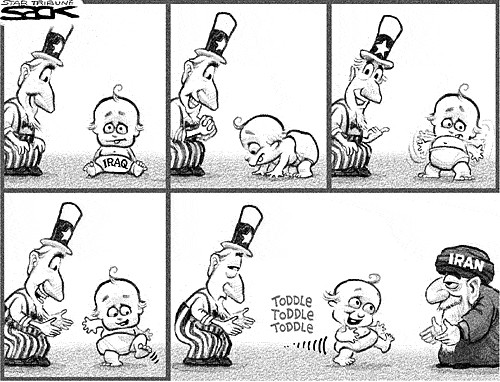
* Meanwhile, Iran has rejected the recent American overtures, dismissing them as "bribes" and "threats." In related news, US carrier groups are reportedly converging in the Mid East.

* Regarding the upcoming two-year anniversary of the Iraq invasion, Geov Parrish writes, "People in Iraq need to know that people in the U.S. oppose this war. That, as much as any changing of Bush Administration minds, is why the demonstrations scheduled across the country [this] weekend are so important. Go. Make your voice heard. Remember that war is not an abstract game. Remember that democracy cannot be installed at the barrel of a gun. Remember that this country belongs to us -- not to a tiny neocon cabal."

* Much to Byron York's chagrin, the NY Times follows up on its story about Al Qaqaa. Recent statements by Iraqi officials confirm that, following the fall of Baghdad, "looters systematically dismantled and removed tons of machinery from Saddam Hussein's most important weapons installations, including some with high-precision equipment capable of making parts for nuclear arms," in what was a "highly organized operation" that "pinpointed specific plants in search of valuable equipment, some of which could be used for both military and civilian applications."

* David Peterson asks, again: "Why do you suppose the American and British governments pay so little attention to how many Iraqis they are killing?"

* Asked to provide an update on Fallujah, Juan Cole is "sorry to say that there is no Fallujah to update. The city appears to be in ruins and perhaps uninhabitable in the near future. Of 300,000 residents, only about 9,000 seem to have returned, and apparently some of those are living in tents above the ruins of their homes. The rest of the Fallujans are scattered in refugee camps of hastily erected tents at several sites, including one near Habbaniyyah, or are staying with relatives in other cities, including Baghdad."

* Following up on the Scripps Howard investigation of a few months ago, Newsweek has discerned that, "as of last week 1,043 American children had lost a parent in Iraq. To put it another way, nearly two years after the invasion on March 19, 2003, among the 1,508 American troops who have died as of March 11 were an estimated 450 fathers, and 7 mothers."

* Hey, did you know children were held and abused at Abu Ghraib and that two detainees were tortured to death in 2002 at Bagram Air Base in Afghanistan? If you missed these stories the first time around, you're in luck. They're being treated as "new" news, although, to be fair, the recent reports do flesh out a few details that were previously unknown.

* Teresa Whitehurst wryly notes, "You'd have to be crazy to disagree with the U.S. military." Literally.

* "Under the Bush administration," the NY Times reports, "the federal government has aggressively used a well-established tool of public relations: the prepackaged, ready-to-serve news report that major corporations have long distributed to TV stations to pitch everything from headache remedies to auto insurance. In all, at least 20 federal agencies, including the Defense Department and the Census Bureau, have made and distributed hundreds of television news segments in the past four years, records and interviews show. Many were subsequently broadcast on local stations across the country without any acknowledgement of the government's role in their production." Critical Montages has more on this.

* E&P summarizes some of the findings of the PEJ's "State of the American News Media 2005" study.

Friday, March 11, 2005

Compressed linkage

* Which way will Lebanon go next? The CS Monitor reports on the rapidly evolving situation in that Middle Eastern country following the re-appointment of Prime Minister Omar Karami. Also, the Washington Post reports that the US is dropping the hammer on Syria, warning that it faces "total political and economic isolation" if the withdrawal from Lebanon is not swift and complete.

* In what would be a surprising move, the NY Times reported yesterday that the US was ready to admit Hezbollah has a "role to play" in Lebanon's political structure. Scott McClellan has since denied this to be the case. Oh, and Israel? Shudup already, lest your occupation forces get brought up in the discussion.

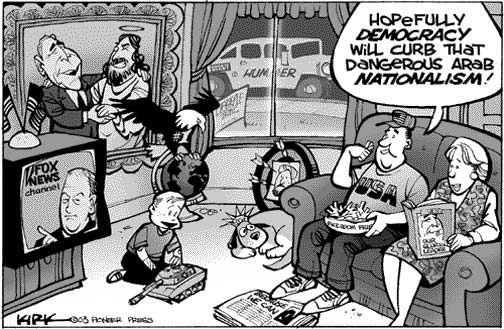
* "The claim that democracy is on the march in the Middle East is a fraud," avers the Guardian's Seumas Milne. "It is not democracy, but the US military, that is on the march."

* "George W. Bush likes to say that democracy has the power to defeat tyranny," writes Naomi Klein in The Nation. "He's right, and that's precisely why it is so very dangerous for history's most powerful emancipatory idea to be bundled into an empty marketing exercise."

* "The Pentagon's widest-ranging examination of prisoner abuse at U.S. detention facilities has concluded that there was no deliberate high-level policy that led to numerous cases of mistreatment, and instead blames inept leadership at low levels and confusion over changing interrogation rules," reports the Washington Post. Obviously, the investigation is a whitewash.

* Jim Lobe says recent moves, most notably Bolton's nomination to be ambassador to the UN, show unilateralism to be back in vogue in Washington.

* Are We in World War IV? Tom Engelhardt probes the neocon line that GWOT = WWIV.

* The Washington Post confirms that the US is willing to join Europe in negotiations that will offer economic incentives for Iran to drop its nuclear ambitions. Most important, however, is what's mentioned in the last paragraph of the Post story: "Bush's willingness to go along with incentives of any kind stems from a desire to gather support for later punitive action, assuming the incentives do not work, and to present a united front before the Security Council." Gosh, that sounds familiar.

* In a Foreign Affairs article that approves of more aggressive diplomatic efforts towards Iran, Ken "An Invasion Is Definitely Not A Good Idea This Time Around" Pollack and Ray Takeyh urge the Bush administration to "force Tehran to confront a painful choice: either nuclear weapons or economic health. Painting Tehran's alternatives so starkly will require dramatically raising both the returns it would gain for compliance and the price it would pay for defiance."

* The International Summit on Democracy, Terrorism and Security in Madrid has concluded on the first anniversary of "3/11."

* With the one-year anniversary of Aristide's removal having just passed, Aaron Maté recounts his recent trip to Haiti, where he found "that there has been not just a coup against the President, but a purge of the mass-based Lavalas party that elected him." As a testament to the violence that plagues the country, Maté points to an "exhaustive and sadly overlooked study" by the University of Miami’s Center for Human Rights, which "found that 'the police routinely enter [poor neighborhoods] to conduct operations which are often murderous attacks, often with firepower support from the UN Civil Police and Peacekeeping forces,' leaving victims that 'prefer to die at home untreated rather than risk arrest at the hospital.'"

* A suit filed on behalf of millions of Vietnamese victims of Agent Orange against a variety of American chemical companies has been dismissed by an American judge, confirming yet again the axiom that there are worthy and unworthy victims.

* Reporting for Al Jazeera, Adam Porter writes that a new US government sponsored study, which he says marks a "landmark in the current oil debate," admits that the only uncertainty about "peak oil" is when it will arrive. The report, "Peaking of World Oil Production: Impacts, Mitigation and Risk Management," makes several recommendations for dealing with the threat of dwindling oil supplies and concedes that "the world has never faced a problem like this. Without massive mitigation more than a decade before the fact, the problem will be pervasive and will not be temporary. Previous energy transitions were gradual and evolutionary. Oil peaking will be abrupt and revolutionary."

* Picking up where Charlotte Beers and Margaret Tutwiler left off, Dubya's pal Karen Hughes is going to be heading up American propaganda public diplomacy efforts abroad.

Wednesday, March 09, 2005

More news

* Paul Woodward of War In Context, noting the double standards rife in the media: "When tens of thousands of Lebanese protest against the pro-Syrian Lebanese government it is hailed around the world as an impressive expression of the will of the Lebanese people and their desire for self-determination. As Newsweek describes it, this is "people power!" Now half a million Lebanese (from a city of 2.25 million) take to the streets and what are we witnessing? Hezbollah's organizational efficiency; the blind loyalty of the Shiite masses; the past; a political exercise of no real significance."

* To this, Robert Fisk adds: "If the Shia of Iraq can be painted as defenders of democracy, the Shias of Lebanon cannot be portrayed as the defenders of 'terrorism'. So what does Washington make of yesterday's extraordinary events in Beirut?"

* Is Bush Bringing Democracy to the Middle East? Democracy Now! presents a debate on this question.

* "By giving George W. Bush and his neoconservative advisers far too much credit for recent political shifts in the Middle East," Robert Parry writes in yet another excellent analysis of recent developments, "the U.S. news media is emboldening these architects of the Iraq War to escalate their regional strategy, which may include a military solution in Iraq that could cross into genocide."

* This AP story summarizes the grisly developments around Iraq earlier today, where the discovery of 41 corpses and a large suicide bombing in Baghdad indicate the country remains mired in chaos, even after January's glorious election.

* This report suggests that the US Army's official historian of the Iraq war, Major Isaiah Wilson, has concluded that the US lost control of Iraq in July 2003 and has failed to regain dominance since. The military, you might recall, was warned this would happen back in July 2003 unless drastic measures were taken to restore civil services and security.

* Mark Benjamin, the award-winning UPI reporter who has done an excellent job tracking down the real number of casualties from Iraq and Afghanistan, has a story in Salon about the US military's continued preoccupation with keeping the messy images of war out of the public eye. Of particular note, Benjamin has found the military tends to bring its wounded back to the US under the cover of darkness.

* "A former U.S. Marine who participated in capturing ousted Iraqi President Saddam Hussein said the public version of his capture was fabricated," reports UPI. "I was among the 20-man unit, including eight of Arab descent, who searched for Saddam for three days in the area of Dour near Tikrit, and we found him in a modest home in a small village and not in a hole as announced," Nadim Abou Rabeh told a Saudi paper. Recall some of the earlier theories about Hussein's capture.

* "War on terror may breed more terrorism." So conclude a variety of participants at the Madrid conference on terrorism. Of course, they're not alone.

* ABC News has stumbled upon an FBI report that downplays the Al Qaeda threat to the US. The report seems to echo the charges Adam Curtis laid out in his BBC documentary series, "The Power of Nightmares," which argued Al Qaeda was nothing more that a loose confederation of like-minded extremists with limited tactical capabilities.

* The NY Times reports that a review of US intelligence on Iran requested by President Bush has found it to be "inadequate to allow firm judgments" on that country's weapons programs. Intelligence about North Korea is lacking as well, but the record on Iran was deemed to be "particularly worrisome."

* According to the NY Times, an internal review of the Israeli government's support of settlement policies in the West Bank conducted by Talia Sasson, a former state prosecutor, "describes widespread state complicity, fraud and cynicism, illegal diversion of government money and illegal seizure of private Palestinian land." The Times also concedes that these conclusions are "no surprise" and "confirm accusations made for years." In a subsequent development, Ha'aretz reports that the US has warned Israel that it needs to "take immediate action based on the conclusions and recommendations" of the Sasson report, or risk losing American aid.

* If America is richer, why are its families so much less secure? Gordon Coale points us to this important LA Times special report.

* A report by the American Society of Civil Engineers gives America's infrastructure a "D" grade and calls for $1.6 trillion to be spent over the next five years to alleviate potential problems, with nearly $1 billion annually needed to address transportation issues alone.

* Russ Baker thinks the Doug Wead tapes that were "leaked" to the NY Times a few weeks ago were, in fact, planted to make Dubya look like a "great guy."

Tuesday, March 08, 2005

The fruits of democracy

Yet more links

* "Was Bush right after all?" asks the Independent's Rupert Cornwell, noting the wave of triumphalism that has transfixed Washington.

* With details slowly emerging about Syria's withdrawal from Lebanon, Robert Fisk finds "growing signs that the Syrian retreat is reopening the sectarian divisions of the 1975-1990 Lebanese civil war."

* Danny Schechter ties Giuliana Srgena's shooting to the Eason Jordan brouhaha, raising important questions in the process.

* On the eve of the International Summit on Democracy, Terrorism and Security in Madrid, B Raman observes, with a touch of irony, that the "counter-terrorism techniques followed by the US, with its heavy reliance on the air force and heavy armor, which have been killing more civilians than terrorists, have become the real root cause of terrorism, relegating Palestine and other issues to the background."

* Juan Cole: "You want to end terrorism? End unjust military occupations."

* The "Ramadi Madness" video uncovered by last week's ACLU torture FOIA request has surfaced. Excerpts of the video are available via the Palm Beach Post. The same documents that highlighted the video's existence also indicate that four American soldiers allegedly raped two Iraqi women. A cursory investigation, which did not seek out testimony from the alleged victims, was shut down because of lack of evidence.

* From Cursor: "Doug Ireland recounts the New York Times' 'really bad day,' when its report on 'extraordinary rendition' by the CIA neglected to mention the Bush Administration's aggressive use of the state-secrets privilege -- and 'served as an uncritical transmission belt' when the Pentagon used cost-cutting as a rationale. And 60 Minutes asks: 'CIA Flying Suspects To Torture?'"

* "War crimes are being committed by US troops and spooks on an extraordinary scale all round the world," writes an appalled Brian Cloughley, "but the biggest war crime is taking place in Washington: it is the twisting of the minds of the American people."

* The Guardian reports on Jeffrey Sachs' new book, The End of Poverty, which outlines a plan to rid the world of "extreme poverty" by 2025. There is an excerpt from the book in this week's Time magazine. Sachs' prescriptions coincide with the UN's recently announced Millenium Development Goals, which, not coincidentally, he played a central role in crafting.

* A new study by the International Helsinki Federation for Human Rights documents an increase in bias incidents against Muslims in Europe since 9/11. I wonder if this study will receive as much attention as the controversial EUMC report on anti-Semitism.

* Bush has nominated John Bolton to be the next ambassador to the United Nations, a move that Fred Kaplan says sends an unambiguous message to the international body: drop dead!

* Hey, look who's making a comeback: Newt Gingrich.

Saturday, March 05, 2005

Since last time

* Amidst mounting pressure from multiple sides, including Arab neighbors, Syria has announced a two-stage pullback of its forces from Lebanon, but left vague precisely when and how this will be accomplished.

* Commenting on the cries of vindication following recent developments in the Mid East, Robert Parry writes, "For a government that wraps its actions in moral absolutes about good versus evil, while deriding liberal relativism, the Bush administration may rank as the most committed in modern American history to an ends-justify-the-means ethos."

* Who's responsible for the recent sprouts of democracy in the Arab Middle East? George Bush? Deploying similar logic, Timothy Garton Ash points the finger to Osama Bin Laden.

* The AP reports on growing anger at insurgent attacks within Iraq. "'The real resistance should only target the occupiers, and no normal person should consider dozens of dead people to be some kind of collateral damage while you are trying to kill somebody else,' cleric Ahmed Abdul-Ghafur told worshippers Friday at Um al-Qura, the main Sunni mosque in Baghdad. 'Everybody should speak out against such inhumane acts.'" Plus: Ari Berman on "The Real Story of the Insurgency."

* "I just want to stay alive and go home with all my body parts." Such is the sentiment among American troops in Iraq as the milestone of 1,500 deaths is passed, according to Rory Carroll of the Guardian.

* The Independent reports on the release of Giuliana Sgrena, the Italian journalist who was subsequently fired on by US soldiers, killing an Italian secret service agent in the process. Also check out an incomplete list of earlier "mistaken shootings in Iraq."

* With European-led negotiations with Iran set to kick off soon, VOA reports that the "U.S. government says it is Iran's responsibility to prove to the world that it doesn't have nuclear weapons capabilities" and Reuters relays that the Bush administration is "ready to give European allies only until June to cajole Tehran before Washington seeks U.N. sanctions." June, eh? Hmm. That time frame sounds familiar.

* The NY Times finally picks up on the Army's recruiting short-fall. In related news, an internal DoD study has found part of the reason for the dip is because the recruitment of blacks has fallen 41% over the last four years.

* Phillip Carter and Paul Glastris' new article in the Washington Monthly, "The Case for the Draft," frames the issue of conscription in terms of maintaining America's superpower status. David Peterson says the issue is better understood within the context of restraining and rolling back a "Super Predator State."

* "The US military is funding development of a weapon that delivers a bout of excruciating pain from up to 2 kilometres away," reports the New Scientist. The device is allegedly meant for use against "rioters," which we can safely assume means any sort of protester. Critics are also worried that the technology -- which was initially developed to help control and limit pain, not inflict it -- will be used for torture.

* A new report from the International Crisis Group, a think tank based in Brussels, charts the diversity of Islamism, which "has a number of very different streams, only a few of them violent and only a small minority justifying a confrontational response."

* China doesn't like it when the US scolds its human rights record. So it releases its own report on the US, which makes for some particularly fun reading this year with all of those easy targets, ie. Gitmo, Bagram, Abu Ghraib, Iraq, etc. Plus, the torture document dumps continue.

* It's good to know that the Treasury Department is being transformed into the Bush administration's "war room" propaganda office on social security. With such a cowed and incompetent press, these people don't have to worry about subtlety, apparently.

* FAIR asks: Did a meeting between New York Times executive editor Bill Keller and Karl Rove kill the Bush bulge story?

Wednesday, March 02, 2005

Today's blurbs

* As Condi Rice says "firm evidence" exists that last week's suicide bombing in Tel Aviv was planned by Islamic Jihad in Damascus, Saul Landau and Farrah Hassen explain how the White House and its allies are stage managing the "get Syria" movement in Counterpunch.

* Justin Raimondo addresses the burning question of whether the "Cedar Revolution" in Lebanon was triggered by the Iraq war and the neoconservative plan to shake up the Mid East.

* A hopeful Rami G. Khouri writes in the Daily Star that the "urgent, significant, unprecedented political reality now is that ordinary Arabs, the U.S. government, and like-minded European allies may share mutually advantageous common goals and a good reason to work together to achieve them. The imperative would seem to be for Arabs, Americans and Europeans to grab that opportunity and find a way to overcome past rancor and resentment, and instead join forces for a great transformation in the three principal issues at play here: the nature of Arab governance, the relationship of Israel with the Arabs, and the manner of American interaction with the Arab world."

* UPI's Martin Sieff says the sucide bombing in the Iraqi city of Hilla "blasted to smithereens the key operating myth of the Bush administration, still comfortably embraced by much of the American people, that the successful holding of parliamentary elections in Iraq a month ago finally turned the tide there." Sieff cautions that the bombing might be a "prelude to a tsunami of violent rage" that will sweep the country in coming months.

* In a piece written for TomDispatch, Ray McGovern warns that the American tanglement and identification with Israel may be driving it head-on into an unnecessary and potentially dangerous confrontation with Iran.

* "A land without people for a people without a land." So went the Zionist propaganda of the 19th century. Today, however, "an Israeli Jewish minority now rules over a larger number of Palestinians living between the Mediterranean Sea and the Jordan River," say Michael Brown, Ali Abunimah, and Nigel Parry in an analysis of new US State Department figures from its annual human rights report.

* Eric Boehlert probes the White House's war on the press in Salon. He writes, "Recent headlines about paid-off pundits, video press releases disguised as news telecasts, and the remarkable press access granted to a right-wing pseudo-journalist working under a phony name, have led some to conclude that the White House is not simply aggressively managing the news, but is out to sabotage the press corps from within, to undermine the integrity and reputation of journalism itself."

* No Child Left Behind? Far from it, says a new UN report.

* "'You know, when I joined the Army nine years ago people would always ask me why I joined. Did I do it for college money? Did I do it for women? People never understood. I wanted to join the Army because I wanted to go shoot motherfuckers.' The room erupted in hoots and hollers. A drill sergeant said something about an Iraqi coming up to them screaming, 'Ah-la-la-la-la!' in a high-pitched voice, and how he would have to be killed. After that, all Arabs were referred to by this battle cry -- the ah-la-la-la-las. In the barracks, they played war. One recruit would come out of the shower wearing a towel on his head, screaming, 'Ah-la-la-la-la!' and the other recruits would pretend to shoot him dead." More wonderful stuff like this in Kathy Dobie's must-read Harper's article, "AWOL in America: When desertion is the only option," which I was introduced to by Paul Street.

Tuesday, March 01, 2005

Baby steps

Keeping track of things

Recently, I've shifted the blog format to these round-up posts, partly because I'm pressed for time and partly because that's the easiest way to condense the material I find significant and/or relevant. Whether or not I switch the blog completely over to this format is something I'm still considering. Like many people, I'm currently fighting a bit of blogger burnout and I'm toying with a variety of ideas in order to deal with this. So, stay tuned, I guess.

* In the wake of the dissolution of the Karami-led government in Lebanon, Patrick Seale observes in the Daily Star that Syria is now "caught in a pincer movement between the U.S. on one side and Israel on the other." He adds, "It remains to be seen whether Syria will act to defuse the crisis, or whether it will dig in its heels and seek to ride out the storm." A prudent course of action would be for Syria to reach out to Europe, withdraw from Lebanon, and accelerate the process of internal political reform.

* Juan Cole offers a useful crash-course in Lebanese history, Andisheh Nouraee provides a different crash-course on why Syria is deeply involved in Lebanese affairs, and Joshua Landis' blog narrates events in Syria as they occur.

* The Independent's Andrew Buncombe revisits a frayed Haiti a year after the US helped usher Aristide out of power.

* Now that Haiti's been "taken care of," is it on to Venezuela?

* Exchanging the stick for the carrot? The Independent and Washington Post report that the US is warming to the idea of joining Europe in negotiations that would offer incentives, rather than threats, for Iran to abandon its suspected nuclear weapons program.

* The NY Times reports on the massive suicide bombing in Hilla, a town 60 miles to the south of Baghdad, that killed 122 and wounded at least 170. Pictures from the scene, here.

* William M. Welch of USA Today examines the effect of PTSD on returning vets from Iraq and Afghanistan, noting that a little more than 5% have been treated for symptoms following their stints abroad. Welch adds that it's hard to compare this ratio with previous wars since there is much more sensitivity to and recognition of the stresses and mental hardship of war nowadays.

* The US State Department released its annual human rights report yesterday. Jim Lobe says it runs down the usual suspects, while Glenn Kessler of the Washington Post, in a piece shocking for its frankness, ridicules the sheer hypocrisy of the report's condemnation of torture and abuse in other countries when such practices are now openly utilized by the US and its surrogates.

* Cutting through the fog, as ever, Paul Krugman writes in the NY Times that we should never forget why the Right wants to "reform" -- aka privatize -- Social Security. "The drive to create private accounts isn't about finding a way to strengthen Social Security," he declares. Rather, "it's about finding a way to phase out a system that conservatives have always regarded as illegitimate. And as long as that is what's at stake, there is no room for any genuine compromise." Plus, Gar Alperovitz on "What A Rich Nation Should Really Be Doing About Social Security."

* Writing for Counterpunch, David Swanson examines the media blackout of BIG, aka basic income guarantee.

* Here's a rarity in the American media: some attention paid to the plight of the homeless.