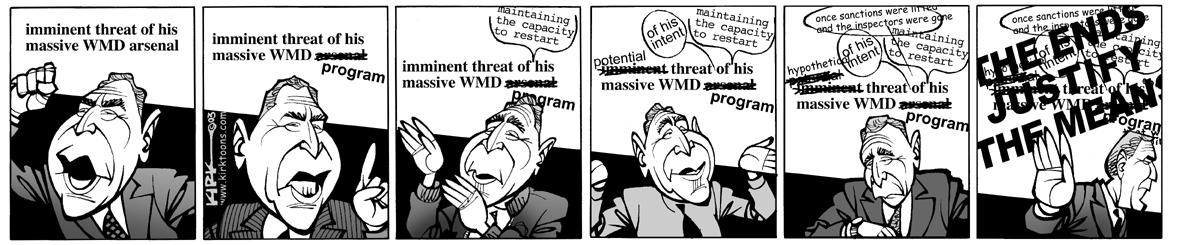
Off for the weekend
Happy Memorial Day. I'll be back some time next week, hopefully.
I've been going through my archives recently. And as much as I cringe when I see depressingly prescient stuff like this and this, there's stuff like this year-old speech from Arundhati Roy that provides a ray of hope:
The battle to reclaim democracy is going to be a difficult one. Our freedoms were not granted to us by any governments. They were wrested from them by us. And once we surrender them, the battle to retrieve them is called a revolution. It is a battle that must range across continents and countries. It must not acknowledge national boundaries but, if it is to succeed, it has to begin here. In America. The only institution more powerful than the U.S. government is American civil society. The rest of us are subjects of slave nations. We are by no means powerless, but you have the power of proximity. You have access to the Imperial Palace and the Emperor's chambers. Empire's conquests are being carried out in your name, and you have the right to refuse. You could refuse to fight. Refuse to move those missiles from the warehouse to the dock. Refuse to wave that flag. Refuse the victory parade.Words that are equally relevant now as they were then.
You have a rich tradition of resistance. You need only read Howard Zinn's A People's History of the United States to remind yourself of this.
Hundreds of thousands of you have survived the relentless propaganda you have been subjected to, and are actively fighting your own government. In the ultra-patriotic climate that prevails in the United States, that's as brave as any Iraqi or Afghan or Palestinian fighting for his or her homeland.
If you join the battle, not in your hundreds of thousands, but in your millions, you will be greeted joyously by the rest of the world. And you will see how beautiful it is to be gentle instead of brutal, safe instead of scared. Befriended instead of isolated. Loved instead of hated.
I hate to disagree with your president. Yours is by no means a great nation. But you could be a great people.
History is giving you the chance.
Seize the time.
Brian Whitaker, writing in the Guardian:
Consider these statements:Whitaker's talking about that neocon handbook by Raphael Patai, The Arab Mind, which basically provided the blueprint for the abuse at Abu Ghraib. Hardly a surprise, eh?
"Why are most Africans, unless forced by dire necessity to earn their livelihood with 'the sweat of their brow', so loath to undertake any work that dirties the hands?"
"The all-encompassing preoccupation with sex in the African mind emerges clearly in two manifestations ..."
"In the African view of human nature, no person is supposed to be able to maintain incessant, uninterrupted control over himself. Any event that is outside routine everyday occurrence can trigger such a loss of control ... Once aroused, African hostility will vent itself indiscriminately on all outsiders."
These statements, I think you'll agree, are thoroughly offensive. You would probably imagine them to be the musings of some 19th century colonialist. In fact, they come from a book promoted by its US publisher as "one of the great classics of cultural studies", and described by Publisher's Weekly as "admirable", "full of insight" and with "an impressive spread of scholarship".
The book is not actually about Africans. Instead, it takes some of the hoariest old prejudices about black people and applies them to Arabs.
Replace the word "African" in the quotations above with the word "Arab", and you have them as they appear in the book. It is, the book says, the Arabs who are lazy, sex-obsessed, and apt to turn violent over the slightest little thing.
America's inmate population grew by 2.9 percent last year, to almost 2.1 million people, with one of every 75 men living in prison or jail.
The inmate population continued its rise despite a fall in the crime rate and many states' efforts to reduce some sentences, especially for low-level drug offenders.
The report issued yesterday by the Justice Department's Bureau of Justice Statistics attributes much of the increase to get-tough policies enacted during the 1980s and '90s, such as mandatory drug sentences, "three-strikes-and-you're-out" laws for repeat offenders and "truth-in-sentencing" laws that restrict early releases.
This was the lead story in the NY Times on December 3, 2003:
In the first verdict of its kind since the Nuremberg trials, an international court today convicted three Rwandan news media executives of genocide for helping to incite a killing spree by machete-wielding gangs who slaughtered about 800,000 Tutsis in neighboring Rwanda in early 1994.While I have grave misgivings about prosecuting media executives, I've been thinking how this court decision resonates with the way the American media handled Iraq. Now I am not saying that the conflicts in Iraq and Rwanda are comparable. Rather, I am suggesting that the media played a similar role in both cases: recklessly inciting a nation to violence.
A three judge panel found that the three defendants used a radio station and a twice-monthly newspaper to inflame ethnic hatred that eventually led to massacres at churches, schools, hospitals and roadblocks. The radio station, dubbed Radio Machete in Rwanda, guided killers to specific victims, broadcasting the names, license plate numbers and hiding places of Tutsis.
..."The power of the media to create and destroy human values comes with great responsibility," the court said in a 29-page summary of its judgment. "Those who control the media are accountable for its consequences."
...Two of the defendants, Ferdinand Nahimana and Jean-Bosco Barayagwiza, were founders of RTLM radio station, which prosecutors said had a huge influence in a country where people primarily rely on the radio for news. The case against the two turned on the question of whether they intended to create a frenzy of violence, or simply failed to control the station.
The judges found that both men, as well as Ngeze, the newspaper editor, had to know that the broadcasts and articles would unleash violence given the political climate in Rwanda at the time. They cited the words of one witness who testified: "What RTLM did was almost to pour petrol, to spread petrol throughout the country little by little, so that one day it would be able to set fire to the whole country."
Stephen Marshall of GNN takes a look back at the telling example of Scott Ritter's journey through the media looking glass during the run-up to the Iraq war.
Surely it must have been an accident that the most prominent critic of Dubya's descent on Baghdad fell victim to a flurry of character assassinations and smear jobs.
(via American Leftist)
Reuters reports:
International trade alone won't pull the world's poorest countries out of poverty and economic growth, though improving, still lags what is needed, the United Nations said on Thursday.And I was under the impression that "a rising tide lifts all boats." Silly me.
Poor countries need aid, and more of it, to improve economic and social conditions in nations where over half the population lives on less than one U.S. dollar a day, said the U.N. Conference on Trade and Development (UNCTAD).
"The notion that it is enough to integrate into the world trade system and liberalise your economy, that's simply not working. More is needed," Carlos Fortin, deputy secretary general of Geneva-based UNCTAD, told a news conference.
Persistent mass poverty is not due to a lack of integration into the global economy nor to trade protectionism -- notions popular in the 1990s, when policymakers coined the phrase "trade not aid" to describe their approach to development.
Indeed, the biannual report said least-developed countries, or LDCs, were already more open to international trade than rich country members of the World Trade Organisation, or WTO, which promotes the global exchange of goods and services.
James C. Moore, Jack Shafer, and William E. Jackson Jr. respond to the NY Times' Iraq apology from yesterday. All three have been amongst the most consistent critics of the Times' reportage, and Judy Miller's work in particular.
James Ridgeway and Juan Cole observe that the abuse of female detainees at Abu Ghraib is being ignored now, but it's unlikely this scandal can be hidden forever.
R. Bruce St. John examines how Bush's approach to fighting terrorism has exacerbated the threat in an article for FPIF. He concludes:
The Bush administration has yet to recognize that the outcome of the war on terrorism will depend on the quality of the peace. By ruling out the peaceful settlement of disputes in Iraq, Palestine, and elsewhere, the White House has not eliminated terrorism. It has provoked it. And it has also legitimized terrorism in many parts of the world. A cursory survey of global terrorist activity reveals an incredibly wide array of distinct and interconnected motives. With a growing number of groups declaring the U.S. their number one enemy, the war on terror could last for generations, if we don’t take a different tactic. Until we do, the world in the coming weeks, months, and years will likely remain a very dangerous place.Make no mistake: the poorly defined and purposefully vague "war on terrorism" is a part of the problem, not the solution.
The Washington Post reports that budget cuts are going to come soon:
The White House put government agencies on notice this month that if President Bush is reelected, his budget for 2006 may include spending cuts for virtually all agencies in charge of domestic programs, including education, homeland security and others that the president backed in this campaign year.Guns and butter. You can't wage wars totalling $191 billion thus far and not cut back on domestic spending, particularly when you're already deep in the hole.
Administration officials had dismissed the significance of the proposed cuts when they surfaced in February as part of an internal White House budget office computer printout. At the time, officials said the cuts were based on a formula and did not accurately reflect administration policy. But a May 19 White House budget memorandum obtained by The Washington Post said that agencies should assume the spending levels in that printout when they prepare their fiscal 2006 budgets this summer.
The AP reports that tests have confirmed that the 155-mm artillery shell found last week in Baghdad contained sarin gas, and that it predated the 1991 Gulf war.
The story notes that the shell's "apparent age would mean it can't be regarded as evidence of recent Iraqi chemical-weapons production," although "some analysts worry the shell may be part of a larger stockpile."
The Independent reports that the US is stepping on Lakhdar Brahimi's toes by prematurely annointing Hussain Shahristani as the leading candidate to be the new prime minister of Iraq.
A peace deal has been signed to hopefully end the civil war in Sudan, according to the Telegraph.
I've never been a big fan of Al Gore, but much of what he said today in his MoveOn speech is definitely on point. Kudos to him.
Newsday reports that "the U.S. military is holding dozens of Iraqis as bargaining chips to put pressure on their wanted relatives to surrender."
In other words, they're taking hostages. And as much as I hate to keep repeating myself, this, too, is old news.
The AP reports of "blowback" in Fallujah:
With U.S. Marines gone and central government authority virtually nonexistent, Fallujah resembles an Islamic mini-state - anyone caught selling alcohol is flogged and paraded in the city. Men are encouraged to grow beards and barbers are warned against giving "Western" hair cuts.This story illustrates well the lessons of Fallujah: the more the US "gets tough" in Iraq and clamps down on "insurgents," the more it risks alienating the rest of the population. Hence, the paradox of American power.
"After all the blood that was shed, and the lives that were lost, we shall only accept God's law in Fallujah," said cleric Abdul-Qader al-Aloussi, offering a glimpse of what a future Iraq may look like as the U.S.-led occupation draws to a close. "We must capitalize on our victory over the Americans and implement Islamic sharia laws."
The departure of the Marines under an agreement that ended the three-week siege last month has enabled hard-line Islamic leaders to assert their power in this once-restive city 30 miles west of Baghdad.
Some were active in defending the city against the Marines and have profited by a perception - both here and elsewhere in Iraq - that the mujahedeen, or Islamic holy warriors, defeated a superpower.
Under the agreement, the Marines handed security in the city to a new Fallujah Brigade made up largely of local residents and commanded by officers of Saddam Hussein's former army.
With the departure of the Marines, the position of the U.S.-appointed civil administration has been weakened in favor of the clerics and the mujahedeen who resisted the U.S. occupation. That is a pattern that could be repeated elsewhere in Iraq after the occupation ends June 30, unless other legitimate leaders come forward to replace those tainted by association with the occupation.
Writing in the International Herald Tribune, Keith Reinhard and Tom Miller, two PR executives, outline some of the concerns American businesses should have about the rising tide of anti-Americanism around the world:
As anti-American sentiments gather force, the U.S. business community runs the risk of seeing decades of progress in building a vibrant, interconnected global economy wither away. And global public opinion about America, already highly unfavorable before the latest shocking revelations from Iraq, is now plummeting to new depths.As I said before when similar sentiments arose, Bush is toast if he loses the support of the American business community. Articles like the above suggest this could eventually happen.
To date, most American business leaders have failed to make the connection between the growth in anti-Americanism and the impact on their companies. Some say their sales continue to grow in foreign markets, while others maintain their brands are perceived to be local in origin, not American. Still others assert that consumers around the world don't mix politics with products; they just buy whatever is best.
There is some truth in all of these perspectives, but when taken together they tend to encourage complacency and a myopic view about what's really going on in the global marketplace. This is precisely the wrong time for the U.S. business community to stick its collective head in the sand.
Amnesty International has released its annual report for 2004. The Guardian provides a summary:
The 2004 annual report documents human rights abuses in 155 countries including execution, detention without judicial process, hostage taking and "disappearances" by state agents.I couldn't have said it better myself.
It condemns attacks by al-Qaida and others as "sometimes amounting to war crimes and crimes against humanity" but says principles of international law that could prevent such attacks were being undermined and marginalised by powerful countries such as the US.
"Governments are losing their moral compass, sacrificing the global values of human rights in a blind pursuit of security. This failure of leadership is a dangerous concession to armed groups," said Irene Khan, the secretary general of Amnesty International.
"The global security agenda promoted by the US administration is bankrupt of vision and bereft of principle. Violating human rights at home, turning a blind eye to abuses abroad and using pre-emptive military force where and when it chooses has damaged justice and freedom, and made the world a more dangerous place."
Eerily reminscient of a report by Justin Huggler and Phil Reeves following Israel's assault on Jenin two years ago, Chris McGreal tries to piece together what happened in Rafah during "Operation Rainbow" in an article for the Guardian.
Jonathan Freedland investigates Israel's construction of its "security barrier" near Jerusalem, nothing that "the wall as currently planned puts 50% of the West Bank in Israeli hands."
He adds, "Not many Israelis seem to have woken up to this yet, still less the Americans who used to keep such a close eye on any changes to Jerusalem, knowing its radioactive sensitivity throughout the Middle East. But they should. For if this wall ends up making a two-state solution impossible and a single state inevitable, it will be Israelis who suffer -- by losing the very national home this wall is meant to protect."
The NY Times has issued a mea culpa of sorts regarding a good portion of its Iraq reporting during the march to war, which Greg Mitchell of E&P characterizes as a "low-key, but scathing, self-rebuke...a primer on how not to do journalism, particularly if you are an enormously influential newspaper with a costly invasion of another nation at stake."
Judith Miller isn't named, but she's behind a good number of the stories in question, a trend Slate's Jack Shafer has been documenting for quite some time.
Also recall the piece by Michael Massing in the NYRB that laid out in devastating detail the pattern of misleading stories in the Times. Massing's essay is a perfect example of what Scott Sherman describes as the rebirth of the NYRB under Bush's reign.
The NY Times reports that a US Army survey has found that the abuse of prisoners in Iraq is much more widespread than previously acknowledged, with incidents dating back to April 2003.
One wonders if people will continue believing the "few bad apples" explanation in the face of a mountain of evidence to the contrary, since the Bush administration and its minions in the media keep pounding home that talking point.
Stephen Zunes has established a cottage industry of sorts with his on-point critiques of speeches by President Bush.
Here's Zunes' take on Bush's talk at the Army War College on Monday.
Reuters reports that the London-based International Institute for Strategic Studies (IISS) has concluded in a new study that "Al Qaeda has more than 18,000 militants ready to strike and the U.S.-led occupation of Iraq has accelerated recruitment to the ranks of Osama bin Laden's network."
This was entirely predictable; it is consistent with past patterns; and, considering new warnings, is quite ominous.
The Economist has a good article on the situation in Sudan:
Sudan, Africa's largest country, is the scene of two separate but related civil wars. One, between north and south, pits the Arab, Islamist government against rebels who are mostly black African and non-Muslim. This war has been raging intermittently for half a century, but has come tantalisingly close to resolution in the past year: partly because of foreign pressure, especially from America, and partly because both sides, exhausted, wish to stop fighting and share Sudan's new-found oil wealth.Worth reading in full.
The other war, between the government and two rebel groups in Darfur, pits Muslim against Muslim. The divide in Darfur is ethnic, between Arabs and black Africans. This war flared up only last year. It was seen at first as a mere sideshow, but is now too vast and vile to be ignored.
Bush's Iraq speech last night was rather pathetic, since aides had built it up as a profound statement that would clearly outline the steps that will be taken in the weeks and months to come.
Instead, Bush offered nothing new, and recycled the exact same platitudes he's been spewing for months. That he delivered his tired rhetoric about "terrorist enemies" and "Saddam loyalists" at the Army War College, whose faculty have been quite critical of the entire Iraq mess, is also rather ironic.
The country would have been better served if Bush visited Carlisle, PA to hear a lecture, rather than to give one.
If you didn't get a chance to see General Anthony Zinni's appearance on CBS' 60 Minutes, you can read the transcript here.
Zinni blasted the Bush adminstration's handling of the Iraq war from the outset, and had especially harsh words for the civilian leadership of the Pentagon.
Well, this was certainly predictable:
An urgent investigation has been launched in Washington into whether Iran played a role in manipulating the US into the Iraq war by passing on bogus intelligence through Ahmad Chalabi's Iraqi National Congress, it emerged yesterday.While it is important to get to the bottom of just what role Iran played in shaping the intelligence Chalabi passed off to the US, just as it's equally important to figure out what role Israel played (something very few in the US seem interested in), I worry that this investigation will distort the narrative of the Iraq war more than clarify it.
Some intelligence officials now believe that Iran used the hawks in the Pentagon and the White House to get rid of a hostile neighbour, and pave the way for a Shia-ruled Iraq.
"It sure is curious how documents entering the Bush Machine exit with blank pages," writes Kurt Nimmo. "It happened with Iraq's 11,800-page dossier on weapons and now it has happened again with the report on prison abuse produced by Major General Antonio M. Taguba."
The Christian Science Monitor is reporting that the US is negotiating with Muqtada al-Sadr in order to integrate his movement into Iraq's burgeoning political order.
Looks like the US is taking a cue from the way the Taliban is being handled in Afghanistan.
The Independent reports of a leaked memo from the British government regarding American military conduct in Iraq:
Details of the internal Foreign Office memo emerged as Labour leaders were warned by campaign teams across the country that middle-class members in marginal seats were deserting the party in droves over the occupation of Iraq.Nothing controversial here. The damage to American credibility wrought by Abu Ghraib is well-known, at least outside the pro-war circles where the torture has been consistently minimized and distorted.
The memorandum, said to have been written last week and leaked to The Sunday Times, warned that "heavy-handed US military tactics in Fallujah and Najaf some weeks ago have fuelled both Sunni and [Shia] opposition to the coalition and lost us much public support outside Iraq."
It added: "The scandal of the treatment of detainees at Abu Ghraib has sapped the moral authority of the coalition inside Iraq and internationally."
The Independent reports on the forgotten war in Afghanistan, and how the "hollow promises" Bush and Blair made to that war-ravaged nation affect the situation in Iraq.
Robert Higgs probes whether the US government has committed war crimes in Afghanistan and Iraq.
What's his conclusion? Take a guess.
So the Washington Post reports that a bunch of lil' scamps from the Heritage Foundation have been managing a $13 billion budget for the CPA in Iraq.
This is just another tale of the cronyism, ineptness, and ideological blindness that has characterized the occupation from the get go. The people running this show really need to be shown the door. News like this is beyond absurd.
The Pew Center has concluded a survey of journalists at more than 500 media outlets in the US. Here's a summary of its findings.
Additionally, many have pointed to this E & P story which notes that the study found newsrooms dominated by liberals and moderates, something conservatives say proves the existence of a liberal bias in the media.
Other findings in the survey contradict this charge, however. As FAIR notes,
It's interesting to look at the stats from the study that aren't getting much play. For example, among national news executives -- the people whose job descriptions involve setting policy at media outlets -- only 16 percent describe themselves as ''liberal.'' Sixty percent call themselves ''moderate,'' and 19 percent ''conservative.'' With 79 percent of media bosses identifying with something other than ''liberal,'' what happens to the myth of the ''liberal media''?Notwithstanding issues of political affiliation or bias, perhaps the most significant finding by Pew is that a growing number of journalists feel commercial pressures are having a negative impact on their craft.
It's also curious why this 79 percent (or 84 percent) of the bosses who are not ''liberal'' end up hiring a workforce that is 41 percent ''liberal'' (or ''very liberal''). Could it be that they are confident that the institutions of media outlets will prevent these ''liberals'' from expressing viewpoints that their non-liberal bosses object to? Or could it be that there are so few qualified ''conservative'' journalists that the ''moderate''-to-''conservative'' bosses just can't find more than 7 percent to hire?
Finally, it's worth asking what journalists mean by ''liberal.'' When people were asked to name a ''liberal'' outlet, the most common response was the New York Times. Think of the Times' most prominent ''scoops'' in recent years: Whitewater, Wen Ho Lee, Judith Miller's reports on WMD. If this is what constitutes ''liberal'' reporting, than the fact that 41 percent of national reporters describe themselves as ''liberal'' is bad news indeed.
Robert Jensen urges Democrats to take a look in the mirror when they bash Bush on Iraq.
The real problem, he contends, is not that Emperor Bush Has No Clothes, but rather that "the U.S. EMPIRE has no clothes, and in that respect mainstream Democrats stand before the world as naked as the most reactionary Republicans."
The US military still tows the line that the 40+ people killed near the Syrian border in western Iraq last Wednesday were "foreign fighters," even though new video obtained by the AP seems to show additional evidence of a wedding party where the US assault took place.
You can watch parts of the video in a BBC News report, here.
An AP survey of morgues in and around Baghdad has found that "more than 5,500 Iraqis died violently in just Baghdad and three provinces in the first 12 months of the occupation," a considerably higher rate than that which existed in the same region prior to the war.
Reminding us of the reports of sexual abuse against American soldiers, Linda Burham links the torture and humiliation at Abu Ghraib with a narrative of sexual domination and hyper-masculinity that permeates American military culture in an essay for Counterpunch.
Business Week has a cover story this week worth reading on the working poor in the United States.
According to the Washington Post, President Bush is set to embark on an "ambitious campaign" to refocus world attention on the future of Iraq, and away from the overwhelming tenor of bad news coming out of that country since the end of March. The initiative, notes Post reporter Robin Wright, will begin with "a tightly orchestrated public relations effort in a speech at the Army War College" tomorrow evening.
One of Bush's major points of emphasis will be the announcement of a new UN draft resolution that will allegedly give "full sovereignty" to the IGC on June 30.
The Independent reports:
The abuse scandal at Abu Ghraib prison continued yesterday with the publication of fresh pictures and sworn statements that detailed a teenage boy being raped, prisoners being ridden like animals and other Iraqis being forced to eat pork and drink alcohol in contravention of their religion. For the first time video footage of some of the abuse was also broadcast, a development likely to increase the political impact of the scandal.This story essentially condenses the important points in this Washington Post article from yesterday.
The new details caused fresh outrage around the Arab world and further rocked the Bush administration already floundering after a week in which US forces killed dozens of guests at a wedding party in Iraq after mistaking them for insurgents. The latest pictures and allegations chronicling more calculated attempts to humiliate Muslim prisoners have only added to the suspicion that they were part of a policy formulated at a high level of authority.
From Knut Royce of Newsday:
The Defense Intelligence Agency has concluded that a U.S.-funded arm of Ahmed Chalabi's Iraqi National Congress has been used for years by Iranian intelligence to pass disinformation to the United States and to collect highly sensitive American secrets, according to intelligence sources.I don't know what to make of this. It's one thing to say Chalabi was getting cozier with Iran, which people like Juan Cole have been noting for some time. It's quite another thing to say he was working with and/or manipulated by Iran for "years."
"Iranian intelligence has been manipulating the United States through Chalabi by furnishing through his Information Collection Program information to provoke the United States into getting rid of Saddam Hussein," said an intelligence source Friday who was briefed on the Defense Intelligence Agency's conclusions, which were based on a review of thousands of internal documents.
"For observers familiar with the rhetoric that dominated Balkan and Rwandan airwaves during the hate and war crimes in those two regions, American radio's strident, accusatory language sounds a troubling echo," contends Phillip Smucker.
* "Some 56 years have passed," notes Meron Benvenisti in Ha'aretz, and Palestinians "are again fleeing in fear of the Israeli attackers." Such is life in Gaza amidst the anniversary of the nakbah.
* The IDF's shelling of a protest march in Rafah on Wednesday received widespread coverage, but such news only highlights the most obvious horror that has been perpetuated in the last two weeks during "Operation Rainbow." Donald Macintyre and Amira Hass fill in some of the blanks with separate reports from Rafah, and Chris McGreal examines the IDF's habit of sniping children.
* Why is Israel in Gaza right now, anyway? Neve Gordon says Sharon "is destroying Gaza in order to withdraw from it," all in keeping with his master plan of expanding the bounds of a "Greater Israel." In the Guardian, Jonathan Steele declares that "Israel's latest actions in Gaza are motivated by revenge, cynicism and desperation. As such, they have destroyed the political and moral capital that Sharon briefly acquired when he announced his unilateral plan to close the Israeli settlements in Gaza."
* Many have charged that the Bush administration's foreign policy, especially towards Israel, is being driven by Christian fundamentalists. I've long thought that was overstating the case, particularly since US policy towards Israel has changed little since 1967. But Rick Perlstein of the Village Voice has uncovered a memo that suggests I need to rethink this position.
* Eric Boehlert observes that the "more we find out about what happened at Abu Ghraib, the less it looks like a case of renegade soldiers" and UPI's Martin Sieff reports that the "scandal continues to metastasize by the day."
* Here are some of the recent revelations on the Iraq torture scandal: one witness says there is "definitely a cover-up" going on; the NY Times reports that "Army officials in Iraq responded late last year to a Red Cross report of abuses at Abu Ghraib prison by trying to curtail the international agency's spot inspections of the prison"; the Washington Post reports that military intelligence officers were a distinct part of the interrogation process, as new details, photos, and videos emerge; four Iraqi journalists claim to have suffered "sexual and religious taunts and humiliation during their detention last January in a military camp near Falluja," according to Reuters; NBC News reports that the Army's Delta Force is under investigation; and the Denver Post probes 5 brutal deaths which occurred in US custody.
* "If you were doing PR for Al Qaeda," avers Barbara Ehrenreich, "you couldn't have staged a better picture to galvanize misogynist Islamic fundamentalists around the world" than the image of female soldiers abusing Iraqi men at Abu Ghraib.
* A poll of Iraqis conducted by the Iraq Centre for Research and Strategic Studies has found that Muqtada Al-Sadr is more popular than the Americans, and that nearly 90% of Iraqis view US forces as occupiers, not liberators.
* The Guardian reports on the "Wedding party massacre" in Iraq which killed 40. The Pentagon denies that it attacked a wedding party, claiming instead the strike was against "foreign fighters." Justin Huggler and Rory McCarthy investigate further.
* Earlier, from Afghanistan: what's up with the attacks on weddings?
* Jim Lobe reports on Ahmed Chalabi's winding road from White House to Dog House in only five months. What brought about Chalabi's astonishing fall from grace? And is he now an Iranian spy?
* Will Doug Feith soon be off to jail or out of a job? Considering nobody ever seems to be held accountable in this administration, probably neither.
* Ted Rall: "The pro-war pundits got the biggest story of their careers dead wrong. Now a lot of people are wrongly dead. The fact that this sorry lot still draw paychecks is a tribute to America's infinite capacity for forgiveness."
* The Guardian's Jonathan Steele writes that "as the miseries of Iraqis under occupation multiply, the burden of proof is increasingly on those who claim that pulling foreign troops out of Iraq would be worse than keeping them there. Playing on the bogeymen of 'chaos' and 'a security vacuum' can no longer go unchallenged." Meanwhile, the Pentagon pushes deeper into the abyss.
* Senator Ernest Hollings of South Carolina says the war on Iraq was waged for Israel's benefit. Justin Raimondo, who has been saying this for nearly two years, responds.
* As Nick Berg's death remains clouded in mystery, his father has lent his support to the UK's Stop the War Coalition. Here's the statement by Michael Berg that will be read aloud during a protest in London tomorrow.
* Scott Ritter - remember him? - chimes in on the sarin-filled artillery shell that was found in Iraq earlier this week. "If the 155-mm shell was a 'dud' fired long ago - which is highly likely - then it would not be evidence of the secret stockpile of weapons of mass destruction (WMD) that the Bush administration used as justification to invade Iraq," he writes. However, the US doesn't seem to be forthcoming with information about the shell, so it's impossible to render any solid verdict on it.
* Two scholars at the Army War College have published a study which likens the political implications of the war in Iraq to the Vietnam debacle.
* "Tossing aside international law and the norms of civilised behaviour...is self-defeating," writes John Gray in an excellent piece for the Independent. "Not so long ago, the clash of civilisations was just a crass and erroneous theory, but after the recent revelations [from Iraq] it is becoming a self-fulfilling prophecy. In toppling Saddam, the Americans destroyed an essentially Western regime, not unlike the Stalinist Soviet Union in its militant secularism. In doing so, they empowered radical Islam as the single most important political force in the country."
* In what the NY Times characterizes as an "unusual step of retroactively classifying information it gave to Congress nearly two years ago," the Justice Department has put the lid on Sibel Edmonds' 9/11 testimony.
* Ed Herman takes a deserved swipe at Michael Tomasky and other liberals in search of a foreign policy.
* In another excerpt from their book Banana Republicans, John Stauber and Sheldon Rampton probe "the highly effective political organizing strategy of the conservative coalition that brought the Bush administration to power."
* The Scotsman has a useful backgrounder on Sudan's forgotten genocide.
* Bill McKibben tackles some of the recent literature on climate change and resource depletion in a review for the NYRB.

As Israel continues raids in Gaza, Amnesty International has released a timely report condemning the IDF's pattern of house demolition in the occupied territories.
The AI report notes that more than 3,000 Palestinian homes have been razed since the beginning of the Al Aqsa intifada, typically for "punitive" reasons.
What are some of the mistakes the US has made in its march to war in Iraq? Let retired General Anthony Zinni explain.
Daniel Williams asks the obvious question in the Washington Post: "If Iraq's titular president, Izzedin Salim, can be blown up at the gates of occupation headquarters, what kind of country is being handed over to Iraqis?"
The US military claims to have found a sarin-filled artillery shell in Iraq. Hallelujah. The war is now justified.
In what seems to be a politically calculated move, the Bush administration has announced that it will be "expediting the approval process for generic and combination antiretroviral [AIDS] drugs so they can be purchased at lower prices and provided more efficiently and safely to millions of infected people in Africa and the Caribbean," according to the NY Times.
Whatever the administration's motivations, this is a step in the right direction.
Update: Here's a different, rather negative take on the Bush administration's announcement.
Since he's been in the news a lot recently, check out this interesting profile of Seymour Hersh from the Columbia Journalism Review. Also see this recent op-ed piece by Jeet Heer which compares Hersh with Bob Woodward, perhaps the two most prominent journalists working in the US right now.
(via Maxspeak)
Here's a story from the Independent that you rarely see:
One year and 16 days after President George Bush declared the end to major hostilities in Iraq, the toll of American and British casualties continues to rise. Since the start of the invasion, 566 members of the American military and 211 US civilians have died. The British figures are 59 and 8.I've said it many times before: the cries of "liberation" sound awfully hollow when invaders pay no attention to the destructive consequences of their own actions.
But at the same time thousands of others men, women, the elderly and the very young have been killed or maimed with far less fanfare. No one knows how many. They are Iraqi civilians, and the Americans and the British do not bother to keep count of the people they have "liberated" and then killed.
This is not usual in modern warfare. In most past conflicts, attempts were made to keep a tally of civilian losses. Legal experts say that, particularly in the case of Iraq, it is the duty of occupying powers to do so under the Geneva Conventions.
The Pentagon says it is not helpful to keep a "body count". Yet, there is no hesitation in giving numbers of Iraqi fighters, described as "Saddam loyalists" and "al-Qa'ida elements" who have supposedly been eliminated by the Allies.
Unofficial estimates of civilian casualties are available. The pressure group Iraq Body Count presents a daily update. It puts the maximum number of killed Iraqi civilians at 11,005, and the minimum at 9,148. But this does not include about 800 reportedly killed recently in Fallujah and 235 in Baghdad, or about 20 reported to have died in the British-controlled Basra region.
The Boston Globe has thorough coverage of the same-sex marriage issue in Massachussetts.
More than 150,000 people protested in Tel Aviv on Friday, mostly from the Labor aligned peace camp, urging Israel to pull out of Gaza.
This came amidst a plethora of "war crimes" committed by Israel over the past week and a half during incursions into Gaza aimed at expanding the Philadelphi route.
Numerous missile strikes and the demolition of dozens of homes have left an incredible amount of destruction in the IDF's wake.
From Reuters:
President Bush on Friday blamed al Qaeda supporter Abu Musab al-Zarqawi for beheading American Nicholas Berg and cited him as an example of Saddam Hussein's "terrorist ties" before the U.S.-led war in Iraq.Someone needs to call the Bushies on rhetoric like this. It's irresponsible and outright misleading to drop the reference to "terrorist ties" without putting into context Zarqawi's links to Ansar al-Islam and his alleged trips to Baghdad for medical treatment. Both hardly connotate a link to Hussein's regime, although the administration has been trying to make the connection for quite some time, only to be rebuffed by virtually everyone in the intelligence field.
Bush's revival of accusations linking Saddam to terrorism comes as the president faces growing doubts among Americans over his Iraq policy.
At a fund-raising lunch in Bridgeton, Missouri, Bush said Zarqawi was an example of the threat posed by the ousted Iraqi leader. "We knew he (Saddam) had terrorist ties. The person responsible for the Berg death, Zarqawi, was in and out of Baghdad prior to our arrival, for example," Bush said.
A Newsweek investigation has essentially unearthed the same story surrounding the Abu Ghraib prison scandal as Seymour Hersh in this week's New Yorker. Reporters John Barry, Michael Hirsh and Michael Isikoff have also found that the abuse and torture in Iraq is a direct descendent of provisions granted by the highest members of the Bush administration in order to "sidestep the historical safeguards of the Geneva Conventions" during the conduction of its "war on terror."
Additionally, both articles raise the point that there was considerable worry from lawyers within the military's JAG corps -- characterized as "almost a revolt" by one Newsweek source -- over the civilian leadership of the Pentagon's disregard for the Geneva Conventions. In fact, the concern was go grave that the lawyers tried to get the NY Bar Association to challenge the Pentagon in court on its handling of detainees.
This is mentioned only in passing in the Newsweek and New Yorker articles, but another investigative report from ABC News fleshes out this aspect of the story in more detail.
As Washington prepares to hand over power to the Iraqi Governing Council on June 30, Yochi J. Dreazen and Christopher Cooper of the Wall Street Journal report that "U.S. administrator L. Paul Bremer and other officials are quietly building institutions that will give the U.S. powerful levers for influencing nearly every important decision the interim government will make."
Tomorrow is the 50th anniversary of the Supreme Court's historic Brown v. The Board of Education decision.
While it was landmark event in the history of the American civil rights movement, any "honest and accurate assessment" of "the lessons and legacy of Brown provide little basis for American self-congratulation," says Paul Street.
The dream of a "New American Century" is dying, says William Pfaff. Events in Iraq are precipitating "a crisis of thought and assumption in the mainstream intellectual community over foreign policy" with unforseeable consequences at this point.
Michael Ventura thinks Americans are about to learn a painful lesson -- that "history is not a spectator sport" -- once the reality of a military draft becomes clear.
(via nmazca.blog)
Seymour Hersh strikes again on Abu Ghraib:
The roots of the Abu Ghraib prison scandal lie not in the criminal inclinations of a few Army reservists but in a decision, approved last year by Secretary of Defense Donald Rumsfeld, to expand a highly secret operation, which had been focussed on the hunt for Al Qaeda, to the interrogation of prisoners in Iraq. Rumsfeld’s decision embittered the American intelligence community, damaged the effectiveness of élite combat units, and hurt America’s prospects in the war on terror.Read the whole thing and then join me in saying goodbye to Rummy.
According to interviews with several past and present American intelligence officials, the Pentagon’s operation, known inside the intelligence community by several code words, including Copper Green, encouraged physical coercion and sexual humiliation of Iraqi prisoners in an effort to generate more intelligence about the growing insurgency in Iraq. A senior C.I.A. official, in confirming the details of this account last week, said that the operation stemmed from Rumsfeld’s long-standing desire to wrest control of America’s clandestine and paramilitary operations from the C.I.A.
US oil prices have hit an all-time high.
On a related note, check out this interview with Richard Heinberg, author of The Party’s Over: Oil, War, and the Fate of Industrial Societies, and this op-ed piece by Paul Krugman.
The World Bank has lost about 100 billion dollars slated for development in the world's poorest nations to corruption since 1946, nearly 20 percent of its total lending portfolio, according to a U.S. Senate committee.I wonder if this will get the same amount of attention as "UNSCAM" from those vigilant overseers of corruption.
”It is critical that every development bank dollar reaches its intended recipient,” said Sen Dick Lugar, chairman of the Senate Foreign Relations Committee, on Thursday. ”Unfortunately, that is not happening à corruption remains a serious problem.”
Lugar cited one of the panellists as the source for the massive figure. Jeffrey Winters of Northwestern University, who testified before the hearing, estimated the World Bank ”has participated mostly passively in the corruption of roughly 100 billion dollars of its loan funds intended for development.”
Other experts estimate that between five and 25 percent of the 525 billion dollars the Bank has lent since 1946 has been misused. This amounts to 26-130 billion dollars.
”Even if corruption is at the low end of estimates, millions of people living in poverty may have lost opportunities to improve their health, education and economic condition,” Lugar said.
A World Bank spokesman vehemently disputed the estimate. ”We completely reject the figure offered by one of the panellists,” said Damian Milverton. ”It has no basis in fact.”
Corruption has become a global issue as developing countries, watchdog groups and some economists complain that poor nations lose huge funds from multilateral development banks (MDBs) like the World Bank because of misuse of money. Yet taxpayers in those borrowing countries have to still to repay the banks.
From today's Washington Post:
Secretary of State Colin L. Powell, joined by the foreign ministers of nations making key contributions of military forces in Iraq, emphatically said yesterday that if the incoming Iraqi interim government ordered the departure of foreign troops after July 1, they would pack up without protest.Good to hear. And I presume that will include "packing up" those 14 "enduring" bases, too.
The Imam Ali Shrine in Najaf was damaged by fighting between US forces and militias loyal to Muqtada Al Sadr yesterday in what the Independent describes, correctly, as "a potentially explosive move."
In an interesting scientific development, the NY Times reports that the world is literally getting darker:
Defying expectation and easy explanation, hundreds of instruments around the world recorded a drop in sunshine reaching the surface of Earth, as much as 10 percent from the late 1950's to the early 90's, or 2 percent to 3 percent a decade. In some regions like Asia, the United States and Europe, the drop was even steeper. In Hong Kong, sunlight decreased 37 percent.I'm in no position to comment on this in detail, but I think we need to realize that the changes to the environment wrought by industrial processes deserve a lot more attention -- especially at the policy making level -- than they currently receive.
No one is predicting that it may soon be night all day, and some scientists theorize that the skies have brightened in the last decade as the suspected cause of global dimming, air pollution, clears up in many parts of the world.
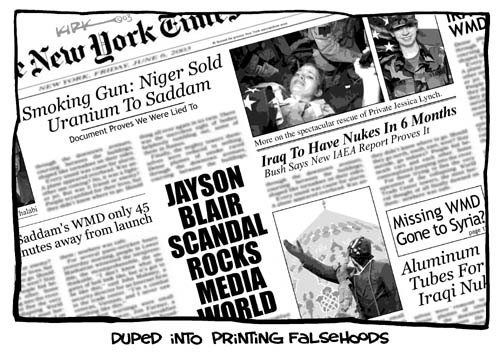
After a decade of containment...
...a new policy emerged
...so the inspection process restarted
...intelligence was carefully considered
...new connections were drawn
...a case for action was presented
...which the pundits debated
...while other threats were ignored
...of course the press held everyone accountable
...and the rest of the world weighed in
...still the Democrats stood strong
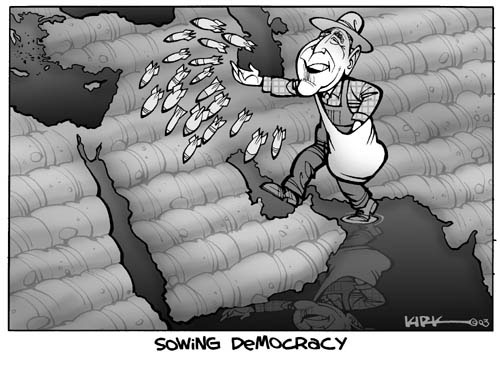
...'cause the seeds of democracy would be sown
...but time ran out; war was on
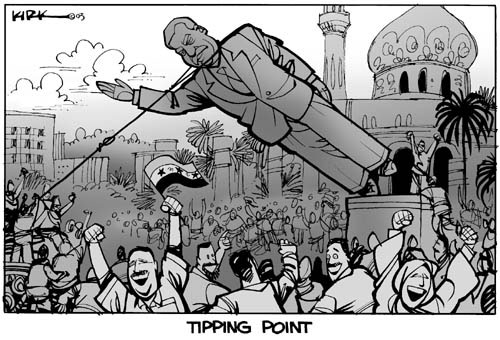
...soon the statue fell
...the looting began
...the search for WMD proceeded, unfettered
...then ack! no WMD were found
...so the rationale shifted
...and after some difficulties, the UN was revived
...but, alas, torture reared its ugly head
...and today, the future looks clear.
(thanks, as always, to Kirk Anderson)
James Conachy says what needs to be said about Nick Berg's murder. Until a credible, consistent account emerges, we should all be skeptical about what's going on with Berg's story.
The outrage over the Iraq torture scandal, claims Derrick Z. Jackson in the Boston Globe, "shows how America keeps forgetting its mistakes at home. Rumsfeld says the abuse was un-American. African-American men remain the proof that abuse is an American pastime."
The Pentagon is probably going to request an additional $50-80 billion to pay for the Iraq war next year.
CBS News reports:
Initially, [Nick] Berg's murder seemed to be a case of an eccentric young American who was in the wrong place at the worst possible time -- just as the revelations of American mistreatment of Iraqi prisoners were coming to light.Yeah, I'd say that's pretty damn weird.
But CBS News National Security Correspondent David Martin reports on what is turning into a bizarre mystery with a connection to 9/11.
U.S. officials say the FBI questioned Berg in 2002 after a computer password Berg used in college turned up in the possession of Zaccarias Moussaoui, the al Qaeda operative arrested shortly before 9/11 for his suspicious activity at a flight school in Minnesota.
The bureau had already dismissed the connection between Berg and Moussaoui as nothing more than a college student who had been careless about protecting his password.
But in the wake of Berg's gruesome murder, it becomes a stranger than fiction coincidence -- an American who inadvertently gave away his computer password to one notorious al Qaeda operative is later murdered by another notorious al Qaeda operative.
NBC News has unearthed a photo which seems to show military intelligence officers involved in the abuse at Abu Ghraib. The notion that CIA and military intel played a prominent role in the torture has been consistently reported since the scandal broke, but this is the first solid piece of evidence to appear.
Jim Lobe also reports that additional evidence has emerged suggesting the abuse is much more widespread than previously acknowledged.
The Boston Globe has an interesting profile of the former anchor of ABC News' World News Tonight Sunday, Carole Simpson, who is now a "news ambassador" for the network. Her new responsibilities mostly include visits to schools where she talks to students about the importance of understanding what's going on in their world.
Here's a pretty telling excerpt from the story:
Simpson, who started her career in 1962 as a journalism instructor and publicist at Tuskegee Institute in Alabama, concedes she's also not entirely happy with the state of network news. "It isn't the ABC News it was when I started," she said. "We've moved away from stories about poor people, people who are powerless," she said. "The focus groups have indicated that the public wants medical and business news."It's not just the kids, either.
Because many networks are owned by ever-larger corporations -- ABC is part of Disney Corp. -- there is an ever-larger concern about expenses, she said. "When I first got into TV, all you had to be was good. Now, it's a question of `Is it going to take a day to shoot this story or a day and a half?' We have to watch the bottom line."
Since February, Simpson has visited 19 high schools in 11 cities, speaking with 2,000 students. Her assessment of the generation she's meeting?
"This is the most frightened I've been in my 40 years in journalism," she says. "I'm finding that current events and geography are not being offered to kids. How can we have a society that sustains itself if young people aren't informed?"
At West Roxbury High, Simpson is passionate in her message.
"How many of you know who Beyonce is dating?" she asks.
"Jay-Z!" they say in unison.
"What is Michael Jackson charged with?" she persists.
"Child molestation!" they all say.
"What is the controversy over the Medicare prescription bill?"
Silence.
"Beyonce is not going to get you a job," Simpson chides. "Jay-Z is not going to stop you from being drafted. Everybody in the world knows everything about us. You don't know anything about other countries. What if Canada decided to invade? You all aren't paying attention."
Juan Cole, on one of the "accomplishments" of the war in Iraq:
The US envisaged its presence in Iraq as a grand nation-building exercise. How ironic that so many Iraqis are coming together with the goal of expelling the US. In the 19th century the Ottoman sultan, Abdulhamid II, and the reformer, Sayyid Jamal al-Din al-Afghani, launched the pan-Islamic project - the unity of Sunnis and Shia against European imperialism - but it always failed. The US hyperpower seems finally to be nudging the movement from a dream into political reality.Someone tell the neocons. They surely won't be pleased to hear this.
A poll commissioned by the CPA has found that over 80% of Iraqis disapprove of the US occupation. In the United States, two recent polls have found that domestic support for the war is sharply eroding, as well.
Justin Podur, writing for ZNet on May 10:
A beleaguered democracy beset by continual terrorist attacks by ruthless, depraved, and highly imaginative terrorists managed to foil a terrorist plot yesterday. By taking swift, decisive police action, a terrorist training camp full of foreign fighters and outside agitators were apprehended. Despite the depraved nature of the terrorist threat against democracy, the democratic country continues to hold itself up to higher standards of human rights and democratic process.The country Podur speaks of is Venezuela, where Hugo Chavez claims his government is under assault from Colombian paramilitaries abetted by the United States.
Horror of horrors, the NY Times reports that the CIA has admitted to using torture against "a select group of high-level leaders and operatives of Al Qaeda," including Khalid Shaikh Mohammed.
Talk about old news. In Mohammed's case, the only remaining question is whether his kids were tortured, too.
Writing in the Boston Globe, Douglas Starr recounts his recent visit to Cuba and reflects on the idiotic foreign policy stance the US takes toward's Castro's country.
"While administration officials express shock and outrage over allegations of the torture and murder of Iraqi prisoners by US forces," writes Heather Wokusch, "a deeper look into Bush's stateside prison-system record shows disturbing similarities."
Sam Smith notes the "signs along the road to Abu Ghraib" over the course of the last two decades, a period when "brutal capitalism and post-modernism firebombed principles of cooperation, decency, individual ethical responsibility, community, and social democracy. In their place came simple brute power manifesting itself in whatever guise seemed most useful at the time. With hubris rather than horror, America celebrated the collapse of its own consensus of conscience."
Bill Berkowitz writes of the "torture fatigue" that is being promoted by certain figures on the Right. In a related column, Norman Solomon criticizes those who see the Abu Ghraib scandal as predominantly "a colossal PR problem" that should be wished away, not a national scandal that demands introspection.
Gustavo Capdevila reports on the release of the WHO's "World Health Report 2004 - Changing History," which aims to assuage the devastating effects of AIDS worldwide.
I'm trying to figure out which is a worse development: the fact that Lt. Gen. William "My God is Bigger Than Yours" Boykin is linked to the Aub Ghraib torture, or that a detainee was allegedly raped and impregnated by a US soldier.
In what world is this a smart move?
The American military attacked a mosque in this holy city [Karbala] on Tuesday in its largest assault yet against the forces of the young rebel Shiite cleric Moktada al-Sadr, even as the first signs emerged of a peaceful resolution to the five-week-long standoff with him.I know the US military wants to send a message of "strength" following the debacle of last month, particularly towards Al Sadr, but is this the right way to go about doing that?
The strike on the Mukhaiyam Mosque brought hundreds of American soldiers and their armored vehicles to within a third of a mile of two of the holiest sites in Shiite Islam, the shrines of the martyrs Hussein and Abbas. A building behind the mosque was fired on, detonating a huge weapons cache, and soldiers stormed the mosque, chasing insurgents out into a hotel and alley. The number of casualties could not be immediately determined.
The NY Times reports on the murder of Nick Berg and the odd story of the last few weeks of his life.
Besides a mention of his parents' anger towards the US government, I have little to say about this. The brutality of life on this planet is sometimes impossible to fathom.
I forced myself to watch the video of Daniel Pearl's execution, for God knows what reason, but I don't know if I have the stomach to watch this.
* The Red Cross's report of the abuses at Abu Ghraib, which suggests that up to 90% of the detainees were arrested "by mistake," has been leaked to the public. You can download it, along with other important documents related to the scandal, via antiwar.com.
* Seymour Hersh has another article in the New Yorker on how the DoD mishandled the disaster at Abu Ghraib, which includes new photos of abuse. Doug Valentine also reprises Hersh's role in getting the US to "unleash its dogs of war."
* The Washington Post ran a three-part series on "The Road to Abu Ghraib" over the weekend worth reading: Part 1, Part 2, Part 3.
* The Independent and Salon detail how two detainees -- a 16 year old boy and an Al Jazeera cameraman -- were subjected to "mock executions."
* As always, Tom Engelhardt has a nice summary of where the Iraq torture scandal sits right now.
* The Military Times wants Rummy to resign.
* The Scotsman reminds us that, usually, the US doesn't torture detainees. Outsourcing the dirty work is far more common.
* Wayne Madsen wonders if Israel has been helping out with "interrogations" in Iraq. The military and intelligence apparatus of Israel has plenty of experience with torture, after all.
* Amidst the torture scandal, Max Sawicky says we should support the troops, not the Pentagon brass. David Rieff, however, thinks we should start taking a critical look at everyone, lest the atrocities that have been committed elsewhere in Iraq flow down the memory hole, aided by an uncritical media.
* Jim Lobe opines that the revelations of torture in Iraq strike a deep wound in the American psyche because they call into question the national metanarrative of exceptionalism, righteousness, and benevolence.
* Danny Schechter asks, "where is the investigation of mainstream media's failure to report on the torture of Iraqis when it became known months before?"
* Mina Hamilton observes that while the abuse at Abu Ghraib is getting a lot of press, the atrocities in Fallujah are "barely noticed by the Western world."
* "Now that U.S. abuses and atrocities against Iraqi prisoners -- up to and including murder -- have captured world headlines," notes Adam Jones, "there is no excuse for not investigating alleged crimes that, although they are receding into history, may have been incomparably worse." Jones is speaking, primarily, of the Afghan massacre at Dasht-e Leili.
* The Washington Post reports of "deep divisions...emerging at the top of the U.S. military over the course of the occupation of Iraq."
* James Sterngold of the SF Chronicle reports that the Iraq war bill continues to swell. Meanwhile, the Washington Post reports that the increased military spending is raising difficult questions and pumping up parts of the economy.
* British troops are coming under scrutiny for the killing of 37 civilians. We might ask, what about the other ~10,000?
* Robert Higgs observes, "Saddam Hussein now languishes in U.S. custody; his government has been overthrown; no weapons of mass destruction existed in Iraq, and therefore 'disarming' the Iraqis of such weapons proved unnecessary. In short, the declared U.S. mission has long since been accomplished fully. Why then does the U.S. government persist in slaughtering the Iraqi people?" In a similarly-themed article, Ray McGovern says, declare victory and get out already.
* Norm Dixon reviews how the Bushies exploited 9/11 to push through their Iraq agenda.
* Conceding that the "war on terror" is being lost, Michael Meacher writes in the Guardian that the "al-Qaida threat will never be resolved until the US adopts a more balanced Middle East policy and is prepared to put the necessary pressure on Israel to secure a viable Palestinian state. And rather than pursue a self-defeating policy of enforced regime change against suspect countries, it would be much better to identify countries where conditions are likely to encourage the proliferation of terrorism, and to try to pre-empt this by well-structured international economic aid programmes."
* Ken Dilanian of Knight Ridder reports that a "series of recent developments in the war on terrorism, barely noticed in the United States, suggests that global Islamic extremism is spreading."
* Fareed Zakaria: "Whether he wins or loses in November, George W. Bush's legacy is now clear: the creation of a poisonous atmosphere of anti-Americanism around the globe."
* The events in Iraq are overshadowing what's going on in the Sudan. Some backgrounders on the Darfur conflict are available here.
* More than 1,100 Gazans have been left homeless due to IDF incursions and house demolitions over the past 10 days, according to the UN Relief and Works Agency for Palestine Refugees (UNRWA).
* Gabriel Ash explains why he won't vote for John Kerry, restating the argument put forth by Gabriel Kolko months ago.
* The investigation into the death of Emmett Till, the black teenager who was murdered in 1955 during the early stages of the civil rights movement in Mississippi, has been reopened by the Justice Department. Professor Kim has more on this.