Golden years
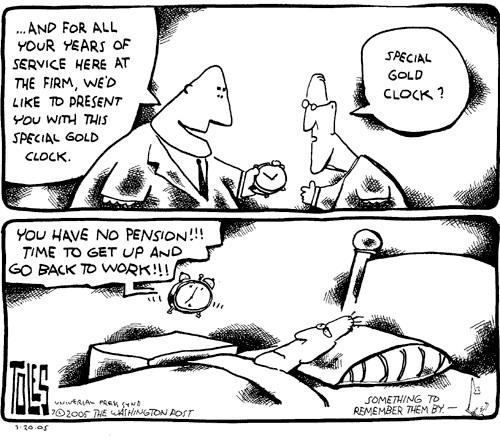
This essay by Stephen Zunes is a very good primer on what's driving US-Iranian tensions.
Some residents of the northern Gaza settlement of Elei Sinai said Thursday they planned to wear Nazi concentration camp prisoner uniforms when security forces evacuate them from their homes during the disengagement.I don't know if the word "ironic" is appropriate here. But it sure is odd how Jewish settlers are using the Holocaust to justify relations where the comfort and security of some 8,000 people is predicated on the misery of another 1.5 million. And, to make things worse, when tiny inroads are made to address this injustice, the settlers have the audacity to claim that they're the primary victims here. It's a blatantly Orwellian situation.
The striped uniforms, which were to include yellow Stars of David with the word "Jude" sewn on to the lapels, have already arrived.
Those British excuses for gunning down Jean Charles de Menezes are unraveling pretty darn quickly.
I'm a bit lethargic on the blogging tip right now, so here's some lazy linkage.
* Despite American grumbling, the Iraqi constitution looks like it will be derived heavily from Islam. Accordingly, some rights that women enjoyed under Saddam Hussein's regime will likely be stripped away. See Juan Cole for more on this.
* Martin Sieff peers behind the promised troop withdrawal from Iraq next year.
* Phillip Robertson's Salon piece, "The victim and the killer," is worth a read.
* According to the CBC, "More than 800 people have died in a surge of rebel attacks and government offensives since March" in Afghanistan. This has triggered a number of angry protests against the American presence there.
* What's this about nuking Iran?
* It's over! The Global War on Terror has been replaced by the Global Struggle Against Extremism. So let it be written, so let it be done.
* The NY Times catches up on speculation that the July 7th London bombers may have been duped into committing suicide. Plus, from The Independent: How big was the terror plot?
* Kevin Drum points to the latest developments in the Plame case, which follow on yesterday's Washington Post article about the wide scope of Fitzgerald's investigation.
* Here's an interesting CJR piece by John Dinges on the ups-and-downs of Venezuela's press under Chavez -- a tale, primarily, of what happens when the class biases of journalists bleed into coverage.
* With a nod to Thomas Frank, Tim Wise asks: What's the Matter with White Folks?
John Aravosis writes:
While the American public is paying the bad news the usual inattention it gives any scandal not involving a missing blonde chick, the Brits have gotten the message and they’re not happy. A recent Guardian/ICM poll shows that two-thirds of Britons see a link between the recent London bombings and Britain’s decision to join the war in Iraq. My conversations with locals on a recent visit to London, hours after the July 7 bombings, confirmed as much. In addition to the surprising number of people I spoke to who blamed the attacks on Britain’s involvement in Iraq, the sole cop standing guard in front of Buckingham Palace that evening, when asked why the attacks happened, told me that it was “because some people want to be free.” Imagine a Secret Service agent saying that in front of the White House on 9/11.Read on for further explication.
The British public’s ire over the bombings only increased after it was discovered that police had one of the suspects in custody months ago, but released him after determining he posed no threat. No doubt the Brits will be even more pissed once they realize the Bush administration twice botched efforts that could have helped prevent the attack.
* The NY Times reports that US soldiers in Iraq are frustrated that the war is not hitting home, in part because politicians are unwilling to ask Americans to make any sacrifices.
* Knight Ridder continues its excellent Iraq coverage with stories on 1) reconstruction in Baghdad (the lack of it); 2) the shabby state of the Iraqi police; and 3) recent developments on the Constitution.
* "For future historians Iraq will probably replace Vietnam as the stock example of the truth of Wellington's dictum about small wars escalating into big ones," writes Patrick Cockburn in his final dispatch from Baghdad for The Independent. "Ironically, the US and Britain pretended in 2003 that Saddam ruled a powerful state capable of menacing his neighbors. Secretly they believed this was untrue and expected an easy victory. Now in 2005 they find to their horror that there are people in Iraq more truly dangerous than Saddam, and they are mired in an un-winnable conflict."
* As Robert Dreyfuss wonders if Aiham Alsammarae can help the US find a way out of Iraq, Jim Lobe sees growing calls for an exit strategy in response to the worsening of the situation in recent weeks.
* In the NY Times, John Burns reports that the "past 10 days have seen such a quickening of [sectarian] killings, particularly by the insurgents, that many Iraqis are saying that the civil war has already begun" and Dexter Filkins and David S. Cloud observe that, despite American and coalition efforts, insurgents "just keep getting stronger" in Iraq.
* The US military habitually uses indiscriminate force that kills a significant number of Iraqi civilians. This may not be highlighted much in the Western media, but, as this LA Times story attests, it is a point not lost on Iraqis.
* David Swanson describes "How the United States Marked the 3rd Anniversary of the Downing Street Memo."
* "To an extent, America has fallen into precisely the trap that the September 11 attackers believed they were setting," Max Rodenbeck writes in a survey of recent literature on jihadism. "It has created new enemies. It has alienated old friends. Arguably, it has not made the world a safer place, as the recent London bombings showed. The reasons for this failure are multiple," Rodenbeck adds, but the most significant is the inability of "America's giant intelligence apparatus to perform its primary function, that of knowing the enemy."
* Turning away from recent analyses that link jihadism to anti-occupation fervor, Olivier Roy argues in the NY Times that Islamists are driven more by the alienation induced by globalization. "Western-based Islamic terrorists are not the militant vanguard of the Muslim community," claims Roy, "they are a lost generation, unmoored from traditional societies and cultures, frustrated by a Western society that does not meet their expectations. And their vision of a global ummah is both a mirror of and a form of revenge against the globalization that has made them what they are."
* M. Shahid Alam wades through the sticky questions one encounters when trying to define terrorism.
* This needs to be said loud and clear: gunning down civilians like Jean Charles de Menezes is not acceptable, no matter the extenuating circumstances.
* "Fears of an anti-Muslim backlash [in the UK] have been realised in a 500-per-cent rise in faith-hate crimes in the past two weeks," reports the Guardian. "More than 1,000 race and faith hate incidents have been reported to police across the country since the London bombings, though community leaders believe the actual number of incidents is at least four times higher."
* Serene Assir reports from Sharm El-Sheikh following the bombing over the weekend for Al Ahram.
* The Pentagon is trying to block the release of the next round of Abu Ghraib images, no doubt because of their explosive content.
* "The Bush administration in recent days has been lobbying to block legislation supported by Republican senators that would bar the U.S. military from engaging in 'cruel, inhuman or degrading treatment' of detainees, from hiding prisoners from the Red Cross, and from using interrogation methods not authorized by a new Army field manual," reports the Washington Post.
* Frank Rich's NY Times column this week seems to have opened up an interesting new angle on the Plame story: the Alberto Gonzales "12-hour gap."
* Michael Klare advises, "there is no evidence that President Bush has already made the decision to attack Iran. But there are many indications that planning for such a move is well under way--and if the record of Iraq (and other wars) teaches us anything, it is that such planning, once commenced, is very hard to turn around. Hence, we should not wait until after relations with Iran have reached the crisis point to advise against US military action. We should begin acting now, before the march to war becomes irreversible." See also: "Iran: the next target?"
* Citing Dov Weissglas' infamous remarks, Henry Siegman and Tony Karon warn that Sharon is intending on using the Gaza withdrawal to damage Abu Mazen's credibility and make impossible any sustained negotiations that could lead to a Palestinian state. Plus: Hasan Abu Nimah on why the "road to nowhere should be abandoned."
* Brian Cloughley notes the Bush administration's current whining about and hypocrisy on China.
* The CS Monitor reports that Robert Mugabe is under increasing pressure from African neighbors to reform his policies and stop punitive actions against adversaries.
* The NY Times and WSWS provide rather differing interpretations of what the AFL-CIO split means. See also: Rose Ann DeMoro's list of "The Top 10 Problems with the Current 'Crisis' in the Labor Movement."
* On a related front, the June issue of Monthly Review has a bunch of good articles on the Labor movement in the US and elsewhere. Check it out.
* In his most recent NY Times columns, Paul Krugman discusses the unpegging of the yuan and the attractiveness of Canada's health care system for North American employers, like Toyota.
* Several reviewers have already weighed in on Tom Friedman's new book, The World Is Flat, but John Gray's appraisal in the NYRB is probably the most thoughtful and expansive one to appear thus far.
* Doug Ireland remembers Herbert Marcuse, the great doyen of the Frankfurt School.
* Bill Cosby, meet Michael Eric Dyson.
* The Scotsman has a summary of what happened in London today, where apparently another four bombs on mass transit failed to detonate as planned.
* Today the House voted to extend the Patriot Act, with representatives somewhat shamelessly using the events in London to help push through the legislation. The ACLU has more.
* The Guardian has a story on the crisis of child starvation in Niger.
* According to the AP, a new Pentagon report suggests that US military morale is low in Iraq, but the suicide rate has dropped substantially in recent months.
* Jim Lobe and Juan Cole note the irony, which remains deeply muted in US media coverage, that the benefits of the Iraq war are accruing mostly to Iran.
* Residents in the northern Iraqi city of Tal Afar seem worried that the US military is getting ready to pull a Fallujah on them. So, they're fleeing in droves, according to CNN.
* USA Today reports that being a kid nowadays means spending a lot of time indoors.
* IPS notes new studies that claim the dominance of neoliberal ideology results in poor global health.
* Taking a cue from the last 30 years of GOP dominance, Susan Douglas thinks the left should be reframing the issue of morality and taxes.
This Bloomberg piece suggests that Libby and Rove might have committed perjury during their testimony about the Plame case:
Two top White House aides have given accounts to a special prosecutor about how reporters first told them the identity of a CIA agent that are at odds with what the reporters have said, according to people familiar with the case.The NY Times is also reporting today that Rove and Libby were in the midst of a major coordinated effort to beat back the 16 words/Bush lied in the SOTU controversy when Wilson popped up on the radar.
Lewis "Scooter" Libby, Vice President Dick Cheney's chief of staff, told special prosecutor Patrick Fitzgerald that he first learned from NBC News reporter Tim Russert of the identity of Central Intelligence Agency operative Valerie Plame, the wife of former ambassador and Bush administration critic Joseph Wilson, one person said. Russert has testified before a federal grand jury that he didn't tell Libby of Plame's identity, the person said.
Like most, I don't know much of anything about Bush's Supreme Court nominee, John Roberts, who wound up being rushed to the podium to deflect attention from Unkle Karl.
Alex Cockburn and Jeffrey St. Clair sum up things well. Further background on Roberts can be found via Moving Ideas.
This Democracy Now! debate between Sidney Blumenthal and Norman Solomon illustrates well the difference in interpretation of the Plame scandal between someone who staunchly supports the Democrats, and someone who does not.
Just in time for those pining for an exit strategy for Iraq, Carl Conetta of the Project on Defense Alternatives has published one that would gradually scale down US commitments over a little more than one year.
It's also worth noting that Conetta's previous study of the cyclical nature of occupation and resistance factors very much into his prescription.
Ray McGovern and Matthew Yglesias ask the question that sits, submerged beneath mountains of spin and propaganda, at the heart of the Plame scandal: who forged the Niger documents?
McGovern points the finger to the obvious candidate, for my money: Michael Ledeen. He writes:
Those searching for answers are reduced to asking the obvious: Cui bono? Who stood to benefit from such a forgery? A no-brainer -- those lusting for war on Iraq. And who might that be? Look up the “neocon” writings on the website of the Project for the New American Century. There you will find information on people like Michael Ledeen, “Freedom Analyst” at the American Enterprise Institute and a key strategist among “neoconservative” hawks in and out of the Bush administration. Applauding the invasion of Iraq, Ledeen asserted at the very start that the war could not be contained, and that “it may turn out to be a war to remake the world.”Yglesias, as is his wont, doesn't stick his neck out and speculate with a name. However, he does a commendable job retracing the steps others like Josh Marshall and Laura Rozen have taken to track the forgeries to Italian intelligence sources, and laments that deeper investigation hasn't uncovered anything solid as yet. His conclusion:
Beyond his geopolitical punditry, Ledeen’s career shows he is well-accustomed to rogue operations. A longtime Washington operative, he was fired as a “consultant” for the National Security Council under President Ronald Reagan for running fool’s errands for Oliver North during the Iran-Contra subterfuge. One of Ledeen’s Iran-Contra partners in crime, so to speak, was Elliot Abrams. Abrams was convicted of lying to Congress about Iran-Contra. He was pardoned before jail time, however, by George H. W. Bush and is now George W. Bush’s deputy national security adviser. Ledeen continues to enjoy entree into the office of the vice president, as well as to his friend Abrams.
During a radio interview with Ian Masters on April 3, 2005, former CIA operative Vincent Cannistraro charged that the Iraq-Niger documents were forged in the United States. Drawing on earlier speculation regarding who forged the documents, Masters asked, “If I were to say the name Michael Ledeen to you, what would you say?” Cannistraro replied, “You’re very close.”
Ledeen has denied having anything to do with the forgery. Yet the company he keeps with other prominent Iran-Contra convictees/pardonees/intelligence contractors suggests otherwise. Another intriguing straw in the wind is Ledeen’s long association with Italian intelligence, which, according to most accounts, played a role in disseminating the forged documents. If Ledeen and his associates were involved, this might also help explain the amateurishness of the forged documents. They would have sorely missed the institutional expertise formerly at their beck and call.
It seems clear that some powerful elements in Washington don't want to know the truth, which should raise suspicions. This, after all, would seem to be an important matter. Somebody went to some lengths to do this. He ore she must have had some purpose in mind, and it's hard to see how that purpose could have been anything but nefarious. Republicans don't seem interested in finding out, perhaps because further scrutiny of the matter would simply reveal how willfully gullible the White House was, or perhaps for some deeper reason. Democrats' reticence to ask what happened to the FBI investigation is more puzzling, but someone ought to get on the case. That there's a partisan payoff at the end of this particular rainbow is far from clear, but unlike in the Plame case, knowing the truth might actually change how we think about a thing or two.Quite true. This detail could very well bring down the administration, particularly if, as many suspect, it relates to the workings of the Office of Special Plans and the propaganda campaign used to drag the nation to war.
The Daily Telegraph's Oliver Poole reports from Iraq:
The people of Baghdad do not need statistics to tell them that they are living through terror unimaginable in the West.Regrettably so. It's impossible to fathom what it's like to live in Iraq right now.
Every two days for the past two years more civilians have died in Iraq than in the July 7 London bombings.
Just yesterday, 31 people lost their lives in several attacks across the country, which included gunmen shooting dead three Sunni Arab members of the team drafting Iraq's new constitution; insurgents slaughtering 10 workers on a bus travelling to a US army base, and gunmen ambushing a police vehicle in northern Mosul, killing two.
Such incidents are so common they merit little attention in the world's press.
Writing in the NYRB, Peter Galbraith recommends a soft break-up of Iraq to deal with the seemingly intractable dilemmas of an out-of-control Sunni insurgency and the creeping political influence of Shia-friendly Iran:
There are two central problems in today's Iraq: the first is the insurgency and the second is an Iranian takeover. The insurgency, for all its violence, is a finite problem. The insurgents may not be defeated but they cannot win. This, of course, raises a question about what a prolonged US military presence in Iraq can accomplish, since there is no military solution to the problem of Sunni Arab rejection of Shiite rule, which is now integral to the insurgency.Galbraith has been calling for/predicting a break-up for some time, and did so in the pages of the NYRB last year. I was skeptical of his claims then, but think he may be right in arguing that there isn't a workable solution right now to mend the fissures between Iraq's three main ethnic groups. The insurgency has exacerbated ethnic tensions to a breaking point, the January elections solidified politics along ethnic lines, and, according to recent reports, the Constitution that is about to be drawn up does not look like it will do much to appease the minority Sunnis and Kurds.
Iraq's Shiites endured decades of brutal repression, to which the United States was mostly indifferent. Iran, by contrast, was a good friend and committed supporter of the Shiites. By bringing freedom to Iraq, the Bush administration has allowed Iraq's Shiites to vote for pro-Iranian religious parties that seek to create—and are creating —an Islamic state. This is not ideal but it is the result of a democratic process.
The Bush administration should, however, draw the line at allowing a Shiite theocracy to establish control over all of Iraq. This requires a drastic change of strategy. Building powerful national institutions in Iraq serves the interest of one group—today it is the Shiites—at the expense of the others, and inevitably produces conflict and instability. Instead, the administration should concentrate on political arrangements that match the reality in Iraq. This means a loose confederation in which each of Iraq's communities governs itself, and is capable of defending itself. It may not be possible to accomplish this in a constitution, since the very process of writing a constitution forces these communities to confront issues—religion, women's rights, ownership of oil, regional militaries— that are hard to resolve ideologically.
To his great credit, Mark Danner has been one of the most consistent champions of truth in the media regarding the Iraq debacle. He's been on board with the torture stuff from day one, and he's been the quickest to the trigger on explicating the importance of the Downing Street Memo in the US.
Here he undresses Michael Kinsley, who, by writing a rather notorious piece downplaying the significance of the DSM, stands in for the multitude of apologists for Bush's fraudulent Mesopotamian adventure. Writes Danner:
What is most deadening and in the end saddening about Kinsley's letter and earlier article is the attitude they exemplify toward history; we see here a deliberate impoverishment, a turning of inquiry and, at bottom, of curiosity into a dull and sterile game of black and white, played by rules that fail to reflect what anyone actually believes. Such rules dovetail perfectly with the grim and gray shutting down of information elsewhere in the Republic, as evidenced most prominently by the Republican-controlled Congress, which, having endorsed a war in the name of destroying weapons that turned out not to exist, has responded by forbidding any thorough investigation into precisely how such a strange set of events could come to pass. Kinsley, like many others in the American press, wants to judge the memo's "worth" on whether or not it contains, as he says, "documentary proof that President Bush had firmly decided to go to war against Iraq by July 2002." As I have written, such "documentary proof" -- if we are talking about firm and incontrovertible evidence of what was in Mr. Bush's mind at the time -- is destined to prove elusive; the President can always claim, all appearances and outward evidence to the contrary, that he "hadn't made up his mind." And so he has claimed.Damn straight.
The fact is that this is not what is most important about the memo and about the documents that have accompanied it. What the memo clearly shows is that the decision to "go to the United Nations" was in large part a response to the British concern that "the legal case for war" was "thin," in the words of British Foreign Secretary Jack Straw. In other words, securing the blessing of the United Nations Security Council was thought to be the only way to give the war a legal clothing. It is worth quoting this passage in full, for Straw puts the matter with admirable concision:"It seemed clear that Bush had made up his mind to take military action, even if the timing was not yet decided. But the case was thin. Saddam was not threatening his neighbours, and his WMD capability was less than that of Libya, North Korea or Iran. We should work up a plan for an ultimatum to Saddam to allow back in the UN weapons inspectors. This would also help with the legal justification for the use of force."The original idea of "the UN route," as set out by the foreign secretary and prime minister, was to issue an ultimatum to Saddam that he allow into Iraq a new team of UN inspectors and then, when he refused the ultimatum, to use his refusal as a justification to invade the country under Security Council mandate. It "would make a big difference politically and legally," as Prime Minister Tony Blair observes in the meeting, "if Saddam refused to allow in the UN inspectors." What the memo made clear, as I wrote, is that "the inspectors were introduced not as a means to avoid war, as President Bush repeatedly assured Americans, but as a means to make war possible."
Paul Woodward says it's time to make way for the New American Asian Century.
I would have to agree. The ultimate irony in all this is that the neocon fantasies played out in Iraq and elsewhere are probably accelerating America's decline as the hegemon. And make no mistake, this journey downwards is going to be very painful, and potentially catastrophic.
There's a lot of stuff worth checking out below. For the sake of time, it's easiest for me to compile it in a single post.
* The NY Times reports on the latest developments in the Rove/Plame case following Matt Cooper's testimonial in this week's Time magazine, notably Bush's "moving of the goalposts."
* Additionally, the LA Times points out that Cheney's chief of staff, Lewis "Scooter" Libby, is a main focus of Fitzgerald's investigation and the WSJ is running a story quoting a source familiar with the June 2003 State Department memo that revealed Plame's identity. Trouble is, for the Bushies, the memo makes clear that information contained within was not to be shared. As the Journal reports, these "details are significant because they will make it harder for officials who saw the document to claim that they didn't realize the identity of the CIA officer was a sensitive matter. Patrick Fitzgerald, the special prosecutor, may also be looking at whether other crimes -- such as perjury, obstruction of justice or leaking classified information -- were committed."
* In accord with recent wake-up calls from Frank Rich and even Justin Raimondo, Jim Lobe sees the emerging Plamegate scandal as important because of its relation to the Iraq war. "The case," Lobe writes, "may also prove to be one more string -- albeit a very central one -- that, if pulled with sufficient determination, could well unravel a very tangled ball of yarn, and one that would confirm recent revelations in the British press -- the so-called Downing Street memo -- that the Bush administration was 'fixing the facts' about the alleged threat posed by Iraqi President Saddam Hussein in order to grease the rails to war." See also: Bush's Brain author James Moore on "Why Karl Rove Will Never Go" and Billmon's announcement, "Here Comes the Cavalry."
* A joint survey conducted by the Iraq Body Count and the Oxford Research Group, based on an evaluation of media reports, accounts for 25k deaths in Iraq from the war. Moreover, responsibility for the deaths broke down this way: 37% from the US military; 9% from the insurgency; and 36% from criminal violence. This figure is rather conservative, and follows previous casualty estimates noted recently on this blog.
* Following up on that LA Times investigation of a few weeks ago, Barbara Bedway examines why graphic images from the Iraq war remain out of view in American newspapers.
* "If the prerequisites for US military withdrawal from Iraq are the building of an effective fighting force and the Iraqis being capable of defending themselves," reports the Guardian's Ghaith Abdul-Ahad after spending two weeks with Iraqi forces, "American troops may be here for a long, long time. What I saw of the Iraqi forces on the ground was sobering."
* Mike Whitney declares, "We know the root of terrorism now; the secret has been divulged. Robert Pape has done an exhaustive study that provides scientifically-researched answers to all the critical questions surrounding suicide bombers. His findings are more important to antiwar activists than the contents of the Downing Street memo."
* Seymour Hersh was interviewed on Democracy Now! about his latest New Yorker piece on American manipulation of Iraq's elections. Worth a gander.
* Mark Sappenfield of the CS Monitor has an interesting report on the American south and midwest's prominent role feeding the US military.
* Writing for Le Monde diplomatique, Gilbert Achcar describes the convenient conjunction of recent events in the Middle East that some have branded an "Arab spring." In the face of these developments, Achcar notes, "Many former critics of George Bush have seized the opportunity to admit the error of their ways and acknowledge that his policies produced positive results after all. His longstanding supporters made no secret of their satisfaction, nor did Bush and his secretary of state, Condoleezza Rice. Unfortunately," he adds, "several stubborn facts contradict the overall impression."
* Two new books out on the Israeli/Palestinian conflict are sure to provoke. Read brief reviews of Jacqueline Rose's The Question of Zion and Virginia Tilley's The One-State Solution.
* While the LA Times runs a lengthy feature on China's emergence as a major player in the global energy equation, Knight Ridder's Tim Johnson reports on China's general rise as a 21st century juggernaut. See also, from earlier: Ted Fishman's NYT Magazine essay on "The Chinese Century."
* "During the cold war, as the Soviet economic system slowly unraveled, internal reform was impossible because highly placed officials who recognized the systemic disorders could not talk about them honestly. The United States is now in an equivalent predicament. Its weakening position in the global trading system is obvious and ominous, yet leaders in politics, business, finance and the news media are not willing to discuss candidly what is happening and why," warns William Greider in the NY Times, with an implicit nod to China's trade dominance.
* FPIF has two articles that give good background on recent developments in Bolivia.
* Naomi Klein looks back on Aristide's ouster from Haiti in her Nation column. She quotes the deposed President on the reasons for his "dramatic falling-out with Washington," citing three: "privatization, privatization and privatization."
* War in Context rounds up the latest news on the London bombings.
* Channeling that lovable scamp Rich Lowry, Rep. Tom Tancredo of Colorado is floating the idea of "bombing Mecca" as the "ultimate response" to a catastrophic terrorist attack on the United States.
* In what is a very significant change in policy, the Bush administration struck an agreement yesterday to share nuclear technology with India. See further analysis of this news from Siddharth Srivastava.
* A pretty strong piece by Ed Herman that appeared around the 10th anniversary of the Srebrenica massacre has triggered an interesting debate over at ZNet.
* Mike Davis, the excellent urban historian, has an incisive essay on Dubai's positioning for the 21st century as the "apotheosis of neo-liberal values" for TomDispatch.
* Meet Alan Dershowitz and Tom Friedman, two alleged "liberals" who are about as despicable as they come.
* In a wide-ranging piece for The Nation that tries to lay out a new vision for the Democratic party, Sherle R. Schweeniger writes, "In his New Republic essay, Peter Beinart argues that the Democratic Party faces a choice similar to the one it made in 1947-48, when Harry Truman and other party leaders took a tough and uncompromising posture toward Soviet Communism. But we can learn more from the twenty-year crisis from 1919 to 1939, whose conditions bear an eerie resemblance to the challenges today."
* Neocons and Greens -- perfect together?
* The British Telegraph reports, "Police were investigating the possibility last night that the London bombings were not suicide attacks. Senior officers said they were examining claims that the four bombers had been duped into killing themselves along with 54 fellow Tube and bus passengers."
* A new report from Chatham House, the respected British think tank with close ties to the government, asserts that Britain's prime vulnerability to terrorism comes from having been "riding as a pillion [back seat] passenger with the United States in the war against terror," and hopping on board for the Iraq invasion.
* According to the Boston Globe, two new studies -- one Israeli, the other Saudi -- provide further documentation that the "foreign fighters" in Iraq are, overwhelmingly, "not former terrorists and became radicalized by the war itself."
* "The wars in Iraq and Afghanistan have already cost taxpayers $314 billion, and the Congressional Budget Office projects additional expenses of perhaps $450 billion over the next 10 years," reports James Sterngold of the SF Chronicle.
* The London Times and NY Times have features on the fallout from the plague of suicide bombings across Iraq over the weekend, which killed 150 and wounded 300.
* Seymour Hersh's New Yorker article on the machinations behind the American manipulation of the January elections in Iraq is now available. Hersh reveals that fears about an Iranian-friendly Shi'ite bloc rising to power drove the Americans to support Iyad Allawi's ticket "off the books" via "retired C.I.A. officers and other non-government personnel" using "funds that were not necessarily appropriated by Congress."
* Judith Coburn examines the ignored and unnamed Iraqi deaths from the war in a TomDispatch piece.
* Things look to be getting very hairy in Gaza, as the Israeli military is, alternatively, preparing to clamp down on settler protests and threatening to invade the strip to knock back Hamas. The planned Gaza withdrawal set to begin August 15 is, most definitely, in trouble.
* In keeping with past patterns, it turns out the FBI is still keen on conflating protesters with terrorists.
* "The last few weeks in Iraq have shown at some indicators of statistical improvement against the insurgency, but in the last the news has been almost irredeemably bad," notes UPI's Martin Sieff, who penned this piece before the rash of suicide bombings on Friday (~25 killed; 111 wounded) and Saturday (one incident; 98 killed; 75 wounded).
* Along these lines, the Washington Post has an extended article on the growing popularity of suicide bombs among terrorists.
* The NY Times' Edward Wong reports from Fallujah: "Transformed into a police state after last winter's siege, this should be the safest city in all of Iraq...But the insurgency is rising from the rubble nevertheless, eight months after the American military killed as many as 1,500 Iraqis in a costly invasion that fanned anti-American passions across Iraq and the Arab world."
* Remember those heady days when our ears were massaged with reassurances lies that the Iraq war would pay for itself by the oil riches that lay in wait for the glorious liberators? We sure have come a long way since then, as this report from the CS Monitor makes clear.
* Ruining the weekend for everyone at AEI, Ibrahim al-Jaafari, the Iraqi prime minister, is off in Iran shoring up relations and signing a security agreement. In related news, two new books that take aim at Iran seem to be gaining popularity in right wing circles.
* Faye Fiore of the LA Times reports on the overlooked ramifications of the Iraq war back home, as an increasing number of soldiers who survive the fighting return only to find "empty houses, squandered bank accounts, divorce papers and restraining orders."
* Seymour Hersh apparently has an article coming out in the next New Yorker that will claim the Americans "covertly influenced" the January elections in Iraq. Here's the NY Times article that tries to throw some cold water on his charges ahead of time. Earlier, Scott Ritter alluded to the elections being manipulated and stated that Hersh was working on an article about it.
* In the NY Times, Frank Rich does his public service by slapping the Democrats and liberals frothing about Karl Rove upside the head. "This case," Rich reminds them, "is about Iraq, not Niger. The real victims are the American people, not the Wilsons. [ed. umm. what about Iraqis?!] The real culprit...is not Mr. Rove but the gang that sent American sons and daughters to war on trumped-up grounds and in so doing diverted finite resources, human and otherwise, from fighting the terrorists who attacked us on 9/11. That's why the stakes are so high: this scandal is about the unmasking of an ill-conceived war, not the unmasking of a C.I.A. operative who posed for Vanity Fair."
* The Washington Post takes a step back and, after several twists and turns over the past week, summarizes the Plame situation (Plamegate?) thus far. The one major piece of information missing from Jim VandeHei and Mike Allen's report is that Plame's identity probably was gleaned from a State Department memo that was drawn up in June 2003, about a month before Joseph Wilson's NYT op-ed piece triggered the pushback from the White House. The memo raises a whole slew of possibilities, which I won't even attempt to outline.
* Meanwhile, the Washington Post reports that Judy Miller may be in deeper trouble than previously believed and, presumably, Scooter Libby with her.
* Via Jim Lobe we find out that neocons are gettin' antsy with all of the political groundswells in recent weeks. We also learn that the neocons' favorite waterboy, Stephen Hayes, is still pounding away on the Iraq-Al Qaeda links. God bless him.
* There's been a recent uptick in violence in Israel/Palestine, with Palestinian groups again opening up attacks after a period of cessation. Ha'aretz has three short pieces of analysis on what this may mean.
* Charley Reese offers his own public service announcement, writing, "The state of Israel – which, the last time I checked, was both a foreign and a sovereign nation – wants the American taxpayers to cough up $2.2 billion in addition to our regular $3 billion-or-so annual subsidy to pay for the withdrawal from Gaza. Unless the American people raise hell about this, it's a done deal."
* The Sunday Herald's James Cusick provides the latest updates on the investigation into the London bombings.
* Barbara Slaughter of the WSWS puts Mugabe's "Operation Murambatsvina" in to context.
* Venezuela: on the road to "21st Century Socialism"?
* David Walker, the GAO's comptroller general, recently laid into the Pentagon's "atrocious financial management" in public remarks and, according to the Boston Globe, warned of "a future of interminable debt due to the high cost of paying for the retirement and healthcare of the nation's aging population." Bush's Medicare prescription boondoggle will prove particularly burdensome in the future, Walker says.
* This is a really good (albeit long) article from the NY Times Magazine on the George Lakoff-inspired "framing" rage of the Democratic party and its supporters.
This is potentially a huge story.
Update: More on this from Juan Cole.
Update II: Yet more from Cole, who quotes a translated story from the French newspaper Liberation suggesting that one of the London bombers may have slipped through the radar because of the fouled-up Summer 2004 operation against the Noor Khan-linked cell.
Cole concludes, "If Mohammad Sadique Khan [the bomber] had been named by Noor Khan in Pakistan, and managed to escape British surveillance because the Bush administration splashed details of an ongoing investigation all over the press to throw John Kerry into the shade, that really is criminal."
Everyone who's whipped themselves into a frenzy over Karl Rove, please note this:
...it's important to look beyond the immediate political spectacle in Washington -- White House spokesman Scott McClellan finally confronted by reporters who feel abused and lied to -- to the reason Rove was talking to a reporter about ex-diplomat Joseph Wilson at all.By throwing so much energy behind trying to topple Rove, whatever little, hard-fought momentum the DSM story had has now vanished.
The real issue, more serious and less glitzy than whether Bush will stand by his political adviser, is the extraordinary efforts the Bush administration made to protect a case for war in Iraq from all contradictory evidence -- in effect, as the British spymaster Sir Richard Dearlove put it, to "fix" the facts and intelligence so they would support a decision already made.
According to the Washington Post, a new report by US military investigators describes how prison abuse practices migrated from Gitmo to elsewhere in the imperium.
It also provides "the strongest indication yet that the abusive practices seen in photographs at Abu Ghraib were not the invention of a small group of thrill-seeking military police officers," but were "approved by Defense Secretary Donald H. Rumsfeld" ahead of time.
For further background, see a related story on the investigation from William Fisher, "Abuse Probes End With Single Reprimand."
Jim Lobe reports, "Concerns about 'Islamic extremism' and disapproval over violence motivated by it are growing in both Muslim and non-Muslim countries, according to a major new survey that also found declining support for Osama bin Laden in most of the Islamic world, with the exception of Jordan and Pakistan."
Here's a Democracy Now! segment worth checking out:
British police now believe that four-British-born men of Pakistani descent carried out last week's deadly bombings in London that killed at least 52 people. We go to Britain to speak with author and activist Milan Rai about how a leaked British government study concluded that British foreign policy, and the Iraq war in particular, was a key cause of young Britons turning to terrorism.(via Informed Comment)
James Walcott on the scandal that is American ignorance to the true nature of the war in Iraq:
At least American soldiers stationed in Iraq have been seen, heard, and shown fleetingly in combat on the news, and had their travails witnessed in print by exemplary reporters such as Ellen Knickmeyer of The Washington Post. On Thanksgiving and Christmas, the cable newsers make a big heart-shaped fuss over holiday greetings exchanged through video linkups from troops in the field and the families gathered in the living room back home. But of the liberated, occupied, afflicted, battered-to-despair Iraqi people, Americans see and hear and, worst of all, care almost nothing. The Iraqis might as well be digitized extras in a Hollywood epic, scurrying in the wide-screen background and being massacred en masse as some tanned specimen of all-American man-steak is heroically positioned in the foreground, giving orders to the lesser-paid stars in his squad as if he had just teleported in from the Battle of Thermopylae...Imagine the impact it would have if 50 police or army recruits were wiped out over the course of a week in this country. Now imagine 50 dying every single week with no relief in sight and tell me the U.S. wouldn't be suffering a national nervous breakdown. But the Iraqi dead are discounted as the Price of Democracy. If Bush, Cheney, Rumsfeld, and Rice harbored any semblance of shame beneath their aluminum-foil Vulcan armor, they would fall to their knees to express sorrow and beg forgiveness from the Iraqi people, even though Cheney might need help rising to his feet again. But of course they never will. They will continue to brazen it out, abetted by a milquetoast Mr. Media.The latest bits of horrific news are here and here. Iraq's interior ministry has released updated figures on the number of civilians killed by the insurgency, too.
IPS' Ferry Biedermann takes a look at recent developments in Lebanon, which he says is "facing a period of political and economic upheaval almost unparalleled since the end of the 1975-1990 civil war."
This essay from Le Monde diplomatique is a bit turgid at points, but nonetheless interesting.
It argues that today the United States is set on a similar course to that which saw the dissolution of the modern liberal order in 1914, and led to the first World War.
(via war in context)
Virtually everyone on the liberal side of the blogosphere is consumed by the Rove story. If you're really interested in developments, check in with Atrios, Daily Kos, Think Progress, and Josh Marshall's pet project, TPM Cafe. Google News, as always, provides the latest updates from the "accredited" media. I won't be following things closely, unless something major happens.
Besides that, it's worth noting the initial GOP talking points, as well as a relatively nice debunker of them from the Left Coaster. For added comedy, see the WSJ's editorial page.
Here's word of an internal survey of Iraqis killed in the war, adding to the existing literature from Western outlets:
An Iraqi humanitarian organization is reporting that 128,000 Iraqis have been killed since the U.S. invasion began in March 2003.(via antiwar.com)
Mafkarat al-Islam reported that chairman of the 'Iraqiyun humanitarian organization in Baghdad, Dr. Hatim al-'Alwani, said that the toll includes everyone who has been killed since that time, adding that 55 percent of those killed have been women and children aged 12 and under.
Jim Lobe describes the new boycott campaign, ExxposeExxon.com, to get the oil giant to face up to the realities of climate change.
British authorities have identified the perpetrators behind last week's bombings -- four "home-grown" Muslims of Pakistani origin from the West Yorkshire area.
Specific motives for the attacks are unclear as of yet, but this revelation has already started a bit of introspection in British media and raised fears of a backlash against Muslim communities (as noted yesterday: already realized, to a certain extent).
This takes the cake. Apparently, an interview with Noam Chomsky appeared in Hustler.
A year after the International Court of Justice in The Hague ruled that its "separation barrier" in the West Bank was illegal, Israel has announced the continued construction of the wall through Jerusalem, an act that will cut off 55,000 Palestinians from the city. As Arjan El Fassed writes,
With this decision, Israel, once again, defies international law and the advisory of opinion of the ICJ, backed by the General Assembly of the United Nations, which ruled that Israel should not only immediately stop with its construction, but also begin dismantling them and to pay reparations to those who had lost their property as the result of the Wall’s construction.Many have pointed out that Israel would have every right to build the wall if it did so on its own land, inside the Green Line. But that's not the case. As a result, critics have charged that the wall is driven by a desire to seize Palestinian land, further cushion Israeli settlements, and alter the demographics around Jerusalem.
Once completed, the total length of the new barrier route will be 670 km long. This includes the sections around the Israeli settlement Ma’ale Adumim and Ariel/Emmanuel settlement ‘fingers’. Together these two areas total 108 km or 16 percent of the route or 10.1 percent of the West Bank and East Jerusalem that will lie between the Wall and the 1949 Armistice Line (also referred to as “Green Line” or the 1967 border). This land constitutes some of the most fertile in the West Bank. It is currently home for more than 55,000 Palestinians, living in 38 villages and towns.
Israel's separation barrier in Jerusalem is meant to ensure a Jewish majority in the city and not just serve as a buffer against bombers, an Israeli Cabinet minister acknowledged Monday.This is the second instance in the past year where a prominent government figure has been a bit too honest in his public assessment of Israeli policy. Last fall, Dov Weisglass, one of Sharon's top aides, admitted that Israel's proposed Gaza withdrawal was a ploy to "freeze the peace process" and "prevent the establishment of a Palestinian state."
The statement by Haim Ramon, the minister in charge of Jerusalem, confirmed Palestinian claims that demographics — and not only security — determined the barrier route.
...Ramon said demography was also a main factor for the barrier route in Jerusalem. It encloses Maaleh Adumim, a settlement with nearly 30,000 Jews, while excluding four Arab sections, including a refugee camp, with 55,000 Palestinians altogether. Of Jerusalem's 700,000 residents, about a third are Palestinian.
Besides keeping suicide bombers out, the route of the barrier "also makes Jerusalem more Jewish," Ramon said. "The safer and more Jewish Jerusalem will be, it can serve as a true capital of the state of Israel."
There's been a lot of applause for the British public's measured response to the attacks in London last week. Nonetheless, there has been a slight spike in violence directed against Muslims, presumably as backlash against the bombings.
The Guardian's Gary Younge also notes the phobia of "Londonistan" that seems to grip American terrorism experts.
A new survey by the Swiss Graduate Institute of International Studies, which re-examines earlier research from the Lancet, approximates that 39,000 Iraqis have been killed "as a direct result of combat or armed violence since the U.S.-led invasion."
This follows on the controversial Lancet figure of 100k "excess deaths" from the war and the UN's calculations of total war dead in the region of 20-30k.
There's a lot of good thinking in this Guardian piece by David Clark.
Noting that the "war on terror is failing" since the terrorists' "ability to bring violence and destruction to our streets is as strong as ever and shows no sign of diminishing," Clark argues for a needed "rethink" because it is now obvious "that we cannot defeat this threat with conventional force alone."
He elaborates:
An effective strategy can be developed, but it means turning our attention away from the terrorists and on to the conditions that allow them to recruit and operate. No sustained insurgency can exist in a vacuum. At a minimum, it requires communities where the environment is permissive enough for insurgents to blend in and organise without fear of betrayal. This does not mean that most members of those communities approve of what they are doing. It is enough that there should be a degree of alienation sufficient to create a presumption against cooperating with the authorities. We saw this in Northern Ireland.Of course, Israel has an allergic reaction anytime this sort of analysis pops up. That shouldn't deter the West from recognizing the importance of what's going on in the West Bank and Gaza, though, and hopefully change course.
From this point of view, it must be said that everything that has followed the fall of Kabul has been ruinous to the task of winning over moderate Muslim opinion and isolating the terrorists within their own communities. In Iraq we allowed America to rip up the rule book of counter-insurgency with a military adventure that was dishonestly conceived and incompetently executed. Tens of thousands of innocent Iraqis have been killed by US troops uninterested in distinguishing between combatant and noncombatant, or even counting the dead. The hostility engendered has been so extreme that the CIA has been forced to conclude that Iraq may become a worse breeding ground for international terrorism that Afghanistan was. Bin Laden can hardly believe his luck.
The political dimensions of this problem mean that there can be no hope of defeating terrorism until we are ready to take legitimate Arab grievances seriously. We must start by acknowledging that their long history of engagement with the west is one that has left many Arabs feeling humiliated and used. There is more to this than finding a way of bringing the occupation of Iraq to an end. We cannot seriously claim to care for the rights of Arabs living in Iraq when it is obvious that we care so little for Arabs living in Palestine. The Palestinians need a viable state, but all the indications suggest that the Bush administration is preparing to bounce the Palestinians into accepting a truncated entity that will lack the basic characteristics of either viability or statehood. That must not be allowed to succeed.
While international attention remains focused on London, it's important not to forget that what happened last Thursday is a very common occurence in Iraq.
Just over the weekend, a suicide bomber struck an army recruitment center in Baghdad, killing 25 and wounding 47.
Violence continued in other areas of the country, as well, with separate attacks near the Syrian border, Mosul, Kirkuk, and Fallujah killing at least 50.
Here's an excellent round-up of the Karl Rove/Valerie Plame situation, as it stands now.
Running updates on this story can be found via Google News.
In The Nation, Max Blumenthal weighs in on Kenneth Tomlinson's pet project at the Corporation for Public Broadcasting, the so-called Mann Report.
"The Mann report may be one of the strangest documents ever produced by the federal government," writes Blumenthal. "Though it may be botched as an indictment of liberal media bias, it inadvertently offers an unfiltered glimpse into the recesses of the conservative mind."
* As the BBC provides running updates on the fallout from the London attack, Jason Burke, the esteemed expert on Al Qaeda and reporter for the Observer, addresses the lingering questions: "How was this done? Who did it? Why? And what happens next?"
* The Independent relays speculation that the attacks were carried out by "white 'mercenary terrorists.'"
* Robert A. Pape, the author of the new book, Dying to Win: The Strategic Logic of Suicide Terrorism, has an opinion piece in the NY Times on the bombings. He argues that they're likely part of a targeted campaign to undermine support for the American occupation of Iraq. See more on Pape's research, here and here.
* An AP survey of terror and security experts notes concern that "al-Qaida is mutating into a global insurgency, a possible prototype for other 21st-century movements." Of course, this sort of analysis has been foreshadowed for some time.
* In related commentary, analysts remain very pessimistic about Iraq.
* Reuters reports, "A leaked document from Britain's Defence Ministry says the British and U.S. governments are planning to reduce their troop levels in Iraq by more than half by mid-2006." More on this story from The Independent and the original source, the Mail on Sunday.
* John Pilger contrasts media coverage of the recent World Tribunal on Iraq in Istanbul with the run-up to the G8 meeting in Scotland. "Reading the papers and watching television in Britain," he observes, "you would know nothing about the Istanbul meetings, which produced the most searing evidence to date of the greatest political scandal of modern times: the attack on a defenceless Iraq by America and Britain."
* "Melting ice and warming waters have raised average sea levels worldwide by more than an inch since 1995," Knight Ridder reports. If such trends continue, "the world's seas will rise at least a foot by the end of this century, causing widespread flooding and erosion of islands and low-lying coastal areas." Much of Florida, for example, would be underwater.
* David Corn sees the potential of frogmarching for Monsieur Rove in the not-too-distant future.
The "Why do they hate us?" question is back in vogue following the attacks in London, says Jim Lobe.
And, even as pro-warriors try to use the bombings to shore up the ranks, Sheldon Rampton implores everyone to start facing up to reality.
Yesterday, the G8 summit at Gleneagles concluded in the shadow of the bombings in London, with leaders pledging to double African aid, to $48 billion, in the next five years.
This action may sound good on the surface, but, again, it only goes a certain distance towards addressing Africa's problems, and doesn't do much to address trade and privatisation-related issues.
According to the Guardian, these were the other major agreements struck at the summit:
· Write off debt initially for 18 African countries.The major disappointment coming out of the summit seems to be the lack of any concrete plan to address climate change, with Ewen MacAskill of the Guardian noting, "George Bush emerged from the Gleneagles summit yesterday once again the victor on climate change, appearing to compromise but in reality giving no ground."
· Provide "as close as possible" universal access to treatment for HIV/Aids; tackle malaria, TB and polio; education; and train a further 20,000 peacekeeping troops.
· Open dialogue between the G8 and emerging countries on climate change, with the first meeting in London in November, but no targets for cutting carbon emissions.
· Provide $3bn a year for the next three years for the Palestinian Authority to help build up institutions.
· Establish a "credible end date" for a trade agreement to eliminate export subsidies.
Who was responsible for the bombings in London? The Daily Telegraph addresses this lingering question. Responding with "Al Qaeda" doesn't do much to clarify things, as the article points out.
Also, several PBS stations are going to be running the Frontline program, "Al Qaeda's New Front," over the next few days. It contains a useful discussion of how and why spikes in Islamic extremism make Europe particularly vulnerable to terrorism, along with a refresher on the March 2004 bombings in Madrid.
Look for it (or watch it online).
Mike Marqusee offers some affirming words in the face of the attacks in London yesterday:
On 15th February 2003, some two million people gathered in London to demonstrate against the imminent attack on Iraq. I remember speaking to a neighbour who told me proudly that he was going on the march – his first ever protest march – because he was damned if he was going to let Tony Blair endanger his children’s lives by making London a prime target for attack.And Kim Peterson strikes a similar note:
Everything that has happened since then – the exposure of lie after lie, the deaths of British soldiers, the refusal of ground realities in Iraq to conform to Blair’s scenario - has further entrenched popular resentment of the war, widely seen as a result of Blair’s determination to court favour with George Bush. The prime minister calculates that the bomb blasts will unite British people behind their government and that a touch of well-rehearsed statesman-like gravitas will refresh his image. Much of the media will pump out the message that we are all under threat from faceless barbarians irrationally opposed to “our way of life”. It will be up to the anti-war movement to articulate a different analysis, to remind people that this attack is a consequence of our role in dishing out brutality in Afghanistan, Iraq and Palestine, and to insist that no amount of moralistic posturing by our leaders can substitute for a desperately needed change in policy.
The London bombings are terrorism and as such the actions are deplorable. But terrorism is terrorism no matter who is carrying it out. The numerous bombs, cruise missiles, cluster bombs, and napalm rained down on Iraqi civilians is no less terrorism and the horror and mayhem experienced by Iraqis no less than that experienced by Londoners. Western leaders who refuse to deplore and denounce the terrorism of the western world carry little moral dignity in condemning the London bombings.Yes, yes. I can hear the cries of "moral equivalency" already, but this is precisely the sort of medicine the west needs right now.
The bombings are a sad day for all peace-loving people. But when the response to terrorism is further terrorism, people of peace can only mourn the lack of humanitarian values in their society.
Irony of ironies, the BBC reports that Iran is going to start training the Iraqi army.
Ledeen and Co. cannot be happy to hear this, especially with military confrontation so high on the wish list. Perhaps this'll make them rev up those charges that Iran duped the US into war again...
In an early excerpt from his next book, Chalmers Johnson revisits the looting and destruction of Iraq's antiquities, concluding:
President Bush's supporters have talked endlessly about his global war on terrorism as a "clash of civilizations." But the civilization we are in the process of destroying in Iraq is part of our own heritage. It is also part of the world's patrimony. Before our invasion of Afghanistan, we condemned the Taliban for their dynamiting of the monumental third century A.D. Buddhist statues at Bamiyan in March, 2001. Those were two gigantic statues of remarkable historical value and the barbarism involved in their destruction blazed in headlines and horrified commentaries in our country. Today, our own government is guilty of far greater crimes when it comes to the destruction of a whole universe of antiquity, and few here, when they consider Iraqi attitudes toward the American occupation, even take that into consideration. But what we do not care to remember, others may recall all too well.In case you missed them, the latest reports on the scale of the archaelogical damage can be found here.