Thursday, October 27, 2005

Merry Fitzmas

'Twas the night before Fitzmas, and in the White House
Every one was scared shitless, and Bush was quite soused.
The indictments were hanging like Damocles' sword
As verminous oxen prepared to be gored.

The perps were all sleepless, curled fetal in bed,
While visions of prison cells loomed in each head.
And Dick in his jammies and George in his lap
Were sweating and swearing and looking like crap.

When out on the web there arose such a clatter,
The blogs and the forums were buzzing with chatter.
Away to the PC Rove ran like a flash;
He booted his browser and cleared out his cache.

The rumors that flew through the cold autumn air
Made Dubya shiver with angry despair.
When what to his horror-filled eyes did he spy?
A bespectacled man with a brown suit and tie!

With an impartial manner that gave Bush the shits,
He knew in a moment it must be St. Fitz!
With unwavering voice, his indictments they came.
He cleared out his throat and he called them by name:

Now Scooter, Now Libby,
Now Blossoming Turd,
Now Cheney, dear Cheney,
Yes, you are the third.
To the bench of the court,
Up the steps, down the hall,
Now come along, come along,
Come along, all!

He then became silent and went right to work.
He filed the indictments and turned with a jerk
And, pointing his finger at justice's scale,
Said, "The people be served, and let fairness prevail."

He then left the room, to his team gave a nod,
And the sound could be heard of a crumbling facade.
And we all did exclaim, as he faded from sight
"Merry Fitzmas to all, and to all a good night!"

(found at Progressive Review)

2K, illustrated


More on this toon, which has caused a bit of a stir, here and here.

Still Separate & Unequal

I recently posted an op-ed by Ira Katznelson, the author of the new book When Affirmative Action Was White: An Untold History of Racial Inequality in Twentieth-Century America, that tried to historicize the inequality and poverty that flashed before everyone's eyes during the Katrina debacle.

George Frederickson, the great historian of racism, has a review of Katznelson's book in the NYRB this week. Check it out if you want a short run-down of how affirmative action has disproportionately benefited whites since the New Deal. You won't be hearing Rush Limbaugh make that argument anytime soon.

Open theft

This essay by Sara Roy on the Gaza withdrawal is about as cogent and infuriating as they come.

(thanks, Helga)

Wiped off the map

The new Iranian President, Mahmoud Ahmadinejad, has caused a bit of an uproar by calling for Israel to be "wiped off the map."

Obviously, those are remarkably harsh, disturbing words that, no matter Ahmadinejad's intentions, deserve to be condemned. But lest any westerners get too high up on their moral horse, take a good look in the mirror.

(via ICH)

Ignored

It's appalling how the situation in Pakistan is being ignored by the international community.

There was a tremendous outpouring of sympathy and relief, from all sorts of parties, after last December's tsunami. Where is it now? In the US, particularly, there's practically no media coverage of this issue, outside of marginalized wire stories and BBC segments on public television.

Help out, please, if you can.

Wednesday, October 26, 2005

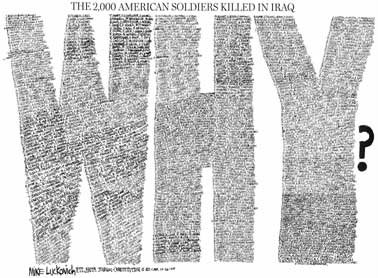
2K

So the 2K milestone has been passed. Stan Goff had some choice words when we passed the 1K mark. His words are equally relevant now.

Also note these links from Cursor:

The New York Times reports that "while it took 18 months to reach 1,000 dead, it has taken just 14 to reach 2,000," with a weekly average of "roughly 17 deaths" since an incident in Fallujah in 2004 involving "Iraq's second-largest force." Plus: The reason for the surge -- and the beat goes on.

Although "there is no way of knowing how many deaths go uncounted," the 'Rising Civilian Toll' in Iraq is known to be "many times larger" than the U.S. military death toll.

Plame drama

Knight Ridder uses the hoopla of the Plame case as an excuse to review "how the Bush administration used intelligence from dubious sources to make a case for a pre-emptive war and discarded information that undercut its rationale for attacking Iraq." Worth a read, if only as a reminder.

Alas, much speculation continues regarding Fitzgerald's coming actions. I'm reading conflicting things about indictments being released today, a press conference scheduled for tomorrow, and, even, the possibility that Fitzgerald may move for an new grand jury. The current one expires this Friday.

My advice is to keep an eye on Raw Story if you're on pins and needles about the case.

Wal-Mart skimps

I somewhat agree with Kevin Drum. Blaming Wal-Mart for socially irresponsible behavior misses the point. Indeed, it's a bit unfair to persecute one major corporate entity for it when such behavior is built into the nature of contemporary capitalism.

What this should suggest is the need to build an adequate social welfare net to mitigate negative effects of living in such a world, or, perhaps, a movement to mobilize for more substantial, institutionalized change.

Gems amongst the rubble

With chaos comes opportunity, notes Mark LeVine.

Bringing Change?

Has the trauma of Katrina triggered, as many suggested it would, any significant change regarding how poverty, race, and inequality work in the United States? Or, at least, how they're discussed?

Robert Jensen says no:

...dramatic and painful images of black people packed into a sports arena-turned-shelter have tweaked the consciences of many. But tweaked consciences are notorious for lapsing back into complacency quickly when no political pressure is applied. Lots of well-off white people may have felt bad about what they saw in New Orleans, but such feelings are not morally admirable unless they lead to action that can change things. That means moving from an emotional reaction to a political analysis, and from speculation about whether things might change to a commitment to making things change.

Racism and racialized poverty in the United States are systemic and structural problems. They are not simply the result of confusion on the part of people in power; they are institutionalized. Progress comes when those systems, structures, and institutions change. That requires collective action, not individual fretting.

It’s true that the collective political project of overcoming racism is intertwined with the very personal struggle to overcome our complacency. It’s true that history can provide dramatic moments in which things can change quickly. But it is naïve -- to a degree that suggests purposeful ignorance -- to believe that a single emotionally charged experience such as viewing the images of racialized suffering in New Orleans will have a long-term effect on systems, structures, or institutions.

...These events don’t create change. Progressive change comes when people commit to take the risks necessary to push change.

The hand-wringing that the white affluent segment of the United States indulged in after the hurricane was a common way middle-class people deal with their sense of guilt when they are confronted by what they have largely chosen to ignore. But this problem is hardly unique to the United States. It happens in virtually every country in which some segment of the elite has convinced itself that the grotesque levels of inequality are acceptable.
I see echoes of what Jensen has to say in coverage of Rosa Parks' death. She was a valiant woman, no doubt, and virtually everyone in the mainstream looks upon her with pride and admiration nowadays. We're glad that she and others stood up to slay that nasty beast of formal racism and apartheid back in the sixties.

But today, unlike in the sixties when millions of people were willing to stick their necks out at great personal risk, few seem willing to step up to the plate and launch the sort of popular, mass movement needed to address issues related to social marginalization and apartheid in a neoliberal world.

Iraq constitution ok'd

The constitution in Iraq passed. Patrick Cockburn has a summary of the election results, as well as what to look forward to in the coming months.

Tuesday, October 25, 2005

Seizing the day?

Paul Woodward tackles a question that's again getting some attention: regime change in Syria?

Darfur's toll

According to the Scotsman, "more than 100,000 people are now believed to have died in the Darfur region of Sudan since the United Nations Security Council set a 30-day deadline last year for the Khartoum regime to begin to resolve the crisis in the area."

Israel redraws the map

There hasn't been too much attention focused on Israel/Palestine since the Gaza withdrawal. How are things going?

Chris McGreal of the Guardian filed this report from Jerusalem last week:

As foreign leaders, including Tony Blair, praised Mr Sharon for his "courage" in pulling out of Gaza last month, Israel was accelerating construction of the West Bank barrier, expropriating more land in the West Bank than it was surrendering in Gaza, and building thousands of new homes in Jewish settlements.

"It's a trade off: the Gaza Strip for the settlement blocks; the Gaza Strip for Palestinian land; the Gaza Strip for unilaterally imposing borders," said Dror Etkes, director of the Israeli organisation Settlement Watch. "They don't know how long they've got. That's why they're building like maniacs."

At the core of the strategy is the 420-mile West Bank barrier which many Israeli politicians regard as marking out a future border. Its route carves out large areas for expansion of the main Jewish settlements of Ariel, Maale Adumim and Gush Etzion, and expropriates swaths of Palestinian land by separating it from its owners.

In parallel, new building on Jewish settlements during the first quarter of this year rose by 83% on the same period in 2004. About 4,000 homes are under construction in Israel's West Bank colonies, with thousands more homes approved in the Ariel and Maale Adumim blocks that penetrate deep into the occupied territories. The total number of settlers has risen again this year with an estimated 14,000 moving to the West Bank, compared with 8,500 forced to leave Gaza.

Israel is also continuing to expand the amount of territory it intends to retain. In July alone, it seized more land in the West Bank than it surrendered in Gaza: it withdrew from about 19 square miles of territory while sealing off 23 sq miles of the West Bank around Maale Adumim.
Nice to know that the formaldehyde is working its charm.

Economic Apartheid

Third place ain't too bad, now, is it?

The United States is now the third most unequal industrialized society after Russia and Mexico. This is not a club we want to be part of. Russia is a recovering kleptocracy, with a post-Soviet oligarchy enriched by looting. And Mexico, despite joining the rich-nations club of the Organization for Economic and Community Development, has some of the most glaring poverty in the hemisphere.

In 2004, after three years of economic recovery, the U.S. Census reports that poverty continues to grow, while the real median income for full-time workers has declined. Since 2001, when the economy hit bottom, the ranks of our nation's poor have grown by 4 million, and the number of people without health insurance has swelled by 4.6 million to over 45 million.

Income inequality is now near all-time highs, with over 50 percent of 2004 income going to the top fifth of households, and the biggest gains going to the top 5 percent and 1 percent of households. The average CEO now takes home a paycheck 431 times that of their average worker.

A growth industry

Sweet land of liberty:

The U.S. prison population, already the largest in the world, grew by 1.9 percent in 2004, leaving federal jails at 40 percent over capacity, according to Justice Department figures released on Sunday.

Inmates in federal, state, local and other prisons totaled nearly 2.3 million at the end of last year, the government said. The 1.9 percent increase was lower than the average annual growth rate of 3.2 percent during the last decade.

According to the International Center for Prison Studies at King's College in London, there are more people behind bars in the United States than in any other country.

China had the second-largest prison population with 1.5 million prisoners, according to statistics updated in April and cited by King's College. The total U.S. population is about 296 million, while China's is 1.3 billion.

Plame investigation coming down to the wire

Patrick Fitzgerald is reportedly on the cusp of announcing his findings and/or indictments from the Plame leak investigation. The grand jury, which expires on October 28, is expected to meet today and possibly render its verdict.

The flurry of media reports, based on a mix of shady leaks, creative sourcing, and speculative reporting, continues unabated. The latest batch of note include:

  • UPI's Martin Walker reports that Fitzgerald has taken a look at "the forgery of documents on African uranium that started the investigation," which suggests he's examining "the broader question about the way the Iraq war was justified by the Bush administration."

  • The NY Times and Washington Post have run articles in the past few days also suggesting that Fitzgerald's scope is wider than initially believed.

  • The NY Times reports that Libby first learned of Plame's identity from Dick Cheney, a fact that appears "to differ from Mr. Libby's testimony to a federal grand jury that he initially learned about the C.I.A. officer...from journalists."

  • Raw Story reports that David Wurmser, one of Cheney's most important advisors on the Middle East and a hardcore neocon, also informed Libby of Plame's identity.

  • This analytic article from the Washington Post links the Plame leaking to the wider war pitting the hard-asses in the White House and the Pentagon versus the softies at the CIA and State Department.
The case Fitzgerald has been juggling is much more complicated than was first believed, obviously. There's a cottage industry of bloggers and observers who are trying to parse what this all means. I'm not one of them, though. This is all very interesting, but I'm personally finding it impossible to hypothesize where it all will lead. All I am trying to do is document the major articles and reporting.

In short, indictments are likely, yes, but I would be surprised if this probe takes out anyone beyond Rove and Libby. It would be wonderful if Fitzgerald decided to go deep into the Iraq war machinations, triggering additional indictments, resignations, or inquiries. However, at this point, that's just a pipedream.

Iraq after the referendum

Another corner turned with this month's referendum in Iraq? No, not quite, at least if you're talking about the virulence of the insurgency.

And how's the vote counting going? Amidst allegations of fraud, two provinces have voted the constitution down. A third would be needed for a complete scrapping of the government and, in essence, a painful do-over. As the BBC reports:

It seems Sunni voters did turn out in large numbers and two provinces - Al Anbar and Salahaddin - are widely believed to have rejected the constitution.

The result from a third Sunni-dominated province, Nineveh, could therefore determine the fate of the constitution.

In the immediate aftermath of the referendum, election officials in the provincial capital, Mosul, were quoted by an international news agency as saying the "Yes" vote had won by a huge majority.

This left most impartial observers perplexed and perturbed.

One Western journalist who had been based there during the referendum described it as "totally ridiculous".

Now the word on the street seems to be that the majority in fact voted "No", but it is not clear if it was by two-thirds or if it fell short of this critical threshold.

Nineveh is one of the provinces under investigation by election officials. They are looking at voting procedures, the ballot boxes and the ballot papers to ensure there were no mistakes or fraud.

The pressure on the election commission to call the correct result from the referendum is intense.
FUBAR'd. Whatever the outcome, there will likely be allegations of illegitimacy.

And as this Knight Ridder report suggests, even the passage of the constitution may do little to halt Iraq's dissolution.

Killing Detainees

From the AP:

At least 21 detainees who died while being held in U.S. custody in Iraq and Afghanistan were killed, many during or after interrogations, according to an analysis of Defense Department data by the American Civil Liberties Union.

The analysis, released Monday, looked at 44 deaths described in records obtained by the ACLU. Of those, the group characterized 21 as homicides, and said at least eight resulted from abusive techniques by military or intelligence officers, such as strangulation or "blunt force injuries," as noted in the autopsy reports.

The 44 deaths represent a partial group of the total number of prisoners who have died in U.S. custody overseas; more than 100 have died of natural and violent causes.
I hope the next round of Abu Ghraib photos get released soon. I think they're the only thing that could possibly force this country to have an accounting for what's going on at US detention centers abroad.

Unpopular Americans

The Sunday Telegraph reports on the findings of a new poll commissioned by the British military in Iraq:

Millions of Iraqis believe that suicide attacks against British troops are justified, a secret military poll commissioned by senior officers has revealed.

The poll, undertaken for the Ministry of Defence and seen by The Sunday Telegraph, shows that up to 65 per cent of Iraqi citizens support attacks and fewer than one per cent think Allied military involvement is helping to improve security in their country.

It demonstrates for the first time the true strength of anti-Western feeling in Iraq after more than two and a half years of bloody occupation.

The nationwide survey also suggests that the coalition has lost the battle to win the hearts and minds of the Iraqi people, which Tony Blair and George W Bush believed was fundamental to creating a safe and secure country.
What's italicized above is bullshit. Polls can be fickle, but virtually every one since 2004 has shown a majority of Iraqis want the occupation to end as soon as possible and view the Americans as a negative, destabilizing force in their country. As Juan Cole says, this poll doesn't reveal anything new, but it does suggest a growing sense of hostility to the American presence:
A USA Today poll in April, 2004, came up with similar findings. Then, 57 percent of Iraqis wanted coalition troops out immediately, and about half said that there were circumstances in which it was legitimate to attack US troops. Attitudes now are more negative, but the attitudes revealed in the British Ministry of Defense poll have been there for some time on about the same orders of magnitude.

Failing N.O.

Post-Katrina coverage has fallen off quite a bit in the media and here on this blog, but the recent news about FEMA's comical and tragic ignorance of the situation on the ground and the levee breaches being "less...acts of God and more...failures of engineering that could have been anticipated and very likely prevented" are worth noting.

Friday, October 21, 2005

Winter Is the Enemy

As I noted recently, the post-earthquake situation in Pakistan is pretty dire, particularly, as this NY Times report attests, with winter approaching quickly and aid workers facing a massive refugee problem.

Perhaps if Americans had paused to consider this dynamic the last time there was a major refugee crisis in the mountainous regions of Central Asia, they would have a better appreciation for it.

But no time for cheap political shots. International help is desperately needed. Pitch in if you haven't already.

Organizing Ecological Revolution

John Bellamy Foster sounds the call for a socialist-inspired "ecological revolution" in Monthly Review. He writes,

The creation of an ecological civilization requires a social revolution; one that, as Roy Morrison explains, needs to be organized democratically from below: "community by community...region by region" (Ecological Democracy). It must put the provision of basic human needs—clean air, unpolluted water, safe food, adequate sanitation, social transport, and universal health care and education, all of which require a sustainable relation to the earth—ahead of all other needs and wants. Such a revolutionary turn in human affairs may seem improbable. But the continuation of the present capitalist system for any length of time will prove impossible—if human civilization and the web of life as we know it are to be sustained.
Hard to argue with that.

Congrats to Noam

Well put:

Noam Chomsky has been chosen the greatest intellectual of our time. In a poll conducted by Prospect magazine and Foreign Policy journal, Chomsky has been declared No 1 Global Public Intellectual. The eminent linguist and easily the most celebrated voice of dissent of our age was pitted against 99 prominent names drawn from fields as diverse as philosophy and politics to literature and journalism.

While questions may be raised about the poll criteria, there is little doubt that Chomsky indeed deserves the honour. The MIT-based theorist, intellectual and author first came to the world attention as a linguist with his path-breaking theory of grammar. His Syntactic Structures revolutionised the study of language.

But it is his political views and writings that really established Chomsky as the voice of the world’s conscience and added to his international standing as the champion of freedom and justice for those who cannot fight for themselves. From Vietnam to Iraq, Chomsky has been fighting his war against imperialism and global hegemony for the past four decades.

...The overwhelming support for Chomsky in the Prospect poll gives you reasons for hope. The world has still not completely lost its faith in humanity and the basic sense of what is right and wrong, just and unjust and good and evil. Wish there were more courageous and committed souls like Noam Chomsky around.
Chomsky also recently finished fourth in a BBC poll that sought to identify 11 individuals "to run the world."

Old Noam no doubt squirms at this sort of adulation, but he deserves his props. It's remarkable the degree to which dominant institutions in this country marginalize him, as well as the general animosity he elicits from liberals and conservatives alike. At least the rest of the world (at least those who participated in the poll) can still recognize a major intellectual and moral force for good.

Will the Grinch Steal Fitzmas?

Billmon:

Fitzgerald isn't the Great White Hope, and I don't expect him to reveal all. But if he can knock the cabal out -- or at least punch the crap out of it -- with the modern equivalent of Al Capone's tax evasion conviction, I'll take it. Capone, after all, emerged from prison a broken man, his mind rotted away by syphilis. We could do worse.
That's pretty much how I see this, too.

Plame latest

The Washington Post's Dan Froomkin observes:

Special prosecutor Patrick J. Fitzgerald has just launched his own brand-new Web site.

Could it be that he's getting ready to release some new legal documents? Like, maybe, some indictments? It's certainly not the action of an office about to fold up its tents and go home.
Indeed.

In other Plame leak news, the NY Times editors have allegedly woken up to Judy Miller's abuses of journalism (gosh, that took long enough).

The Times also reports that Fitzgerald is focusing on whether Rove and Libby "sought to conceal their actions and mislead prosecutors," possibly resulting in charges of "perjury, obstruction of justice and false statement." Both men have been "advised that they may be in serious legal jeopardy."

Meanwhile, the White House's excuses for the leak have crumbled under the weight of their own contradictions, ass-saving, and lies. To make things worse, according to the Washington Post, White House insiders don't know what the hell to do about the probable indictments heading down the pipeline.

Syria fingered over Hariri death

The UN's investigation of Rafiq Hariri's assassination in Lebanon last February has thrown blame Syria's way. In response, the Bushies have hopped on the punitive bandwagon.

Joshua Landis' blog is a good place to go for further analysis of this development. I'm sure there will be a lot of noise about it in the coming days and weeks.

Wasted $$

Following news that the Pentagon's leading actuarial office closed up shop in Iraq more than one year ago comes an article from the American Conservative surveying the depth of corruption in America's "51st state."

As Philip Giraldi writes,

When the final page is written on America’s catastrophic imperial venture, one word will dominate the explanation of U.S. failure—corruption. Large-scale and pervasive corruption meant that available resources could not be used to stabilize and secure Iraq in the early days of the Coalition Provisional Authority (CPA), when it was still possible to do so. Continuing corruption meant that the reconstruction of infrastructure never got underway, giving the Iraqi people little incentive to co-operate with the occupation. Ongoing corruption in arms procurement and defense spending means that Baghdad will never control a viable army while the Shi’ite and Kurdish militias will grow stronger and produce a divided Iraq in which constitutional guarantees will be irrelevant.

The American-dominated Coalition Provisional Authority could well prove to be the most corrupt administration in history, almost certainly surpassing the widespread fraud of the much-maligned UN Oil for Food Program. At least $20 billion that belonged to the Iraqi people has been wasted, together with hundreds of millions of U.S. taxpayer dollars. Exactly how many billions of additional dollars were squandered, stolen, given away, or simply lost will never be known because the deliberate decision by the CPA not to meter oil exports means that no one will ever know how much revenue was generated during 2003 and 2004.
Read on. There's more teeth-gnashing details in this article than you can shake a stick at. For additional elaboration on the nature of the corruption, see also this recent IPS article.

Nabbed

The Guardian's Rory Carroll was recently kidnapped in Iraq, and subsequently released about a day later. His account of the experience is rather harrowing.

Thursday, October 20, 2005

Making grandma poor

The simple fact that should never go unmentioned the next time the political right wants to gut Social Security is this: it would drive millions into poverty.

(via Democratic Left Infoasis)

The horror will go on

Feeling a bit of schadenfruede over the possible indictments coming down the pipeline for some members of the Bush crew? If so, Chris Floyd will bring you back to earth.

Print this?!

Paranoid? Well, you probably should be.

Starve em out

From the BBC:

A senior United Nations official has accused US-led coalition troops of depriving Iraqi civilians of food and water in breach of humanitarian law.

Human rights investigator Jean Ziegler said they had driven people out of insurgent strongholds that were about to be attacked by cutting supplies.

..."A drama is taking place in total silence in Iraq, where the coalition's occupying forces are using hunger and deprivation of water as a weapon of war against the civilian population," Mr Ziegler told a press conference in Geneva.
I believe Dahr Jamail aptly titled this the "Fallujah Model" of counterinsurgent warfare, which the Americans brought to diverse locales like Haditha, Tal Afar, Najaf, and Ramadi.

"Taunting" the Taliban

Here is the work of another bunch of "bad apples," I'm sure.

The state of higher ed

The truth about colleges? They pretty much suck right now.

The Cabal

One of Colin Powell's aides has railed against the Cheney-led "cabal" that drove this nation to war.

What's curious is that Powell himself said pretty much the same thing a few years ago. That little tidbit wound up making its way into Woody's book, Plan of Attack. Why it didn't get any attention back in '04 is beyond me.

Wars leave National Guard short

Knight Ridder reports:

The Army National Guard has lost so much critical equipment in Iraq and Afghanistan that its ability to respond to a national emergency could be severely hampered, says a government report released Thursday.

Lt. Gen. H. Steven Blum, chief of the National Guard Bureau, told the House Government Reform Committee that the Guard needs $1.3 billion to replace or upgrade radios, helicopters, tactical vehicles, heavy engineering equipment, chemical detection gear and night-vision goggles, which are essential to responding to national emergencies such as the recent Gulf Coast hurricanes and terrorist attacks.

Blum's testimony, along with that of other top National Guard and military officials and the governors of Idaho and Pennsylvania, coincided with the release of a new Government Accountability Office report, which says the wars in Iraq and Afghanistan have left many Army National Guard units dangerously short of critical equipment. The shortages threaten the National Guard's ability to prepare its forces for future missions at home and overseas, the auditors found.

"The bottom line is that our inventory is now at 34 percent" of what it should be, Blum said.

"National Guard officials believe that the National Guard's response to Hurricane Katrina was more complicated because significant quantities of critical equipment, such as satellite communications equipment, radios, trucks, helicopters and night-vision goggles were deployed to Iraq," said U.S. Comptroller General David M. Walker in a statement accompanying the report's release.
No surprise here. But it's always nice to have confirmation; especially when it comes straight from the horse's mouth.

The Sorrows of Haiti

Stephen Lendman offers a useful primer on recent Haitian history.

New allies

Anatol Lieven's review of Andrew Bacevich's book on American militarism is a good read, but I especially want to point to this excerpt:

Now, as never before, American progressives have the chance to overcome the knee-jerk hostility to the uniformed military that has characterised the left since Vietnam, and to reach out not only to the soldiers in uniform but also to the social, cultural and regional worlds from which they are drawn. For if the American left is once again to become an effective political force, it must return to some of its own military traditions, founded on the distinguished service of men like George McGovern, on the old idea of the citizen soldier, and on a real identification with that soldier’s interests and values. With this in mind, Bacevich calls for moves to bind the military more closely into American society, including compulsory education for all officers at a civilian university, not only at the start of their careers but at intervals throughout them.

Or to put it another way, the left must fight imperialism in the name of patriotism. Barring a revolutionary and highly unlikely transformation of American mass culture, any political party that wishes to win majority support will have to demonstrate its commitment to the defence of the country. The Bush administration has used the accusation of weakness in security policy to undermine its opponents, and then used this advantage to pursue reckless strategies that have themselves drastically weakened the US. The left needs to heed Bacevich and draw up a tough, realistic and convincing alternative. It will also have to demonstrate its identification with the respectable aspects of military culture. The Bush administration and the US establishment in general may have grossly mismanaged the threats facing us, but the threats are real, and some at least may well need at some stage to be addressed by military force. And any effective military force also requires the backing of a distinctive military ethic embracing loyalty, discipline and a capacity for both sacrifice and ruthlessness.

...Because they are the ones who pay the price for reckless warmongering and geopolitical megalomania, soldiers and veterans of the army and marine corps could become valuable allies in the struggle to curb American imperialism, and return America’s relationship with its military to the old limited, rational form. For this to happen, however, the soldiers have to believe that campaigns against the Iraq war, and against current US strategy, are anti-militarist, but not anti-military. We have needed the military desperately on occasions in the past; we will definitely need them again.
I agree with the overall sentiment here, although there are a few niggling points I balk at (ie, "fight imperialism in the name of patriotism").

The antiwar movement's relationship to the military today is much less antagonistic than it was during Vietnam. This is, on the whole, a very good thing.

The old New Deal coalition that sustained the liberal-left over the middle of the 20th century is pretty much dead. If the left is to have any chance of regaining momentum in the US, new alliances are going to have to emerge and the military is one of the primary arenas of American society where new allies could be found.

Hard Road Still Ahead

Democracy marches on in Iraq. This time with the added bonus of vote rigging! Who says Iraqis haven't learned something from the Americans...

Separate and unequal

Jonathan Kozol's new book "rips the veil off of America’s 'apartheid schools,'" says Sarah Knopp.

Plame link summary

In Plamegate news, a couple of major stories have come out over the past few days. Here's a quick run down:

* Judy Miller and the NY Times finally coughed up explanations for their role in the leak -- damning, but grossly inadequate ones.

* Reports from Bloomberg News and the Washington Post suggest Dick Cheney's office is "a focus" of Fitzgerald's investigation. Two of Dick's aides are allegedly singing, too.

* The hammer seems to be firmly down on Libby and Rove's coattails, but it's possible they're playing against each other.

* An interesting story in Newsday suggests, in a roundabout way, that Bush knew about Rove's involvement from the very beginning. Of course, Dubya hasn't been forthcoming about this.

* The NY Times reports that Fitzgerald "is not expected to take any action in the case this week" and "has no plans to issue a final report about the results of the investigation, heightening the expectation that he intends to bring indictments."

Additional commentaries of note on this tangled ball of yarn come from Justin Raimondo, James Moore, and Laura Rozen. They're each worth a read, if only because they go off in differing -- but equally important -- directions.

The Real Case for Israel

Neve Gordon has written a nice review of Norman Finkelstein's new book for In These Times. The review does more than just weigh in on its strengths and weaknesses, but also contextualizes the general Finkelstein-Dershowitz brouhaha.

Gordon's conclusion:

Two important implications can be drawn from Finkelstein’s study, one political and the other academic. Politically, Beyond Chutzpah reveals how Israel has defied the rule of law in the Occupied Territories by providing a condensed and precise summation of literally thousands of pages of human rights reports. In this way, Finkelstein does a great service for those who long for a better Israel, since one is left with the conclusion that the only way of putting an end to the violations of Palestinian rights is by ending the occupation. There is no other option.

Academically, the section discussing Israel’s human rights record raises serious questions about intellectual honesty and the ideological bias of our cultural institutions, since it reveals how a prominent professor holding an endowed chair at a leading university can publish a book whose major claims are false. The significant point is not simply that the claims cannot be corroborated by the facts on the ground -- anyone can make mistakes -- but that any first-year student who takes the time to read the human rights reports would quickly realize that while The Case for Israel has rhetorical style and structure, it is, for the most part, fiction passing as fact.

All of which leads me back to the question raised at the beginning: What is the controversy about? While it is in part about Dershowitz’s political investments and his intellectual veracity, its intention goes much deeper than that to expose a grave cultural distortion. On the one hand, the controversy surrounding Beyond Chutzpah seems to be a reaction to Finkelstein’s attempt to expose how elements in academia have played an active role in covering up Israel’s abuse, and by extension, the abuse of other rogue regimes, not least the United States itself. Obviously those intellectuals who do participate in this covering tactic prefer to operate in the dark. On the other hand, the heated response to his book is just another example of how the literature discussing the new anti-Semitism delegitimizes those who expose Israel’s egregious violations of international law. The major irony informing this saga is that Finkelstein’s book, not Dershowitz’s, constitutes the real case for Israel -- that is, for a moral Israel.

What don't we get?

Bill McKibben is trying to slap people upside the head when it comes to global climate change:

So far human beings have increased the planet's temperature about 1 degree Fahrenheit. Unless we do everything possible, as quickly as possible, to shift away from fossil fuels, scientists say we will warm the planet another 5 degrees before the century's end.

...It's about time for denial to come to an end. We're no longer talking about theory, about computer models of what might happen. We're talking about what is happening, all around the world, with almost unimaginable speed. Other countries have at least begun to try to deal with the problem, implementing small first steps like the Kyoto Protocol. But here in the United States, there's only a scattering of state and local measures. Washington is governed by a bipartisan consensus that somehow the laws of physics and chemistry don't apply to us.

But they do. I said I wasn't going to talk about the hurricanes, but I lied. In early August a paper by a Massachusetts Institute of Technology researcher in the journal Nature showed that hurricanes were 50 percent stronger and lasted 60 percent longer than a generation ago. In early September a Georgia Tech team showed that the number of category 4 and 5 storms had doubled. You've seen the results on every TV screen and magazine cover.

Exactly how much more do we need to know? Exactly when are we going to roll up our sleeves and get to work?
With yet another major hurricane bearing down on Florida, perhaps the spell will be broken. I'm not too confident, though.

Oh, and if you need more grist for the global warming mill, try these three stories on for size.

Quake aid

From the BBC:

The UN says the shortfall in aid for victims of the South Asian quake has made the relief situation worse than after last December's tsunami.

UN emergency relief chief, Jan Egeland, said the organisation had never seen such a "logistical nightmare".

Nato began flying in 900 tonnes of aid on Thursday, but Mr Egeland said a massive airlift was also needed to bring people out of remote areas.

Pakistan says nearly 50,000 people died in areas under its control.

Local officials put casualties far higher, and the number is expected to rise.
Pony up, people.

Thursday, October 13, 2005

Away

I'm going to be on the road for the next week or so. I'll pop in again when I'm back in town.

Before I go, let me drop in a plug for "The Torture Question," which is set to air on PBS' Frontline next week. Check it out and pass a recommendation along to colleagues who still cling to the few "bad apples" explanation for the new gulag treatment in Gitmo, Bagram, Abu Ghraib, et al.

What Iraqis Really Think About the Occupation

Tom Hayden reminds us that the media's tendency to divide Iraqis in two -- good and bad -- obscures the overwhelming hostility to the American presence in the country.

"From its beginning," he writes, "this war has been one of perception. Perhaps the media elites, whose collaboration with the Pentagon gave public justification during the 2003 invasion, now worry that if they report that a majority of the Iraqis we are supposedly 'saving from terrorism' are actually calling for our departure, any remaining support for the war will collapse."

Wednesday, October 12, 2005

Quake overview

Damned, either way

"Five days before Saturday's referendum on Iraq's proposed constitution," Jim Lobe reports, "the U.S. foreign policy elite appears both anxious and gloomy, increasingly worried that win or lose, the process will bring Iraq one step closer to civil war and, with it, the possible destabilisation of the wider region."

Fitzgerald fiddling with WHIG

The WSJ is reporting today that Fitzgerald's Plame investigation is taking an interesting side tour into the activities of the White House Iraq Group, the executive branch organ that coordinated efforts to "market the war" to the American public via propaganda and disinformation typically funneled from the Pentagon's Office of Special Plans.

We're still deep in the woods of speculation here, but this is an interesting development. If Rove and/or Libby get indicted, as many now suspect, that'd be bad for this administration. But if some pesky prosecutor starts sniffing around the Iraq war run-up, Bush's crew could be in deep trouble. It's their Achilles heel.

Today's two other Plame news items can be found here and here.

Tuesday, October 11, 2005

Hooray for fascism

Lewis Lapham strikes again with his sardonic wit:

It does no good to ask the weakling's pointless question, "Is America a fascist state?" We must ask instead, in a major rather than a minor key, "Can we make America the best damned fascist state the world has ever seen," an authoritarian paradise deserving the admiration of the international capital markets, worthy of "a decent respect to the opinions of mankind"? I wish to be the first to say we can. We're Americans; we have the money and the know-how to succeed where Hitler failed, and history has favored us with advantages not given to the early pioneers.

The future looks bleak

America's broke, Anatol Lieven argues, and the political culture here makes it nearly impossible to fix things.

(via wood s lot)

Monday, October 10, 2005

New Mysteries

David Corn has the latest on developments in the Plame leak case.

Seizing the opportunity

It warms my heart to know that some people are getting rich on global warming.

Catastrophes strike

I recommend checking in with the BBC and the Daily Times from Lahore for news updates on the earthquake in Pakistan. As of now, the unofficial death toll has climbed to 50K.

It's also worth noting that while international attention is understandably focused on the Asian catastrophe, the tragedy in Guatemala over the weekend has gotten short thrift.

A mixed picture

Jim Lobe examines the Americans' "progress" in Afghanistan, four years after the initiation of the GWOT.

A century behind the curve

Alex Cockburn takes on the Bill Bennett flap, but with his usual twist:

Every year or so, some right-winger in America lets fly in public with a ripe salvo of racism, and the liberal watchdogs come tearing out of their kennels, and the neighborhood echoes with the barks and shouts. The right-winger says he didn't mean it, the president "distances himself," and the liberals claim they're shocked beyond all measure. Then, everyday life in racist America resumes its even course.

...The deeper irony here is that liberals have pondered longer and deeper than conservatives on how exactly to carry out Bennett's hypothetical plan, either by sterilization or compulsory contraception.
Taking liberals to task here, as Cockburn goes on to do by raising the sordid issue of eugenics history, may be a tad bit of a cheap shot. But it's worth acknowledging that his overall argument is sound.

The sad truth is that eugenicism was nurtured by Progressives and reformers in the early 20th century. Liberal skepticism of, if not outright hostility to, mass movements and the "crowd" mentality provided the intellectual momentum for a whole slew of experiments meant to improve the lower classes and temper crime, degeneracy, and the like.

Liberals shouldn't necessarily feel guilty for what some of their predecessors did a century ago. However, knowing this history should encourage them to activate their inner caution button, especially when they start to fret about the "underclass," hearken back to Daniel Patrick Moynihan's musings, and condemn those at the bottom of the social ladder for not thinking and acting like, well, liberals.

Raid on New Orleans in early phase

This is just one of several reasons why the NewStandard deserves support. With very limited means, its tiny staff typically produces excellent journalism. We could use its voice coming out of the Bayou.

Saturday, October 08, 2005

Between corruption and poverty

Why Is Africa Still Poor? Andrew Rice addresses this question in a book review from The Nation.

Melting away

My pessimistic views on the state of the world were not helped by reading this article by Mike Davis.

Amongst other things, he references recent research from EOS, the newsletter of the American Geophysical Union, that suggests a Younger Dryas-type event may happen in my lifetime.

No more "rotten apples"

I agree. It's well past the time to move on:

One might hope that the Abu Ghraib scandal is now coming to a close. The last of the photographed soldiers to be put on trial, the hapless Pvt. Lynndie England, was convicted last week and sentenced to three years in prison. NBC's Dateline had an exclusive interview with England before her sentencing; she blamed her superior officers and made a few weak excuses for her own conduct. Now she’ll go off to prison. Bush administration officials, for their part, will probably be glad to trumpet England’s conviction and then move on.

And that is something we can agree on. We should move on. It’s time to move beyond Lynndie England and start thinking about the mounting evidence that detainee abuse was a systematic and chronic problem throughout Iraq and Afghanistan, not just a problem with a few "rotten apples." It is becoming increasingly clear that what took place at Abu Ghraib in late 2003 is but one instance of a much larger problem of detainee abuse, a problem rooted in policies promulgated by the top ranks of the administration. It is also becoming clear that the current focus on low-level soldiers as scapegoats is part of an effort to bury the problem. The photographed abuses at Abu Ghraib, while originally a lightening bolt on detainee abuse issues, were a distraction from these larger concerns.

Does God Speak to Bush?

Commenting on the recent BBC claim that Bush advised Palestinian authorities that God told him to invade Iraq and Afghanistan, as well as push for a Palestinian state, Ira Chernus urges everyone not to "get too excited" about it. He adds:

There are so many more horrendous things Bush has said and done that deserve our harsh criticism. There are so many more ways he has used religious beliefs and religious language to justify immoral policies. Let's put our critical energy there, and not on one isolated statement that he'll go on denying he ever said.
Chernus thumbs through relevant material in his essay, but I disagree with his conclusion here. We should use any opportunity to pressure the White House to account for what type of influence Bush's religious fervor has on his Presidency, since I think it manifests itself in the confidence (which many read as "arrogance") with which Bush goes through on so many disastrous policy decisions.

Iron Fists and Gates

Terrorism in Iraq continues apace. How tragic.

Unprepared


The media seems to have just discovered avian flu in the past week. Check Google News for the multitude of stories that have been published recently.

Friday, October 07, 2005

Crime and Prejudice

Tax cuts at work

David Sirota:

Politicians love to put signs up next to the projects they created saying "your tax dollars at work." The only way for the United States to have the desperately needed debate over budget priorities is if Democrats find the courage to plant a figurative sign in New Orleans’ flood-drenched streets that says “your tax cuts at work.” Then, and only then, will America’s tax debate transform from a theoretical one that features terrific-sounding promises into a concrete one that highlights the very real consequences of a political system that seeks only to enrich the already rich, no matter what the cost to society.
Yes, I think this is what's usually called a "teachable moment."

"The need for fundamental social change, lest we suffer worse disasters in the future"

That Noam Chomsky is such a loon (albeit, a popular one). Just read his latest deranged musings here.

Climate change and pollution are killing millions

More climate change news, from the Guardian:

Almost a fifth of all ill health in poor countries and millions of deaths can be attributed to environmental factors, including climate change and pollution, according to a report from the World Bank.

Unsafe water, poor sanitation and hygiene as well as indoor and outdoor air pollution are all said to be killing people and preventing economic development. In addition, says the bank, increasing soil pollution, pesticides, hazardous waste and chemicals in food are significantly affecting health and economies.

More controversially, the report, released yesterday in New York, links cancers to environmental conditions and says global warming has a major impact on health. "For almost all forms of cancer, the risk of contracting this disease can be reduced if physical environments are safe for human habitation and food items are safe for consumption," says the report.

It also cites the spread of malaria and dengue fever as climate change intensifies. Global warming, says the report, is leading to lower yields of some crops and the salination of coastal areas.
On a related front, this recent article from the New England Journal of Medicine discusses the effects of climate change on global health.

Rich Media, Poor Democracy

Al Gore channels Bob McChesney in a pretty good speech on media policy. Worth a read.

Thursday, October 06, 2005

Rove headed for indictment?

Yesterday:

The federal prosecutor investigating who leaked the identity of a CIA operative is expected to signal within days whether he intends to bring indictments in the case, legal sources close to the investigation said on Wednesday.

As a first step, prosecutor Patrick Fitzgerald was expected to notify officials by letter if they have become targets, said the lawyers, who spoke on condition of anonymity because of the sensitivity of the matter.
Today:
Federal prosecutors have accepted an offer from presidential adviser Karl Rove to give 11th-hour testimony in the case of a CIA officer's leaked identity and have warned they cannot guarantee he won't be indicted, according to people directly familiar with the investigation.

The people, who spoke only on condition of anonymity because of grand jury secrecy, said Special Prosecutor Patrick Fitzgerald has not made any decision yet on whether to file criminal charges against the longtime confidant of President Bush or anyone else.

The U.S. attorney's manual requires that prosecutors not bring witnesses before a grand jury if there is a possibility of future criminal charges unless the witnesses are notified in advance that their testimony can be used against them in a later indictment.
Stay tuned, but an indictment looks likely at this point.

Doing God's work

Does this quote look familiar?

God told me to strike at al Qaeda and I struck them, and then He instructed me to strike at Saddam, which I did, and now I am determined to solve the problem in the Middle East. If you help me, I will act, and if not, the elections will come and I will have to focus on them.
It should. Dubya dropped it on Abu Mazen right after the Iraq invasion.

Apparently, the BBC dug up something similar for a forthcoming documentary on the Israeli-Palestinian conflict.

Blind to privilege

Is Bush a racist? Robert Jensen weighs in.

"Affirmative action for whites."

In the Washington Post, Ira Katznelson writes:

Hurricane Katrina's violent winds and waters tore away the shrouds that ordinarily mask the country's racial pattern of poverty and neglect. Understandably, most commentators have focused on the woeful federal response. Others, taking a longer view, yearn for a burst of activism patterned on the New Deal. But that nostalgia requires a heavy dose of historical amnesia. It also misses the chance to come to terms with how the federal government in the 1930s and 1940s contributed to the persistence of two Americas.
This is just a teaser. Make sure you read the whole thing.

(via Cynthia's Interests)

The American Dream is Dead

The American Dream of working hard, moving up the ladder, and maybe even making it rich one day is, sad to say, a scam.

Holy Sklar and J.R. Mooneyham recount some of the more unsavory details of life, labor, inequality, and inheritance in the good ol' US of A.

Bad neighbors

Humans, feel free to kill yourselves, slowly. But your destructive habits are having detrimental effects on your neighbors, you know.

Doing Damage Control

In a cogent media critique, Mark Major observes that "the criminal nature of US foreign policy and its actual motives" are "generally passed off as 'good intentions gone bad' or flaws that make 'American talk of democracy sound hollow,' which sometimes makes the 'worth' of spreading and defending the 'exceptional character of American liberty' too costly."

"Presently," he adds, "the United States is in violation of international law and does not seem to be changing course anytime soon. Unfortunately, events during this past summer show that US corporate media institutions have no intention of changing their efforts at 'damage control' while instilling and defending the 'economic, social, and political agenda of privileged groups that dominate the domestic society and the state.'"

Wednesday, October 05, 2005

Beyond the (In)Security State

Ira Chernus speaks the truth:

The idea of a whole society working together to imagine a better world, and then turning imagination into reality, has been off the American radar screen for some six decades now (except for a brief ray of light in the 1960s). When it seems safer to allow no significant change at all, politics naturally becomes an exercise in circling the wagons and hunkering down for an endless siege. The 9/11 attack and the Bush-orchestrated response insured that the United States would continue to be a hunkered-down national insecurity state (and now a homeland insecurity state) well into the 21st century.

All of us, supporters and critics alike, have absorbed this lesson. When we criticize Bush because he has failed to keep us safe, we score valuable political points. But we pay a price for those points, because we reinforce the basic premises of the national insecurity state -- that danger is everywhere and can never be eliminated; that all systemic change is dangerous; and that our best hope lies in a government strong enough and pugnacious enough to prevent significant change and so protect us from fear's worst effects.

The urge to be safe, to keep fear at bay, is certainly natural and understandable. But after more than half a century in a state of heightened national insecurity, Americans have largely forgotten the other side of the human coin: the urge to be daring, to take chances that can lead to positive change. Insecurity is now in the national bloodstream. That's why anti-Bush campaigns that evoke fear can be so successful. To be successful in the longer term, though, we have to constrict that sense of insecurity, to return it to the more modest place where it belongs, until actual security comes into sight.

Otherwise, no matter how much anti-Bush campaigns weaken the President, they end up reinforcing the pervasive insecurity that has been the key to his political success. They make it more likely that the public will want future leaders in the Bush mold, who demand "peace through strength." No flip-flops need apply.

The war on poverty, lost

Here's some serious discussion of poverty in the US in the American media, which you don't usually see.

To pull out just one part from this article, it's widely known that the poverty rate has jumped under Bush's reign, but what is not discussed much is how that rate obscures the reality of the situation:

Academic experts also say the government's figures minimize the true scale of poverty because they are outdated. The formula for the poverty level was set in 1963 on the assumption that one third of the average family's budget was spent on food.

This is no longer true. Housing has become the largest single expense and tens of thousands of the "working poor," the label for those who work at or near the minimum wage, are forced to sleep in cars, trailers, long-term motels or shelters.

..."Every August, we Americans tell ourselves a lie," said David Brady, a Duke University professor who studies poverty.

"The poverty rate was designed to undercount because the government wanted to show progress in the war on poverty.

"Taking everything into account, the real rate is around 18 percent, or 48 million people. Poverty in the United States is more widespread, by far, than in any other industrialized country."

Rotten Guys

Robert Parry rounds-up some of the recent news on GOP corruption. There sure is a lot of it, coming from several different angles.

OFF

Check out Joshua Holland's two-part report on the real and fake oil-for-food scandals.

Iraqi parliament reverses rule change

The Iraqi parliament has backpedalled on its recent election rigging efforts, reportedly due to UN and US pressure. In response, several Sunni groups have vowed not to boycott the referendum, although they promise to work feverishly to garner enough votes for a rejection. As the AP explains:

Under the restored election rules, Sunnis can defeat the document if they get a two-thirds "no" vote in any three provinces, even if a nationwide majority approves the charter. Sunnis have a chance of doing so in four of 18 provinces.

The Shiite-dominated parliament tried to close that loophole Sunday by passing a new interpretation of the rules, determining that a simple majority of those who cast votes was needed to pass the constitution but that two-thirds of all registered voters had to vote no in three provinces to defeat it.

That effectively raised the bar for defeating the constitution to an impossible level, and the United Nations cried foul.

After a brief debate Wednesday, the National Assembly voted 119 to 28 to restore the original voting rules for the referendum. Only about half of the 275-member legislative body turned up for the vote.

Tuesday, October 04, 2005

Rigging the election

Democracy marches on in Iraq:

Iraq's Shiite and Kurdish leaders quietly adopted new rules over the weekend that will make it virtually impossible for the constitution to fail in the coming national referendum.

The move prompted Sunni Arabs and a range of independent political figures to complain that the vote was being fixed.

Some Sunni leaders who have been organizing a campaign to vote down the proposed constitution said they might now boycott the referendum on Oct. 15. Other political leaders also reacted angrily, saying the change would seriously damage the vote's credibility.

Under the new rules, the constitution will fail only if two-thirds of all registered voters - rather than two-thirds of all those actually casting ballots - reject it in at least three of the 18 provinces.

The change, adopted during an unannounced vote in Parliament on Sunday afternoon, effectively raises the bar for those who oppose the constitution. Given that fewer than 60 percent of registered Iraqis voted in the January elections, the chances that two-thirds will both show up at the polls and vote against the document in three provinces would appear to be close to nil.
It's usually frowned upon when participants try to change the rules in the middle of the game. That's typically called cheating, is it not?

Iraq war delayed Katrina relief effort

The Independent claims to have seen a Pentagon-commissioned report that states bluntly, "Another major factor in the delayed response to the hurricane [Katrina] aftermath was that the bulk of the Louisiana and Mississippi National Guard was deployed in Iraq."

The report goes on to conclude, "The one thing this disaster has demonstrated [is] the lack of coordinated, in-depth planning and training on all levels of Government, for any/all types of emergency contingencies. 9/11 was an exception because the geographical area was small and contained, but these two hurricanes have clearly demonstrated a national response weakness...Failure to plan, and train properly has plagued US efforts in Afghanistan, Iraq and now that failure has come home to roost in the United States."

Iran invasion by '08

According to the Calcutta-based Telegraph:

Top-ranking Americans have told equally top-ranking Indians in recent weeks that the US has plans to invade Iran before Bush’s term ends. In 2002, a year before the US invaded Iraq, high-ranking Americans had similarly shared their definitive vision of a post-Saddam Iraq, making it clear that they would change the regime in Baghdad.
Sure, this is an isolated report. I mean, there's nothing in the NY Times or Washington Post along these lines, so we should take it with a grain of salt.

Right?

(via pro rev)

Buying Propaganda

Apparently, the GAO took on the Bush administration's use of Armstrong Williams' bought musings and Karen Ryan's fake reporting in an investigation and didn't like what it found. The final report came down pretty hard on the Bushies, decrying their penchant for "covert propaganda."

Plamegate happenings

As you no doubt know, the Plame leak investigation has heated up once again over the past few days.

First, Judy Miller stepped down from the martyr podium and testified to special prosecutor Patrick Fitzgerald on Friday. Her cover story is that Libby finally gave her a waiver, so she no longer had to protect him. God bless 'er.

Then, over the weekend, the Washington Post reported that Fitzgerald might be seeking conspiracy charges in his probe, which could possibly throw the noose around a number of people in and around the White House.

According to the Post, "two lawyers who have had extensive conversations with the prosecutor while representing witnesses in the case" contend that "Fitzgerald is considering whether he can bring charges of a criminal conspiracy perpetrated by a group of senior Bush administration officials. Under this legal tactic, Fitzgerald would attempt to establish that at least two or more officials agreed to take affirmative steps to discredit and retaliate against Wilson and leak sensitive government information about his wife."

To add to the intrigue, George Stephanopoulous on This Week claimed that one of his sources says Bush and Cheney were involved in the scheme. That could, of course, mean big trouble.

Fitzgerald is reportedly close to wrapping up the case, since Judy's testimony was one of the last pieces of the puzzle. He could act on his findings as early as this week -- or by the end of this month, at the latest.

Gaza chaos

Things seem to be getting back to normal in Gaza:

Israeli pilots carried out a series of air and artillery strikes throughout the Gaza Strip, targeting civilian infrastructure, assassinating militants and striking fear into the population with deafening noise as low-flying F-16 fighter jets shatter the sound barrier overhead day and night.
To make things even more groovy, Palestinian turf wars have, as expected, exploded. Hamas is generally causing all sorts of headaches for the woefully inadequate police forces under the aegis of the P.A.

Saturday, October 01, 2005

Going backwards

Dear lord, this is pathetic:

The number of Iraqi army battalions that can fight insurgents without U.S. and coalition help has dropped from three to one, top U.S. generals told Congress yesterday, adding that the security situation in Iraq is too uncertain to predict large-scale American troop withdrawals anytime soon.

Gen. George W. Casey Jr., who oversees U.S. forces in Iraq, said there are fewer Iraqi battalions at "Level 1" readiness than there were a few months ago. Although Casey said the number of troops and overall readiness of Iraqi security forces have steadily increased in recent months, and that there has not been a "step backwards," both Republican and Democratic senators expressed deep concern that the United States is not making enough progress against a resilient insurgency.
Stay the course. Just give us a little more time. Things are bound to turn the corner soon. Honest.

Fumbling the image war

Seriously, is anyone at all surprised that Karen Hughes doesn't know what the hell she's doing?

Doth protest too much?

Are mass protests worth the effort anymore? David Corn argues no. David Swanson argues yes.

Paving the way for cleansing

This essay by Mike Davis should be read with these remarks in mind.

(via Democratic Left Infoasis)

Unaccountable

In his Moscow Times column, Chris Floyd applauds Army Captain Ian Fishback for blowing the whistle on the continued use of torture by the US in Iraq and Afghanistan, as noted in a recent HRW report on the subject.

After getting nowhere by trying to address the issue through "proper channels," Fishback finally concluded that the military was more interested in covering up the abuse than rectifying or stopping it. He then took his concerns elsewhere.

"What will come of the good captain's moral courage?" Floyd asks.

Nothing much. A Pentagon investigation has been belatedly launched; no doubt a few more bad eggs will be fried, just as the hapless Lynndie England, poster girl for Abu Ghraib, was convicted this week for "aberrations" that, as Fishback confirms, were countenanced and encouraged throughout Iraq. Fishback himself will be certainly slimed in one of Karl Rove's patented smear campaigns. By next week, the upright, Bible-believing West Point grad -- a veteran of both the Afghan and Iraqi wars -- will be transformed by Fox News and the war-porn bloggers into a cowardly, anti-American terrorist sympathizer under the hypnotic control of Michael Moore.

Meanwhile, one of the Republican senators Fishback approached, Senate Majority Leader Bill Frist, has already put the kibosh on legislation setting clear legal guidelines for prisoner treatment. Frist, a goonish errand boy now under investigation for insider trading, killed the bill after hearing Fishback's evidence. His White House masters don't want any legal clarity for their dark deeds; they can only thrive in the murk of moral chaos.

One thing is certain: The true architects of these atrocities will never face justice. They'll go on to peaceful, prosperous retirements, heedless of the broken bodies and broken nations -- including their own -- left behind in their foul wake.
Unfortunately, he's damn right. Despite the copious documentation of White House and Pentagon malfeasance (just read Mark Danner's three NYRB exposes), there seems to be no accountability for anyone at or near the top of the pyramid. War criminals run the show, and most everyone's too polite or cowardly to say so.