Saturday

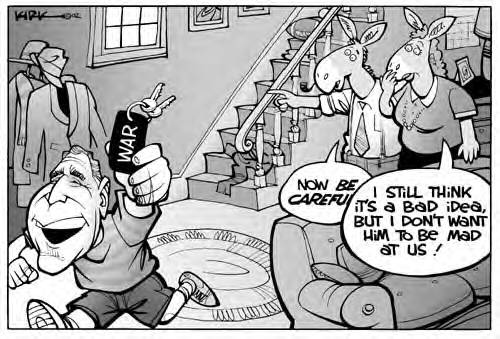
The Washington Post reports of soaring war costs, and in the process buries a rather significant lede.
(via Am Sam)
With the UN Security Council set to reconvene over the Iranian nuclear issue, the CS Monitor tries to lay out the likely and possible moves to come:
The confrontation returns Friday to the United Nations Security Council, where the Iranian regime is hoping a divide-and-conquer strategy will prevent the UN body from taking any coercive action to limit its nuclear program. It may be a bold gambit: Just a month ago, the Council acted - unanimously - to give Iran 30 days to show it had ceased uranium enrichment.Most analysts believe the UN route is a dead end, and that comes across in the remarks above.
But the Security Council, in fact, is split over the need for action against a defiant Tehran - increasing the likelihood that steps such as economic sanctions will be taken not by the UN, but by a "coalition of the willing" of the US and equally adamant allies.
...The United States...has been emphasizing its preference for united Security Council action against Iran. But it is also floating with allies the possibility of steps outside the UN if the Security Council proves unable to bridge its differences - essentially with the US, Britain, and France on one side, and Russia and China on the other.
...The Iranian game plan appears to be to set up a confrontation with the West that not only divides the international community but shatters any consensus against its nuclear program, analysts say.
...Initially, the US, Britain, and France are set on seeking something more from the Council than the simple "presidential statement" that was approved a month ago. This time they want a so-called "Chapter 7 resolution," which would designate Iran a threat to international security - a step that would open the door to sanctions and eventually even military action.
In the days leading up to Council deliberations, the US is reiterating that it is not seeking sanctions at this time. "The resolution we are contemplating ... would not be a sanctions resolution," the US ambassador to the UN, John Bolton, said Tuesday. "So from our perspective, we are going to take it one step at a time."
But for China and Russia, a Chapter 7 resolution puts the Council on a course of action, including sanctions, even if the text does not specifically call for it. And it also starts looking increasingly like the diplomatic road the US took before going to war with Iraq, some experts say.
That helps explain why neither veto-wielding nation is likely to go along with a tough new resolution. "I think the Chapter 7 route is dead on arrival," says Mr. Cirincione. "The US can keep talking about it, but our own policies have doomed it."
Two years after the abuse by U.S. soldiers of detainees at Abu Ghraib prison in Iraq first came to light, accountability for what turns out to have been a widespread pattern of mistreatment at several detention sites, including torture and at least eight homicides, remains elusive, according to a new report released by three major human rights groups here Wednesday.Have I told you lately how proud I am to be an American at this point in history?
"By the Numbers: Findings of the Detainee Abuse and Accountability Project" says that at least 330 credible cases of abuse involving 600 U.S. personnel and 460 alleged victims have been reported in Afghanistan, Iraq and at the U.S. detention facility at Guantanamo Bay, Cuba, since late 2001.
So far, however, only 40 troops -- almost all of them low-ranking enlisted personnel -- have been given prison terms. Of these, 30 were sentenced to less than one year's confinement, even in cases involving serious abuse, such as the beating deaths of two detainees at the detention facility at Bagram airbase in Afghanistan.
"What happened on 9/11?" asks Ernest Partridge in a review of what most deem to be "conspiracy theories" about that fateful day. "Who is responsible? The questions remain open even as they remain urgent. The American people deserve answers, and more immediately, competent and sustained investigation leading to these answers."
(via informed dissent)
Gregory D. Foster, in the Baltimore Sun:
The American public is being lulled into a false sense of insecurity. And insecurity, constructed or real, is what gives those in power - our purported protectors - their self-righteous aura of indispensability.Bold words coming from a faculty member at that bastion of leftist radicalism, NDU.
President Bush; Defense Secretary Donald H. Rumsfeld; the chairman of the Joint Chiefs of Staff, Gen. Peter Pace; the head of the U.S. Central Command, Gen. John P. Abizaid; and the recently released Quadrennial Defense Review, among other authoritative purveyors of received wisdom, all warn us that we're embroiled in - and destined to be further subjected to - what is to be known as a Long War.
It would be one thing if such semantic legerdemain reflected revelatory strategic insight or a more sophisticated appreciation of the intrinsic nature of postmodern conflicts and enemies. But that is not the case. In fact, it's hard to avoid the cynical view that America's senior military leaders are willfully playing public relations handmaiden to their political overlords at the expense of a naive, trusting citizenry.
Even as Long War rhetoric artfully circumvents such politically discomfiting terminology as "insurgency," its underlying message should be clear: We dutiful subjects should be quietly patient and not expect too much (if anything) too soon (if at all) from our rulers as they prosecute their unilaterally proclaimed war without end against ubiquitous evil.
The intent of the message is to dull our senses, to dampen our expectations, to thereby deaden the critical, dissenting forces of democracy that produce political turbulence and impede autocratic license. Being warned here amounts to being disarmed - intellectually and civically.
A manifesto on the "politics of oil" from The Oil Drum:
The political discourse on this topic is simply so devoid of fact, and constructive discourse so buried and out of the mainstream, that we felt we needed to raise a voice of reason. Public officials will continue to misinform and obfuscate if we allow it.Worth heeding, I think.
The only solution is to educate the public about the most important problem we face as a generation. We, the citizens of the US and the world, must move our attention to this the issue of energy more than any other. We must hold our representative governments accountable for having an open and honest debate on the subject.
Simply put, we must learn more about where our energy comes from.
I know little about Nepalese politics, but these articles from J. Sri Raman, Marty Logan, and Pratyush Chandra provide some useful context on the protests that have been raging in that country for several weeks.
Yes, indeed, this is "truly remarkable." By all accounts, FEMA emerged as one of the best run government agencies under Bill Clinton, after being mired in bureaucratic morass in the early 1990s.
Bush's reign and, more specifically, the vaunted creation of Homeland Security have beaten it down to such a degree that the Senate is now calling for it to be killed off completely.
I've said it before, "Rathergate" paid off for the Bushies. It even reined in Robert Scheer, one of the few liberal columnists who still shows a backbone every now and then.
From the AP:
America may still think of itself as the land of opportunity, but the chances of living a rags-to-riches life are a lot lower than elsewhere in the world, according to a new study published on Wednesday.Uh oh. What will we tell the children?
The likelihood that a child born into a poor family will make it into the top five percent is just one percent, according to "Understanding Mobility in America," a study by economist Tom Hertz from American University.
By contrast, a child born rich had a 22 percent chance of being rich as an adult, he said.
"In other words, the chances of getting rich are about 20 times higher if you are born rich than if you are born in a low-income family," he told an audience at the Center for American Progress, a liberal think-tank sponsoring the work.
He also found the United States had one of the lowest levels of inter-generational mobility in the wealthy world, on a par with Britain but way behind most of Europe.
Several other experts invited to review his work endorsed the general findings, although they were reticent about accompanying policy recommendations.How 'bout more tax cuts for the wealthy? What about expensive imperial excursions?
"This debunks the myth of America as the land of opportunity, but it doesn't tell us what to do to fix it," said Bhashkar Mazumder, a senior economist at the Federal Reserve Bank of Cleveland who has researched this field.
Recent studies have highlighted growing income inequality in the United States, but Americans remain highly optimistic about the odds for economic improvement in their own lifetime.Poor Bushies. Always getting guff from a malevolent intellectual class.
A survey for the New York Times last year found that 80 percent of those polled believed that it was possible to start out poor, work hard and become rich, compared with less than 60 percent back in 1983.
This contradiction, implying that while people think they are going to make it, the reality is very different, has been seized by critics of President Bush to pound the White House over tax cuts they say favor the rich.
On average, 47 percent of poor families remain poor. But within this, 32 percent of whites stay poor while the figure for blacks is 63 percent.Virtually all of Hertz's findings smash to pieces the most noble myths of life inside the United States. Accordingly, his study, like the many others that have come to populate the fields of sociology and economics in recent years, will probably gain little traction in the US media or in government.
It works the other way as well, with only 3 percent of blacks making it from the bottom quarter of the income ladder to the top quarter, versus 14 percent of whites.
"Part of the reason mobility is so low in America is that race still makes a difference in economic life," he said.
Brian Urquhart has the audacity to point out in the NYRB that we live in an "outlaw world."
What we commonly understand as international law, while initially drawn up in the hope that nation states would start to give a damn about stuff like human rights and morality following the carnage of WWII, is today mainly used by stronger states to beat weaker states into line, Urquhart observes. Lamentably, it has hardly anything to do with what we might call "justice."
Karl Rove's appearance before a grand jury in the CIA leak case Wednesday comes on the heels of a "target letter" sent to his attorney recently by Special Prosecutor Patrick Fitzgerald, signaling that the Deputy White House Chief of Staff may face imminent indictment, sources that are knowledgeable about the probe said Wednesday.I'd move it from "possible" to "probable" at this point.
It's unclear when Fitzgerald sent the target letter to Rove's attorney, Robert Luskin. Sources close to the two-year-old leak investigation said when Rove's attorney received the letter Rove volunteered to appear before the grand jury for an unprecedented fifth time to explain why he did not previously disclose conversations he had with the media about covert CIA operative Valerie Plame and her husband, former Ambassador Joseph Wilson, who criticized the Bush administration's use of pre-war Iraq intelligence.
A federal grand jury target letter is sent to a person in a criminal investigation who is likely to be indicted. In a prepared statement Wednesday, Luskin said Fitzgerald indicated that Rove is not a "target" of the investigation. A "target" of a grand jury investigation is a person who a prosecutor has substantial evidence to link to a crime.
Last week, Rove was stripped of some of his policy duties in a White House shakeup orchestrated by incoming Chief of Staff Joshua Bolten. The White House insisted that Rove was not demoted, but insiders said the executive branch is bracing for a possible indictment against Rove.
Is the US capable of handling a national healthcare emergency? Of course not.
Nor is the nation capable of dealing with a major national disaster, like Katrina, as a new Senate report is set to detail.
There's some new research linking last year's busy hurricane season with global warming.
Previously, researchers had only been able to draw links between global warming and the increased strength of hurricanes, not the total number of storms. You might recall that this was the conclusion of two relatively high profile research papers from MIT and Georgia Tech last year.
Looks like we might have a new wrinkle to think -- and worry -- about.
Yay for American healthcare, which remains a shining beacon for the rest of the industrialized world.
This is a good interview with Lewis Lapham, the outgoing (yes, you read that right) editor of Harper's. Two excerpts that caught my eye below.
Q: What do you make of the Times’s editorial that said calls for impeachment and even Senator Feingold’s censure bill will only embolden the right?That deserves emphasis, I thought. I also thought this exchange was on point:
Lapham: Well, the right doesn’t need emboldening. The right is perfectly happy to lie, cheat, steal, say anything that comes conveniently to mind. If you make your politics a matter of waiting to see what the other fellow will do, you have already lost the argument, or the election. And it is this kind of pussyfooting on the part of the Democratic Party that has led us into this morass.
Q: What’s to be done now?
Lapham: In the short term, it’s trying to get the Democratic Party in the forthcoming election to take control of at least one of the houses of Congress. And if the Democrats fail to win control of either the House or Senate in November, then they are utterly useless and must be replaced with a third party.
We also need an awakening on the part of large numbers of people, both Democrat and Republican, of a political consciousness that has been dormant for the better part of the last thirty years. We have to change the notion that politics isn’t important, that what’s important is the economy and money, and that politicians serve at the pleasure of their corporate sponsors. They might as well be hired accordion players at a hospitality tent at a golf tournament.
I graduated from Yale in the 1950s, and the word “public” was still a good word. Public meant public health, public service, public school, commonwealth. And “private” suggested greed, selfishness, and so on. Those words have been turned around. That was the great triumph of the Reagan Revolution. By the time we hit the end of the Reagan Administration, “public” had become a dirty word, a synonym for slum, poor school, incompetent government, all things destructive. And “private” had become glorious: private club, private trout stream, private airplane.
When it comes to the US-Israeli relationship, Uri Avnery asks: "does the dog wag its tail, or does the tail wag its dog?"
For a test case, he looks at the Iraq war, which provides a useful illustration:
The Israeli government prayed for this attack, which has eliminated the strategic threat posed by Iraq. America was pushed into the war by a group of Neo- Conservatives, almost all of them Jews, who had a huge influence on the White House. In the past, some of them had acted as advisers to Binyamin Netanyahu.In other words, the "dog wags the tail and the tail wags the dog. They wag each other."
On the face of it, a clear case. The pro-Israeli lobby pushed for the war, Israel is its main beneficiary. If the war ends in a disaster for America, Israel will undoubtedly be blamed.
Really? What about the American aim of getting their hands on the main oil reserves of the world, in order to dominate the world economy? What about the aim of placing an American garrison in the center of the main oil-producing area, on top of the Iraqi oil, between the oil of Saudi Arabia, Iran and the Caspian Sea? What about the immense influence of the big oil companies on the Bush family? What about the big multinational corporations, whose outstanding representative is Dick Cheney, that hoped to make hundreds of billions from the "reconstruction of Iraq"?
The lesson of the Iraq affair is that the American- Israeli connection is strongest when it seems that American interests and Israeli Interests are one (irrespective of whether that is really the case in the long run). The US uses Israel to dominate the Middle East, Israel uses the US to dominate Palestine.
But if something exceptional happens, such as the Jonathan Pollard espionage affair or the sale of an Israeli spy plane to China, and a gap opens between the interests of the two sides, America is quite capable of slapping Israel in the face.
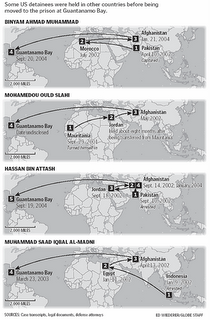
According to the LA Times, about 141 detainees are being released from Gitmo because they have been deemed to pose "no threat to U.S. security."
One might wonder why it was necessary to brand these folk "unpeople" for the last ~4 years, but I suppose that's a question best left to our "Constitutional scholars."
This added detail from the Times' story makes my heart warm:
Charges are pending against about two dozen of the remaining prisoners, the chief prosecutor said. But he left unclear why the rest face neither imminent freedom nor a day in court after as many as four years in custody.Yes, merely "allegations" that Gitmo detention is "illegitimate and abusive." We have no evidence to suggest otherwise.
Only 10 of the roughly 490 alleged "enemy combatants" currently detained at the facility have been charged; none has been charged with a capital offense.
That leaves the majority of the U.S. government's prisoners from the war on terrorism in limbo and its war crimes tribunal exposed to allegations by international human rights advocates that it is illegitimate and abusive.
As Pepe Escobar asserts, Iranian politics tend to be caricatured in the West as monolithic, but the reality is far more complex, featuring at least four different factions that are typically at odds with one another.
If, like me, you haven't been able to catch Eugene Jaurecki's film, "Why We Fight," in a theatre, I wanted to mention that you can check it out online.
For most of you who bother to stop by here, the film won't deal with anything terribly new; however, taken as a whole, it is a sobering indictment of the militarism that dominates the way this country works. Although the quality of the online version is a bit poor, the film is definitely worth a gander.
As an added bonus, old reliables Chalmers Johnson and Karen Kwiatkowski are interviewed extensively throughout, and they come across very well. (Kwiatkowski was subsequently invited on C-Span to talk about the film and her personal experiences in the Pentagon).
(hat tip to estimated prophet)
Robert Dreyfuss profiles the new Iraqi Prime Minister, Jawad al-Maliki, who seems like a swell guy:
Last year Maliki pushed for a law that would have imposed the death penalty not only for insurgents but even their sympathizers, including anyone found to “finance, propagate, cover up, support, or provide shelter for the terrorists, no matter how involved they are.” He has bitterly condemned not only the Sunni-led resistance that opposes the U.S. occupation, but also the two moderate, secular parties that hold several dozen seats in Iraq’s parliament, led, respectively, by Salah Mutlaq and Iyad Allawi, the former a secular Iraqi nationalist who claims to maintain a dialogue with elements of the resistance and the latter a secular Shiite who spent years on the CIA’s payroll as an opponent of Saddam Hussein. “It should be recalled that some of the electoral lists contain elements that were possibly part of the machinery of the old regime, i.e. Baathists who are subject to the de-Baathification law [and] intelligence agents or those who got involved in the Iraqi Intelligence Service immediately before the collapse of the regime,” warned Maliki.Doesn't quite seem like a uniter, does he?
He enthusiastically endorsed the wholesale purge of the police force and the Interior Ministry that was imposed by Bayan Jabr, the hard-line official of the Supreme Council for the Islamic Revolution in Iraq (SCIRI), saying, “Hateful elements have penetrated the security services and we must purge them.” The result, of course, was the creation of a ministry whose commandos are heavily infiltrated by SCIRI death squads responsible for the murders of thousands of Iraqis.
In the deal that brought Maliki to power, the Shiite bloc, the United Iraqi Alliance, deigned to make a deal with the two Kurdish warlord parties that control the Kurdish enclave in the north, and with the Sunni fundamentalist religious bloc, the Iraqi Islamic Party, which is a branch of the Muslim Brotherhood secret society. But pointedly they excluded both Mutlaq and Allawi. By including the Sunni fundamentalists, whose leaders got both a deputy president slot and speaker of the parliament, Maliki and the Shiites put their stamp of approval on the Lebanonization of Iraq. And by excluding the secular Mutlaq and Allawi, they made it clear that Iraq has no place for anyone who wants a united state with a strong central government.The "Lebanonization of Iraq." We're hearing an awful lot of that lately. And here I thought the "Palestinization of Iraq" was bad enough.
The Asia Times Online has a report about "US covert operations inside Iran aimed at destabilizing the country and toppling the regime - or preparing for an American attack."
There's a number of details in the article that have not received much attention, so read the whole thing. Yes, it's vaguely sourced, but it covers quite a bit of important ground.
Let's pray that New Orleans doesn't get hit by a another strong hurricane this summer. Because, if it does, the city is screwed.
It's damn near criminal that the Army Corps of Engineers hasn't been able to do more to repair/reinforce/improve the levees.
* Looks like we're still engaged in a "war on terror" that, err, creates more terror.
* As ever, what's important isn't whether the US does bad things; it's that the American people are kept safely in the dark about them. Also, via Drum, we learn of the new meme from the pro-Bush blogosphere about rendition.
* Regime Change 101 via Democracy Now!'s interview with Stephen Kinzer, who's hawking his new book Overthrow.
* CBS' 60 Minutes continues to be a place where high-level folk speak out against the Bushies. But, typically, to no avail. This week Tyler Drumheller reminds us that there was no intelligence failure on Iraq.
* Al-Maliki in, al-Jaafari out as Iraqi PM.
* Kevin Zeese has a useful review of the "base reality" of the US' long term presence in Iraq.
* Army suicides are at their highest level in more than 10 years.
* Woops. Condi Rice has been fingered in her own Israel lobby leak. Of course, her people deny this.
* John Brown wonders, as no doubt many do: How do you sleep at night, Mr. President?
* The world rediscovered New Orleans again over the weekend with the city's mayoral primary, what the Black Commentator described as a "generation defining event." The incubent, Ray Nagin, finished first, mostly on account of the black vote.
* Check out State of the Planet -- a graphical look at what we've done and where we're going.
Famed peacenik military historian Martin van Creveld argues persuasively in Forward that a US-led attack on Iran would be lunacy -- for a great many reasons.
Rami G. Khouri offers a warning to those who wish to capitalize on last Monday's suicide bombing in Tel Aviv by sweeping Hamas from power in the Palestinian territories:
Israel, with American backing, is now on a course to destroy the Hamas-led government and the Palestinian Authority, as it has been doing for the past four years. Hamas is pursuing a policy that will help this process along, based on its diehard commitment to armed resistance to occupation as a right that it will not abrogate or curtail.Whatever happens in coming months will have huge consequences, and the moves being made thus far do not look encouraging.
This path will have enormous regional consequences. It will discredit two important dimensions of recent Palestinian political change: the integrity and legitimacy of democratic elections, and Hamas’ decision to enter into mainstream governance at the local and national levels.
If the current Israeli-American policy prevails, with increasing European support, the collapse of the democratically elected Hamas-led government will send political shockwaves throughout the Middle East. Hundreds of thousands of young people who pursued peaceful democratic politics will feel duped and betrayed, and will become radically disenchanted. The wellspring of support for Hamas- and Muslim Brotherhood-style democratic engagement will slowly dry up in favor of more intense armed struggle.
We should not be surprised then to see large numbers of young men and women shift from the path of electoral democracy to that of military attacks against civilians and official targets, along with more Bin Laden-style terrorism in a wider arena. They will conclude that Israel, the United States and Europe value Israeli rights more than Palestinian rights. They will stop wasting their time trying to achieve a redress of grievance through peaceful democratic politics or diplomacy, and instead fight the larger civilizational battle they see before them.
Bringing down the Hamas-led Palestinian government will not bring quiet and more Palestinian and Arab acquiescence. It will result in further radicalization, resistance and terrorism across the region.
Add "ineffective bureaucrat" to John Negroponte's resume. It could go right below the slot that says "international terrorist."
Sam Gardiner, who you might remember as the author of the "Truth From These Podia" report or, perhaps, for the role he played wargaming an attack on Iran for the Atlantic Monthly in 2004, popped up on Democracy Now! on Monday.
Amy Goodman asked him about the issue of Iran and he had an interesting response, essentially saying that the war has already begun.
Here's the relevant excerpt:
AMY GOODMAN: We're talking to retired Air Force colonel, Sam Gardiner. You were quoted on CNN on Friday night, saying the question isn't if we would attack Iran, that military operations are already happening. What do you mean?Silly Sam. Doesn't he know that our reverence for the "constitutional framework" is obsolete? Bush and his acolytes, with the aid of a cowered media and opposition party, have made sure of that.
COL. SAM GARDINER: Well, the evidence is beginning to accumulate that a decision has already been made to use military force in Iran. Now, let me do a historical thing, and then I'll tell you what the current evidence is. We now know that the decision and the actual actions to bomb Iraq occurred in July of 2002, before we ever had a U.N. resolution or before the Congress ever authorized it. It was an operation called Southern Focus, and the only guidance that the military -- or the guidance that the military had from Rumsfeld was keep it below the CNN line. His specific words. The evidence that we've already --
AMY GOODMAN: Keep it below what?
COL. SAM GARDINER: The CNN line. In other words, I don't want this to appear on CNN, okay? That was his guidance to the military, you can begin to bomb Iraq, but don't let it appear on CNN. You're catching your breath.
AMY GOODMAN: Yeah.
COL. SAM GARDINER: I think the same thing has happened, and the evidence -- let me give you two or three evidences. First of all, the Iranians in their press have been writing now for almost a year that the United States is involved inside Iran conducting and supporting those who conduct military operations, attacks on military convoys. They've even accused the United States of shooting down a couple airplanes inside Iran. Okay, so there's that evidence from their side.
I was in Berlin three weeks ago, sat next to the Iranian ambassador to the International Atomic Energy Agency, and I asked him a question. I read these stories about Americans being involved in there, and how do you react to that? And he said, oh, we know they are. We've captured people who are working with them, and they've confessed. So, another piece of evidence.
Let me give you a couple more. Seymour Hersh, in his New Yorker article, said that there are Americans in three locations operating inside Iran. Another point. We know that there is a group in Iraq, a Kurdish group called the Party for Free Life in Kurdistan [PJAK], that crosses the border from Iraq into Iran, and they have taken credit for killing numbers of revolutionary guard military people. And the interesting part about that is, you know, we tell the Syrians, ‘Don't let that happen. Don't let people come across the border and stir things up in Iraq,’ but we don't seem to be putting any brakes on on this unit. So, you know, the evidence is pretty strong that the pattern is being followed.
Now, the question that really follows from that is “Who authorized that?” See, there is no congressional authorization to conduct combat operations against Iran. There are a couple of possibilities. One of them is that it's being justified under the terrorism authorization that occurred in 2001. The problem with that is that you would have to prove a connection to 9/11. I don't think you can do that with Iran. The second possibility is that it's being done under the War Powers Act. I don't want to get too technical, but the War Powers Act would require the President to notify the Congress 60 days after the use of military force or invasion or putting military forces in a new country under that legislation, and the President hasn't notified the Congress that American troops are operating inside Iran. So it's a very serious question about the constitutional framework under which we are now conducting military operations in Iran.
Phyllis Bennis weighs in on the Iranian nuclear issue:
At the end of the day Iran has been pretty clear about what it wants. It doesn't seem to want an actual nuclear weapon (both the late Ayatollah Khomeini and his successor have issued religious prohibitions, or fatwas, against such weapons) although there's little doubt that President Ahmadinejad appears to believe that posturing aggressively about "going nuclear" will help his flagging domestic ratings. (Sound familiar?) What Iran really wants, and has asked for, is serious negotiations with the U.S., based on equality, not humiliation. And at the end, a security guarantee that neither Europe nor the UN, but only the U.S. itself – the world's "sole super-power" and the only nuclear weapons state threatening to actually use its nuclear arsenal – can provide.Sounds quite reasonable to me. I'd also add that Egypt and Iran have been intermittently pushing the idea of a nuclear free Mid East since 1974, much to no avail. In a sane world, one would think that's a fact that deserves to be on the table.
For all sides, talk is crucial. Nuclear weapons - in anyone's hands - are a nightmare that should be abolished once and for all, as the now-fading Non-Proliferation Treaty anticipated so many years ago. Certainly Iran should abjure any search for nuclear weapons - but that's not going to happen alone. What we need - what we ALL need - is a weapons of mass destruction-free zone throughout the Middle East. So not only no nukes for Iran, but let's be sure Israel signs the NPT and places its unacknowledged but highly provocative Dimona arsenal of 200-400 high-density nuclear bombs under international supervision, and then allows the inspectors to destroy them. Let's be sure no country in the Middle East is running a chemical- or biological-weapons program - the poor countries' nuclear weapons substitute of choice and an unfortunate inevitability as long as Israel has a nuclear monopoly in the region.
And it’s way past time for the U.S. to make good on its own NPT obligations to move towards full and complete nuclear disarmament. As long as Washington laughs off that obligation, and officially rejects it, it is hard to imagine why any other countries should take seriously a U.S. demand that take nuclear weapons off their agenda.
Ironically enough the U.S. is already on record supporting just such a WMD-free zone in the Middle East. Article 14 of UN Security Resolution 687, that ended the 1991 Gulf War and imposed crippling sanctions on Iraq, states that disarming Iraq should be viewed as part of "establishing in the Middle East a zone free of all weapons of mass destruction and the missiles to deliver them."
The language was written by the U.S. It's time we held Washington accountable to that pledge. Let's talk to Iran.
As the Bush administration confronts the Tehran government over its suspected nuclear weapons program and accusations that it supports terrorism, a newly created office of Iranian affairs in the State Department is poring over applications for a rapidly expanding program to change the political process inside Iran.Imagine if this went the other way. It would be branded as akin to a declaration of war.
The project, which will spend $7 million in the current fiscal year, would become many times larger next year if Congress approves a broad request for $85 million that the Bush administration has requested for scholarships, exchange programs, radio and television broadcasts and other activities aimed at shaking up Iran's political system.
The effort, overseen by Elizabeth Cheney, a deputy assistant secretary of state who is a daughter of Vice President Dick Cheney, has been denounced by Iran's leaders as meddling in their internal affairs.
It comes at a time of escalating confrontation between Iran and the United States over Iran's nuclear program, exacerbated by reports, which the administration has played down, that military contingency plans are being reviewed as well.
While the United States has marshaled international support for diplomatic pressure on Iran, some Asian and European allies have expressed misgivings about other avenues of pressure, which are seen as aimed at undermining the government in Tehran.
One Asian diplomat said the effort was reminiscent of the subsidies the United States provided to Iraqi exile groups in the 1990's. "They don't call it 'regime change,' but that is obviously what it is," he said.
This Knight Ridder report takes the angle that the Americans made a "mistake" letting Shiite militas overrun Iraq, but it seems in all probability that the "inaction" the article laments was in fact a conscious choice whereby the US would, at the least, look the other way while the militias wreaked their havoc.
I mean, are we not supposed to remember the fact that the DoD announced it was considering using the militias to beat back the Sunni insurgency? Likewise, are we supposed to ignore the copious amount of evidence the US military has been looking to enlist local "irregulars" to do its dirty work? Do they take us for idiots?
"Looking back," Tony Judt writes in a NY Times op-ed on the Israel Lobby controversy, "we shall see the Iraq war and its catastrophic consequences as not the beginning of a new democratic age in the Middle East but rather as the end of an era that began in the wake of the 1967 war, a period during which American alignment with Israel was shaped by two imperatives: cold-war strategic calculations and a new-found domestic sensitivity to the memory of the Holocaust and the debt owed to its victims and survivors."
He continues:
For the terms of strategic debate are shifting. East Asia grows daily in importance. Meanwhile our clumsy failure to re-cast the Middle East — and its enduring implications for our standing there — has come into sharp focus. American influence in that part of the world now rests almost exclusively on our power to make war: which means in the end that it is no influence at all. Above all, perhaps, the Holocaust is passing beyond living memory. In the eyes of a watching world, the fact that an Israeli soldier's great-grandmother died in Treblinka will not excuse his own misbehavior.In Judt's telling, the Likudnik endorsement of the Iraq war was an act of desperation that has gone terribly wrong (maybe not, for some) and will probably accelerate the disintegration of the US-Israeli partnership.
Thus it will not be self-evident to future generations of Americans why the imperial might and international reputation of the United States are so closely aligned with one small, controversial Mediterranean client state. It is already not at all self-evident to Europeans, Latin Americans, Africans or Asians. Why, they ask, has America chosen to lose touch with the rest of the international community on this issue? Americans may not like the implications of this question. But it is pressing. It bears directly on our international standing and influence; and it has nothing to do with anti-Semitism. We cannot ignore it.
Slowly but surely, the grand strategy of the Bush administration is being revealed. It is not aimed primarily at the defeat of global terrorism, the incapacitation of rogue states, or the spread of democracy in the Middle East. These may dominate the rhetorical arena and be the focus of immediate concern, but they do not govern key decisions regarding the allocation of long-term military resources. The truly commanding objective -- the underlying basis for budgets and troop deployments -- is the containment of China. This objective governed White House planning during the administration's first seven months in office, only to be set aside by the perceived obligation to highlight anti-terrorism after 9/11; but now, despite Bush's preoccupation with Iraq and Iran, the White House is also reemphasizing its paramount focus on China, risking a new Asian arms race with potentially catastrophic consequences.This is a good read.
The Worst President in History? Gosh, who might that be?
Check out Mark Hertsgaard's long article on global warming in Vanity Fair.
As time goes by and more dire predictions about what lies in wait for us in the not-too-distant future come out, I get the feeling it's going to be very difficult to explain our contemporary recklessness on this issue to future generations. We should probably start working on our collective apologies now.
According to the Independent, Saudi "religious authorities" and real estate developers are essentially building over and disrespecting many of the holiest (and historic) sites in and around Mecca.
I haven't been paying attention to this issue, so the article caught me by surprise. I thought it was worth passing on.
* Americans and other external observers have the luxury of debating whether Iraq is experiencing a civil war. Iraqis, on the other hand, have the privilege of living through one.
* Reporting for IPS, Dahr Jamail and Arkan Hamed relay that Baghdad's central morgue is receiving an average of 85 bodies a day, a finding that's in accord with Robert Fisk's contention that morgue tallies suggest the Lancet figure of "excess deaths" from the war is probably a conservative estimate.
* Robert Dreyfuss foresees another round of "shock and awe" in Iraq, as the London Times reports on speculation of a "second liberation" (ha) of Baghdad likely to be launched towards the end of the summer.
* The AP profiles the massive US colonial office embassy being built in Baghdad, which will be the "largest of its kind in the world, the size of Vatican City, with the population of a small town, its own defense force, self-contained power and water, and a precarious perch at the heart of Iraq's turbulent future." It will fit in nicely alongside those "enduring" bases being built elsewhere in Iraq.
* Grand-scale robbery continues without pause in Iraq.
* The Guardian reports that Britain took part in the "Karona" war game exercise, which was a transparent dry run for an attack on Iran. For elaboration on Karona and further US war planning, see William Arkin's Sunday Washington Post article.
* Neocons, in unison: Bomb Iran!
* "There is no point in putting the moral position against attacking Iran," laments Brian Coughley in an ever-so-cheery essay. "The Cheney-Bush administration has shown itself impervious to argument, and presenting a case against killing thousands of innocent people cuts no ice with blinkered zealots. The planned blitzkrieg of divine strikes will probably take place. It will alter the entire world and create hatred of America that will never be eradicated. And there is nothing we can do about it."
* A suicide bomber in Tel Aviv kills 9 and gets more than ample coverage, typically on the front pages of newspapers and non-stop regurgitation on 24-hour cable outlets. Meanwhile, Gaza, home to some 1.2+ million Palestinians, is being strangled to death. Where, might I ask, do you find substantial, comparable coverage of that? Nowhere, obviously. See also: "Who is a terrorist?"
* Fire Rumsfeld? Matthew Rothschild says we'd be better off indicting him. John Yoo, too.
* In Vanity Fair, Carl Bernstein, the half of the famous Watergate duo who didn't sell his soul to the devil, urges "a full investigation of the conduct of the presidency of George W. Bush, along the lines of the Senate Watergate Committee's investigation during the presidency of Richard M. Nixon."
* "Sixteen days before President Bush's January 28, 2003, State of the Union address in which he said that the US learned from British intelligence that Iraq had attempted to acquire uranium from Africa - an explosive claim that helped pave the way to war - the State Department told the CIA that the intelligence the uranium claims were based upon were forgeries, according to a newly declassified State Department memo," reports Jason Leopold.
* In a related report, Murray Waas says that Cheney ordered Libby to leak the March 2002 NIE on 12 July 2003. While not earth-shattering, Waas contends that this revelation "adds to a growing body of information showing that at the time Plame was outed as a covert CIA officer the vice president was deeply involved in the White House effort to undermine her husband."
* According to the London Times, Britain's chief scientist, Sir David King, has recently warned that Earth will face a 3 degrees celsius rise in temperatures within the next century, a "process that will lead to a rise in sea levels and increase in desertification that will place 400 million people at the risk of hunger."
* Listen up, disillusioned Leftists. Progressive social change, via mass moblizations of people, is still possible. Look to Latin America/ns and French labor for inspiration.
* This is worth tucking away for those conversations when people contend that illegal immigrants are sucking the US dry. In actuality, they seem to have very little negative effect on the economy as a whole, and probably a marginal benefit when wider variables are factored in. See also: Looking beyond the Beltway...
* If you're a woman in the US, you might want to inquire into whether your state is thinking about seizing your womb.
* Glad I'm not alone. The "Purity Ball," which was featured on last week's NOW, gave me the willies. Creepy, creepy stuff.
* In another excerpt from his new book, Kevin Phillips fleshes out his understanding of American theocracy in The Nation.
* Matt Taibbi profiles Jack Ambramoff in Rolling Stone.
* "Universal" health care in Massachusetts -- what a great idea! Umm, no. Think again.
* We learned over the weekend that the National Archives was in cahoots with the CIA over its reclassification operation. Nice to know that an institution that's supposed to preserve history is helping the intelligence services whitewash it.
* This AP study, which found that states are fudging school test scores typically by excluding the results of certain minority blocs, seems to suggest that Bush's much vaunted No Child Left Behind program is a cruel hoax.
Dahr Jamail and Jeff Pflueger have a comprehensive analysis of the number of civilians who have died as a result of the Iraq war. Read the whole sickening article.
According to Martin Sieff, the death toll amongst US troops in Iraq is on the rise again. While 31 were killed in March, 33 have lost their lives thus far this month, not even half way through.
Sieff observes that this should not be a surprise, because "even when the rate of U.S. military fatalities in Iraq fell significantly in recent months, the numbers of U.S. troops wounded, Iraqi troops killed and Iraqi civilians killed in terror bombings continued at their previous levels or higher." To this, we should also add the uptick in Iraqis killed in sectarian reprisals, which by recent accounts have taken more lives than bombings since the destruction of the Askariya mosque in Samarra on February 22.
We also learn, today, of this:
At least 65,000 Iraqis have fled their homes as a result of sectarian violence and intimidation, according to new figures from the Iraqi government.Things only get bleaker by the day...
And the rate at which Iraqis are being displaced is increasing.
Figures given to the BBC by the Ministry for Displacement and Migration show a doubling in the last two weeks of the number of Iraqis forced to move.
This is a good column by Norman Solomon.
It explicitly links the Israel lobby debate to the death of Rachel Corrie, something that might sound a bit odd at first. But, in Solomon's hands, it makes perfect sense.
I'd be willing to bet a great deal of money that if 15 Israelis were killed in less than a week by Palestinian shell and air attacks suicide bombings, you'd hear a lot about it. When the violence goes the other way, of course, it's hardly reported at all.
I'll also venture to say that if Tom Hurndall had happened to be killed in virtually any country other than Israel, his name and story would be much more widely known (and agonized over).
Yet again, the NY Times reminds us that, by the US government's own best estimate, Iran is at least 5 to 10 years away from being able to produce a nuclear weapon. Rest be assured, if you hear radically smaller estimates, you're probably in the midst of propaganda.
This reiteration follows on yesterday's State Department announcement that Iran was "16 days" away from a capability to build a weapon. That seemed particularly outlandish, and Bloomberg News' reporting of it didn't help. As Paul Woodward points out,
"16 days" doesn't mean by April 28, 2006. It means 16 days once the Iranians have 50,000 centrifuges. Iran so far has 164 centrifuges and has told the IAEA that it plans to construct 3,000 more next year. Rademaker thus went on to say, "We calculate that a 3,000-machine cascade could produce enough uranium to build a nuclear weapon within 271 days." Still, "16 days" was good for a headline.I didn't adequately parse this story yesterday when I mentioned it. Sorry about that, but at least you now have clarification.
Matthew Rothschild looks at "what the human costs of dropping a tactical nuclear weapon on Iran might entail."
He finds that the toll would be "astronomical" -- ranging from nearly 1 to 3 million deaths, according to three respected estimates.
Wow, so you're telling me that there's actually an alternative to war and poverty? Who'd a thunk it...
If you enjoyed Adam Curtis' documentary, "The Power of Nightmares," you might want to check out his earlier film, "The Century of the Self." The latter is now online, too.
Where TPoN probed the nature of the overblown threat of Al Qaeda, TCotS probes how consumerism has essentially destroyed the modern conception of democracy.
To put it another way, TPoN is a video CliffsNotes version of Jason Burke's Al Qaeda. TCotS is the video CliffsNotes version of Stuart Ewen's PR!. Both, of course, feature some twists by Curtis, which are usually enlightening.
The big-ish news, from Knight Ridder:
Iran claimed on Tuesday to have enriched uranium to a level suitable for civilian power plants, defying a U.N. Security Council demand that it halt work on the process, which also can be used to produce fuel for nuclear weapons.Indeed it will, as the Guardian observes.
"Iran has joined the club of nuclear nations," declared President Mahmoud Ahmadinejad in a nationally televised speech.
The announcement was certain to heat up the international crisis over Iran's nuclear program.
What is really going on here is a ratcheting war of rhetoric. The Iranian hard liners are down to a popularity rating in Iran of about 15%. They are using their challenge to the Bush administration over their perfectly legal civilian nuclear energy research program as a way of enhancing their nationalist credentials in Iran.Again, a good point, but the Americans don't seem the least bit cautious or objective about the situation. Via Bloomberg News:
Likewise, Bush is trying to shore up his base, which is desperately unhappy with the Iraq situation, by rattling sabres at Iran. Bush's poll numbers are so low, often in the mid-30s, that he must have lost part of his base to produce this result. Iran is a great deus ex machina for Bush. Rally around the flag yet again.
If this international game of chicken goes wrong, then the whole Middle East and much of Western Europe could go up in flames. The real threat here is not unconventional war, which Iran cannot fight for the foreseeable future. It is the spread of Iraq-style instability to more countries in the region.
Iran, which is defying United Nations Security Council demands to cease its nuclear program, may be capable of making a nuclear bomb within 16 days if it goes ahead with plans to install thousands of centrifuges at its Natanz plant, a U.S. State Department official said.How about a round of applause for this! What a wonderful piece of scaremongering propaganda. It should go in a vault somewhere.
One month after the publication by two of the most influential international relations scholars in the United States of a highly controversial essay on the so-called "Israel Lobby", their thesis that the lobby exercises "unmatched power" in Washington is being tested by rapidly rising tensions with Iran.Ok, that seems reasonably comprehensive. From my vantage point, what's above is the most significant stuff to appear recently on the Iran issue.
...What makes the growing confrontation with Iran so remarkable is that the Israel Lobby appears to be the only major organised force here that is actively pushing it toward crisis.
Tom Porteous makes very important points in this piece for TomPaine.com:
We now know that Al Qaeda had nothing to do with the London bombings in July 2005. This is the conclusion of the British government's official inquiry report leaked to the British press on April 9."Stripped of exaggeration, romanticism, demonization and myth making," Porteous continues, "the picture of Al Qaeda which has emerged...is of a fractious organisation that has been a magnet for bewildered martyrdom-seeking fantasists." It is not a centralized organization with any sense of hierarchy, perhaps the most prominent myth promoted by the international media and the US/UK governments.
We now also know that the U.S. military is deliberately misleading Iraqis, Americans and the rest of the world about the extent of Al Qaeda's involvement in the Iraqi insurgency. This was reported in The Washington Post on April 10, on the basis of internal military documents seen by that newspaper.
What do these revelations tell us about the arguments of President George W. Bush and Prime Minister Blair that in Al Qaeda the "Free World" faces a threat comparable to that of the Soviet Union and Nazi Germany, a world-wide terrorist network which seeks to build a radical Islamist empire over half the world?
That they are threadbare, to say the least. But also that they are cynical, misleading and self serving.
This is not to say that Al Qaeda is not dangerous. It is a serious security challenge. It may even one day be a strategic threat, especially if it gets hold of some WMD. But it is not the threat Bush and Blair tell us it is.Porteous concludes, rightly, that the "real danger" of Al Qaeda "lies in its ability to inspire terrorist attacks. In this it has no better allies and collaborators at present than the United States and Britain under their current leaders."
The recent revelations of the non-existent role of Al Qaeda in the London bombings and of the Pentagon's deliberate exaggeration of Al Qaeda's role in Iraq reinforce the argument that in their response to the threat of Al Qaeda (the so called "war on terror," or "Long War"), the United States and its allies are making strategic errors of monumental proportions.
First, this war, as it is being fought in Iraq and Afghanistan, is not principally fighting "Al Qaeda" but is creating and fighting new enemies: people who don't like being invaded, occupied and kicked around by foreigners and who are prepared to stand up and resist. These people may eventually become terrorists. But it will have been U.S. policies that created them. If Iran is next on the Pentagon's list, the same thing will happen there. To the extent that Israel is seen by the United States as pursuing its own war on terror in the Palestinian territories it occupies, it is happening in Gaza and the West Bank too.
Second, the Long War is a distraction from the real issues which need to be addressed as a matter of urgency in order to reduce conflict, violence and injustice in the region and thus to reduce the radicalization of a generation of angry and alienated Muslim youth at home and in the diasporas. These include: ending the Israeli occupation of occupied Palestinian territories through negotiation; pursuing peaceful nuclear reduction throughout the region; and engaging seriously with political Islam. Talk of "democratization" without engaging with political Islam is nonsense.
Third, on the grounds that it is fighting a "just war," the United States and its allies have justified using levels of violence, coercion and repression—including torture, collective punishment and the killing of large numbers of civilians—which are not only of questionable tactical efficacy, but have led to a collapse of U.S. prestige in a part of the world where it has long been seen as a necessary protector, stabilizer and arbiter.
Pharmaceutical companies are systematically creating diseases in order to sell more of their products, turning healthy people into patients and placing many at risk of harm, a special edition of a leading medical journal claims today.I'm sorry, but this is what happens when you leave important issues like public health to the whim of a ridiculously profitable industry. Nobody should be shocked about this.
The practice of “diseasemongering” by the drug industry is promoting non-existent illnesses or exaggerating minor ones for the sake of profits, according to a set of essays published by the open-access journal Public Library of Science Medicine.
The special issue, edited by David Henry, of Newcastle University in Australia, and Ray Moynihan, an Australian journalist, reports that conditions such as female sexual dysfunction, attention deficit hyperactivity disorder (ADHD) and “restless legs syndrome” have been promoted by companies hoping to sell more of their drugs.
Republicans may be paving the road to apocalypse, but the Democrats, for their part, are at least painting the stripes.
Elizabeth de la Vega boils down the latest revelations regarding Bush's role in the NIE leak from July 2003, which preceded and, in a sense, laid the groundwork for the outing of Valerie Plame, to one question:
Is a President, on the eve of his reelection campaign, legally entitled to ward off political embarrassment and conceal past failures in the exercise of his office by unilaterally and informally declassifying selected -- as well as false and misleading -- portions of a classified National Intelligence Estimate that he has previously refused to declassify, in order to cause such information to be secretly disclosed under false pretenses in the name of a "former Hill staffer" to a single reporter, intending that reporter to publish such false and misleading information in a prominent national newspaper?Obviously, she declares, the answer is no. "Such a misuse of authority is the very essence of a criminal conspiracy to defraud the United States. It is also precisely the abuse of executive power that led to the impeachment of Richard M. Nixon."
For the third straight year, Baghdad has been ranked as the worst city in the world by Mercer Human Resource Consulting.
Thanks, America.
According to the Washington Post, the Bush administration even lied, repeatedly, about the pathetic weather balloon trailers the President first cited as proof of a WMD find in Iraq on 29 May 2003.
Jeff Blankfort responds to Joseph Massad (and others) on the question of the Israel lobby.
An accurate headline for this story would be: "Humans, Killing the Planet."
Ask any polar bear: climate change is real and coming faster than anyone anticipated. But how will that affect life globally? Now a new study says that a rise of just 2 degrees in Earth’s temperature over the next 50 years could wipe out tens of thousands of plant and animal species around the planet, even in remote places far away from human activity. So pervasive would this ‘wave’ of extinction be, that the study...says that by the end of this century, climate change will represent a greater threat to biodiversity than deforestation, with important implication to the long-term endurance of our conservation gains.
...Examining plants and animals in 25 of the 34 biodiversity hotspots, the report’s scientists also determined that some regions were more vulnerable than others, especially the Cape Floristic, Caribbean, Indo-Burma, Southwestern Australia, Mediterranean Basin and Tropical Andes hotspots, where extinctions of plant and animal species in each region could exceed 2,000. While the hotspots studied represent only 1 percent of Earth’s land surface, they are nonetheless home to some 44 percent of all terrestrial plant species and 35 percent of all land animals...
The new study also corroborates controversial findings published two years ago in the journal Nature by scientists from the University of Leeds and CI, that claimed global warming from increased atmospheric greenhouse gasses could drive species to seek cooler latitudes or higher altitudes. But for many specialized creatures already living on mountaintops or islands, there may be nowhere else to go, resulting – the Leeds study said – in the extinction of over a million animal species by 2050. This year’s study reported a more conservative drop in species, but supported the earlier claims that a rise in planetary temperatures of only a few degrees could destroy vast numbers of species in less than a century.
For those of you who care, I'm sure you know there's been much ado about food shortages in Gaza recently.
Thankfully, however, Gideon Levy informs us that "talk about a 'humanitarian disaster' is exaggerated."
He explains:
The use of the term "humanitarian disaster" is actually proof of the dehumanization of the Palestinians. There's no flour? "Humanitarian disaster." There is flour? Then there's no disaster. There's an assumption that all the Palestinians need is a daily serving of food so they won't be considered disaster victims. It's enough that they have water and food in their troughs to conclude that their situation is fine. But human beings, including the Palestinians, have a few other basic needs as well.
The real humanitarian disaster in the territories began a long time ago, and it is not hunger. Those who regard the neighboring people as human beings know this very well. It is true that the dimensions of the disaster are worsening, but that's been taking place over years, and the food index is not the only measure. The cessation of the flow of funding since the rise of Hamas might threaten to depress the economic situation even further, but the thought that if they only have enough food, their needs will be satisfied and our conscience can be clear, is outrageous.
...Those who have been silent until now can remain enveloped in their silence. Those whose conscience doesn't torture them and whose sleep is uninterrupted by Israel's behavior in the territories can continue resting in peace. There is no "humanitarian disaster." Israel will find a solution to the food crisis, and the stores in Gaza won't lack for flour. But those who regard the Palestinians as only requiring basic food should remember that even in the zoos, where the animals presumably don't lack for a thing, people are often shocked by the conditions of their imprisonment.
Pray tell, how will we explain to the children that the United States harbors terrorists? That surely doesn't fit with the metanarrative...
This is a good, angry essay by Steve Lendman on our current national dialogue on immigration. That is, if you can call it a "dialogue"; I'd suggest a better term is "spittle-flecked shouting match."
Here's a snippet, but read the whole thing:
"Give me your tired, your poor, Your huddled masses yearning to breathe free, The wretched refuse of your teeming shore." Once that was true, but no longer. Emma Lazarus’ beautiful and memorable words we’ve all heard many times and know well are fading into memory. If we’re honest, they should be removed from "Lady Liberty" and be replaced with something like: We’ll take your Anglos, especially well-off ones, and the ones we choose with needed skills; you keep the rest, especially your poor, dark-skinned and desperate. We needed ’em once for our homegrown sweatshops. No longer. We’ve got plenty all around the world. It now looks like we’ll make an exception though for the menial or toughest low pay, no benefits, no security jobs no one else wants. We’re still debating it and will let you know.It doesn't take much to expose the racism embedded in this nation's fabric, does it? For shame.
...Long ago we were building a new nation, needed lots of labor and threw open our doors. Now we can be as picky as we choose and even slam the door and bolt it, except for the special skills we need or the few privileged we always welcome who can jump the queue to get in. We still need lots of help to pick strawberries and cabbages, make beds and clean commodes and so far have allowed the undocumented ones who make it here to stay for that kind of work few others want. But racist and far-right lawmakers in the Congress with a pathological desire to guard our borders like Fort Knox and close them to people with dark skins we denigrate or label potential terrorists are in a dog fight now with less extreme but hardly moderate voices there. So far we don’t know who’ll win or if it will be a draw to be replayed at a future time. We do know that if even the best of the current proposals now being debated becomes law, future immigrants, those wishing to come, and the undocumented already here will be the losers.
This is probably the right tack to take on all of the "bomb Iran" speculation in the press:
It's possible that Seymour Hersh's latest article amounts to a kind of journalistic pre-emptive attack on the Bush administration's Iran planning. In other words, making public the grave misgivings that Pentagon planners have about the recklessness of a bombing campaign against Iran -- even using tactical nuclear weapons -- might serve to diminish the chance of that happening as the administration gets an earful of editorial outrage. At the same time, the press is treading a fine line as it reports the current "attack Iran" planning. Willingly or not, the media is making itself part of the administration's propaganda campaign intended to make the Iranians believe that the mess in Iraq won't inhibit this administration from military action against Iran. Perhaps the White House really doesn't feel constrained, but it's hard right now to tell whether the media is functioning as a watchdog alerting the public to the administration's wild ambitions or as an attack dog under the administration's command. It seems like a bit of both.BTW, this remark is from Paul Woodward, who I've referenced a few times. He runs War In Context, which is, for my money, probably the most underappreciated blog out there. If you're not a regular visitor, you're missing out.
...As for the likelihood of an attack on Iran, it's tempting to say that the more we hear about it, the less likely it is that its about to happen. At the same time, it's very easy for rational observers to underestimate the Bush administration's capacity for irrational behaviour.
So I see the editors of the Washington Post still aren't reading their own paper. I remember them doing the same thing back in August 2003.
This would be hilarious if it didn't cut right to the heart of the media's biggest problem: how a great many important facts can be reported, rather openly, but opinion managers and editors fail to line them up into anything resembling a coherent, accurate narrative of contemporary life.
Apparently, they've got "forensic vagina inspectors" in El Salvador, where abortion has been comprehensively criminalized.
If pro-lifers in the US get their wish, I have no doubt that we'll be seeing them here, too.
The Washington Post reports what you'd have to be an idiot not to have realized on your own: as part of a broad-ranging PSYOPS campaign, the US military establishment has purposefully built up Abu Musab al-Zarqawi as a larger than life "terror mastermind" in the hope of a) discrediting and/or fragmenting the insurgency in Iraq amongst Iraqis and b) boosting support for the Iraq war within the US, by implicitly linking it to the "war on terror."
Aaron Glantz of IPS reports:
A new study released Thursday by the non-profit Center for Media and Democracy found that at least 77 television stations around the country have aired corporate-sponsored video news releases over the past 10 months. The report accused the stations of actively disguising the content -- which has been produced and paid for by companies like General Motors, Panasonic and Pfizer -- to make it appear to be their own reporting.Frankly, local TV news is so unbelievably bad that corporate propaganda masquerading as news segments may lead to even better coverage than if the beat reporters were left to their own devices.
"You don't know if you're watching independently gathered news or something that's little better than an advertisement that's just being played on a news program," the Center for Media and Democracy's Diane Farsetta told IPS.
The report says none of the 77 television stations that used material from video news releases told viewers where their footage came from.
"The focus is promoting products sometimes in an incredibly blatant way," she added. "You get Panasonic promoting their electronics, Bisquick promoting their pancake mix. We also found two examples of video news releases promoting new prescription drugs."
The NY Times reports that, despite a major effort to play up "good news" from Iraq -- of the missing variety -- recently, the situation remains pretty bleak, even by the US Embassy's own admission:
An internal staff report by the United States Embassy and military command in Baghdad provides a sobering province-by-province snapshot of Iraq's political, economic and security situation, rating the overall stability of 6 of the 18 provinces "serious" and one "critical. The report is a counterpoint to some recent upbeat public statements by top American politicians and military officials.These details come across relatively clearly in the better coverage coming out of Iraq, but it's always welcome to have some documentation from the US government itself.
In 10 pages of briefing slides, the report, titled "Provincial Stability Assessment," underscores the shift in the nature of the Iraq war three years after the toppling of Saddam Hussein. Warnings of sectarian and ethnic frictions are raised in many regions, even in those provinces generally described as nonviolent by American officials.
There are also alerts about the growing power of Iranian-backed religious Shiite parties, several of which the United States helped put into power, and rival militias in the south. The authors also point to the Arab-Kurdish fault line in the north as a major concern, with the two ethnicities vying for power in Mosul, where violence is rampant, and Kirkuk, whose oil fields are critical for jump-starting economic growth in Iraq.
Here's Seymour Hersh's latest in the New Yorker, which I hope will cause an uproar.
It more or less iterates every fear I have of what's going to happen regarding Iran in coming months. Frankly, in his telling, the people lording over US policy come across every bit the evil, cartoonish figures that their worst critics say they are.
If 10% of what Hersh says is true -- the US is actively planning to launch a nuclear strike against Iran, US forces are already conducting ops within Iran meant to destablize the regime, Ahmadinejad is indeed seen as a Hitler-like figure, the crazies really believe striking Tehran will precipitate an uprising, etc. -- then we are truly, deeply fucked. Hersh holds out some hope that a military confrontation might be avoided, but it seems that the people pulling the strings are dead set on regime change, no matter what the cost.
This is a smart review essay by John Gray on what he terms "the other side" of globalization, namely the more destructive and negative consequences of rapid modernisation.
Contra the more utopian renderings of what globalization will bring, Gray argues that our future is likely to be shaped more by forces of resource depletion and ecological devastation, rather than any benign universalizing tendency:
Models of economic development that anticipate societies converging in a harmonious universal system have deep roots in Western thinking. It is not surprising that they should have been revived in theories of globalization in the aftermath of the cold war; but they reflect the conditions of the nineteenth century, when the environmental limits of industrial expansion were hardly suspected. They fail to take account of the fact that industrialization on a global scale intensifies scarcity in vital natural resources while triggering a powerful ecological backlash. These developments, which form the other side of globalization, will shape its future course.Worth a read. Earlier in the essay, Gray references a 2003 Pentagon report on climate change and ensuing resource conflicts, which hasn't seen much light of day recently. That's worth a second look, too.
According to Shayana Kadidal, a lawyer for the Center for Constitutional Rights, the Electronic Frontier Foundation is handling a legal case that alleges AT&T is helping the NSA conduct a "'vast fishing expedition' directed at everyone in America -- a data mining program using voice recognition software and the NSA's vast array of computers to scan more or less every phone call entering or exiting the United States."
I swear, if I see any more articles -- even alleged straight news pieces! -- that prominently feature the fact that David Duke "approves" of the Mearsheimer/Walt (M/W) paper, I'm going to scream. It is such a red herring!
But more importantly, framing the paper through the "Duke lens" is perhaps one of the more blatant examples of bias I've seen recently in the press. That it seems to be systemic is all the more telling.
Alas, I also see that Alan Dershowitz has written a 45 page rebuttal to M/W -- or, rather, had his research assistants cobble together a response, which he then arranged or edited in some way.
Please, if you have time, read it. If this is what passes as a legitimate response, no wonder people sympathetic to or aligned with the Israel lobby are a bit nervous.
Here's the abstract:
The working paper by Academic Dean and Professor Stephen Walt and Professor John Mearsheimer presents a conspiratorial view of history in which the Israel Lobby has a “stranglehold” on American foreign policy, the American media, think tanks and academia. In his response, Professor Alan Dershowitz demonstrates that the paper contains three types of major errors: quotations are wrenched out of context, important facts are misstated or omitted; and embarrassingly weak logic is employed. One of the authors of this paper has acknowledged that “none of the evidence represents original documentation or is derived from independent interviews.” In light of the paper’s errors, and its admitted lack of originality, Dershowitz asks why these professors would have chosen to publish a paper that does not meet their usual scholarly standards, especially given the risk – that should have been obvious to “realists” - that recycling these charges under their imprimatur of prominent authors would be featured, as they have been, on extremist websites. Dershowitz questions the authors claims that people who support Israel do not want “an open debate on issues involving Israel.” He renews his challenge to debate the issues.I know it's a bit shaky to cite the abstract and pick at that, but it does provide you with a brief shorthand of what's wrong with Dershowitz's response. Do read the entire paper, though. It is long, but that's because a very significant percentage of it is fluff. The last third of it is the only part with any real meat.